Warning: Cannot modify header information - headers already sent in /home/u278635817/domains/myhousegarden.com/public_html/wp-content/plugins/artigosgpt/artigosgpt.php on line 28454
She opened the box, sniffed the soil puck, and within a week had peppery microgreens poking through a peat pellet — all promised by a pre-made microgreen kit. Kits are everywhere on feeds and storefronts, and that glossy unboxing moment is exactly why people buy them. But does the convenience translate into reliable yields and a real side income? Let’s cut through the hype: this article compares kits to DIY setups, lists where they actually shine, and who should avoid them if profit (or serious yields) matter.
Why Pre-made Microgreen Kits Hook Beginners Fast
Kits sell confidence, not guarantees. Inside the tidy box: trays, growing medium, seeds in labeled packets, and a photograph of success. For a beginner, that removes four major friction points — sourcing, timing, setup, and decision paralysis. The result: faster first harvests and a dopamine hit that feeds the habit. Many kits also spoon-feed maintenance schedules, which reduces early mistakes. That front-loaded convenience is why influencers post week-by-week stories and why beginner growers don’t cancel their cart before checkout.
The Costs Nobody Shows in the Unboxing Video
Initial cost is one thing; recurring cost is another. Most kits appear cheap, but consumables add up: refill seed packs, specialized mats, and replacement lights. A 12-week run of kits can easily exceed the price of a modest DIY rack with reusable trays. Expectation vs. reality: a $40 kit can become a $200 habit in three months.
- Upfront kit: $25–$80
- Monthly refills: $15–$60
- DIY reusable setup (one-time): $120–$350
If you’re trying to scale for income, those recurring costs matter more than the pretty packaging.
The Mechanism Nobody Explains: What Limits Yield in a Kit
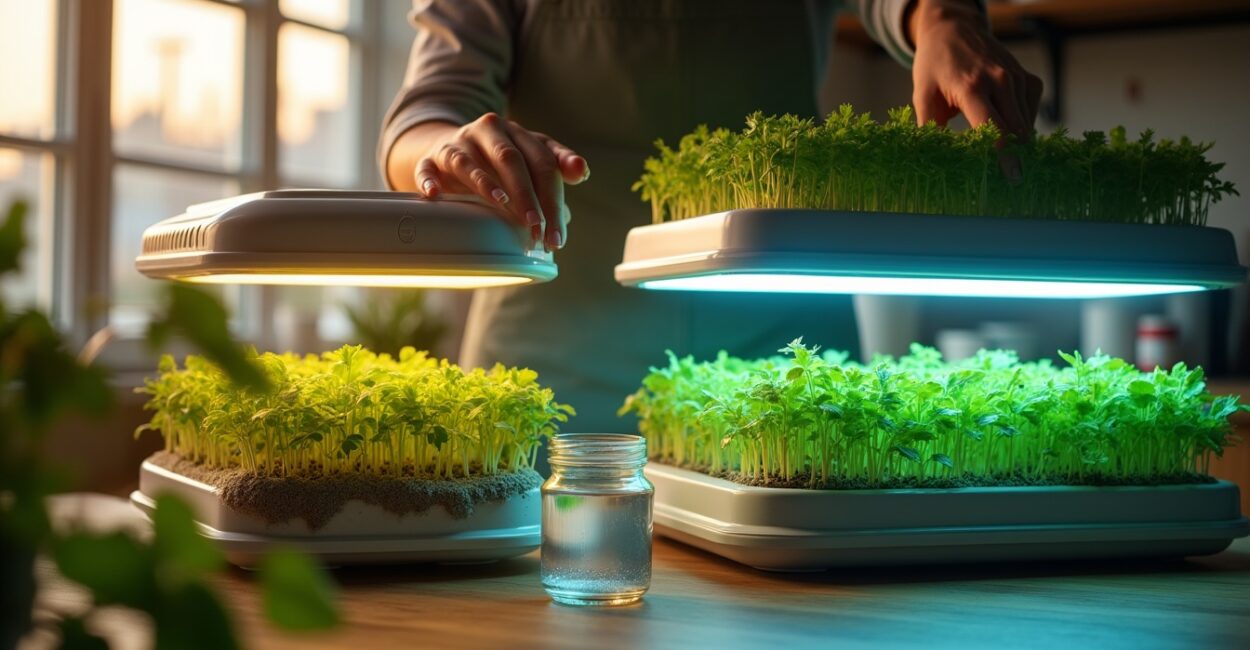
The limiting factor is usually light and airflow, not seeds. Kits ship with simplified lighting that’s sufficient for 1–3 trays, but light spectrum, intensity, and uniformity determine how dense and fast microgreens grow. Poor airflow invites mold. So the real bottleneck is environmental control — which most kits under-deliver. That’s why experienced growers switch lights, add fans, or stack trays differently. A kit’s “works for most” approach trades peak yield for simplicity.
Comparison: Kit Vs. DIY Setup — Yield, Time, and Money
| Metric | Pre-made Kit | DIY Setup |
|---|---|---|
| Initial cost | Low–Medium | Medium–High |
| Recurring cost | High | Low |
| Time to first harvest | Fast | Moderate |
| Scalability | Limited | High |
| Ideal user | Novice/hobbyist | Serious hobbyist/small business |
This side-by-side shows the trade-off: kits win for speed and simplicity; DIY wins for long-term margin and scale. If you want more than a few trays a week, DIY almost always outperforms.
Common Mistakes People Make with Kits (and How to Avoid Them)
People equate “easy” with “no thinking required.” That’s the trap. Here are errors that kill harvests — and quick fixes.
- Overwatering: keep trays damp, not dripping.
- Ignoring light needs: swap the included light or add reflectors for uniform growth.
- Using kits for immediate scale: don’t promise markets more than you can produce.
- Trusting seed freshness: test a packet before committing to a client order.
Avoid these and a kit still gives you a fast, reliable learning curve.
Who Should Buy a Kit — And Who Should Skip to a Custom Build
Buy a kit if you want quick wins, a low-pressure hobby, or a giftable experience. Kits are also great for educators teaching plant cycles in one lesson. Skip kits if you plan to sell to restaurants, scale a farm‑stand business, or need consistent, dense yields.
- Buy: first-timers, educators, gift buyers.
- Build: aspiring entrepreneurs, CSA suppliers, high-demand chefs.
Think of a kit as training wheels: perfect for learning balance, but limiting when you want speed or competition-level performance.
A Three-line Mini-story That Proves the Point
She started with a $30 kit to impress dinner guests. By month three she had swapped the LED, rebuilt the tray stack, and was filling weekly farmer’s market orders. The kit taught her the basics — then became the bridge to a business. That progression from toy to toolbox is common: kits spark habit, but skills and upgrades convert that habit into meaningful yield.
For impartial data, check studies on small-scale urban agriculture practices from universities like the Penn State Extension and government resources such as the USDA’s urban agriculture guides at USDA Urban Agriculture. These sources show environmental control and seed quality are primary drivers of success — not packaging.
In short: kits deliver immediate satisfaction and lower the barrier to entry. But if your goal is consistent income or maximum yield per square foot, treat a kit as the first purchase on a longer path. Upgrade lights, invest in reusable trays, and learn environmental control. Do that, and the viral kit becomes the opening act — not the headline.
One final thought: a shiny box can start a garden, but habits and small technical upgrades turn that garden into a livelihood.
Do Kits Produce the Same Quality as Professional Microgreens?
Kits can produce flavorful, visually appealing microgreens, but they rarely match professional-grade density and uniformity. Commercial growers control light spectrum, intensity, humidity, and airflow to maximize quality; kits usually use simplified lighting and generic mats that favor convenience over optimization. For home use or farmer’s market experiments, kit-grown microgreens are fine, but chefs and retailers often demand denser stems and uniform leaf size, which come from controlled conditions and refined workflows.
How Much Does It Cost Per Tray to Run a Kit Long-term?
Running cost per tray varies by brand and local prices for seeds and mats, but a realistic range is $2–$8 per tray for consumables. That includes seeds, growing medium, and occasional replacement mats. If you need to buy replacement LEDs or specialized trays, amortize that cost across dozens of trays and your per-tray cost drops. For consistent income, calculate both variable costs and amortized equipment — kits often hide the latter in repeat purchases and upgrades.
Can I Scale a Kit-based System to Sell to Restaurants?
Scaling purely with kits is inefficient. Kits are optimized for single-use convenience, not continuous production. Restaurants need reliable delivery schedules and consistent volume; that typically requires reusable trays, higher-output lighting, and climate control. You can start with kits to refine varieties and timing, but transitioning to a custom rack system will be necessary to scale economically and reliably for wholesale or restaurant contracts.
Are Refill Packs Worth Buying, or Should I Buy Seeds in Bulk?
Refill packs are convenient but more expensive per gram than bulk seeds. For casual growers, refills remove guesswork and ensure compatibility. If you plan regular production, bulk seeds reduce cost and often have better germination per dollar. Store bulk seeds properly (cool, dry) and test batches for germination rate. Buying bulk becomes financially compelling once you exceed a few dozen trays per month.
What Quick Upgrades Turn a Basic Kit Into a High-yield Setup?
Small, targeted upgrades give the biggest returns: swap the kit’s light for a full-spectrum LED with higher PAR, add a small oscillating fan to reduce mold risk, and invest in reusable polypropylene trays and proper drainage. Simple reflectors or white walls improve light uniformity. These changes preserve the kit’s convenience while addressing the true yield bottlenecks: light and airflow. Together they push a hobby setup toward commercial viability without a massive investment.