

📅 Updated on 06/14/2026
Modern gardens work because they strip outdoor design down to a few strong moves: clear structure, restrained planting, honest materials, and spaces that feel usable every day. The result is not “empty” or cold; it is deliberate, calm, and easier to maintain than a heavily ornamental yard.
If you want a garden that looks current rather than dated, the difference usually comes from layout before planting. Clean lines, well-sized hardscaping, lighting, and privacy planning matter more than expensive plants. This guide shows what defines contemporary garden design, how to build it in small and large spaces, and how to keep it practical on a real budget.
What You Need to Know
- A modern garden is defined by structure first: paths, patios, edges, and sightlines do more work than decorative planting.
- The fastest way to modernize a yard is to reduce visual clutter, repeat a small material palette, and use fewer plant types with stronger massing.
- Low-maintenance success comes from hardscaping, drought-tolerant planting, and lighting that makes the space useful after dark.
- Modern and contemporary garden design overlap, but “modern” usually points to cleaner, more minimal forms while “contemporary” changes with current trends.
- Most budget mistakes happen when people buy plants before solving layout, drainage, and privacy.
What Modern Gardens and Contemporary Garden Design Actually Mean
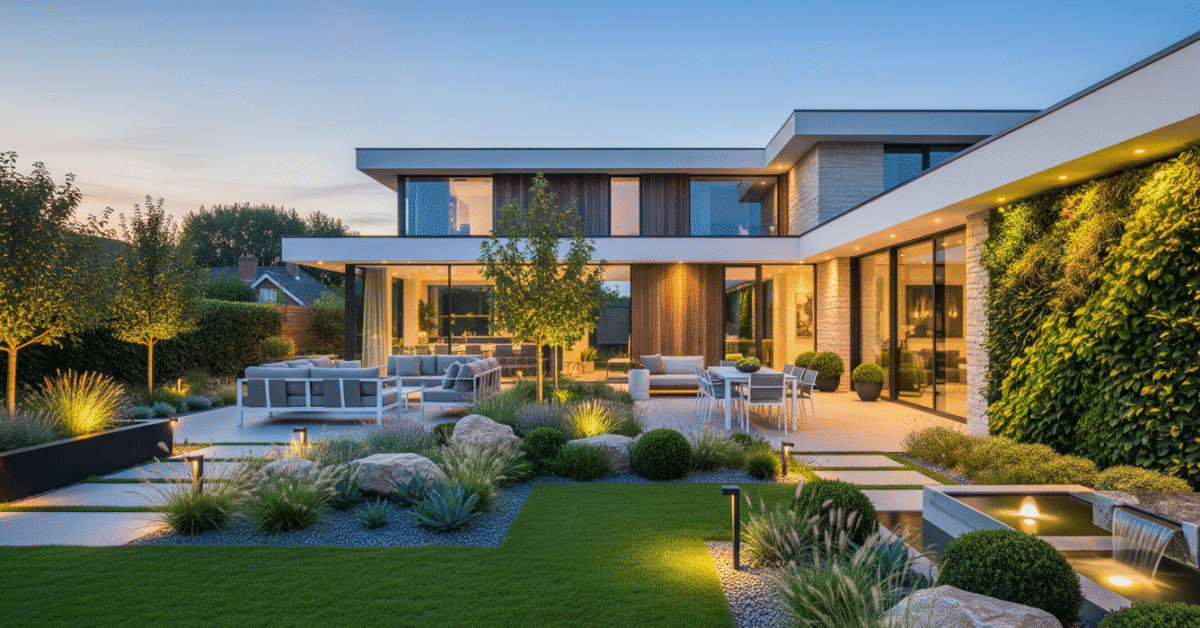
Modern gardens are outdoor spaces designed around simplicity, order, and function, with a strong emphasis on geometry, materials, and negative space. In practice, that means the layout looks intentional even before the plants mature: paths align, edges are crisp, and every feature has a job.
People often use modern garden design and contemporary garden design as if they mean the same thing, but they do not. Modern design usually refers to a restrained style with clean lines and limited ornament, while contemporary design is more flexible and reflects what is current now—today that may include minimalism, outdoor living spaces, and mixed textures.
The most useful way to think about it is this: a modern garden is edited, not decorated. You are not filling space; you are shaping it. That’s why a small patio with good proportions can feel more modern than a large yard packed with feature plants.
What separates a modern garden from a traditional one is not the plant list — it is the discipline of the layout.
For design references, the Royal Horticultural Society is useful for plant selection and spacing, while the National Park Service design guidance is a good source for understanding how pathing, edges, and spatial hierarchy affect outdoor environments. For materials and environmental planning, the U.S. Environmental Protection Agency has practical guidance on runoff, water use, and landscape decisions.
Key Characteristics That Make a Garden Look Modern
What makes a garden look modern is a combination of clean geometry, restrained detail, and a clear relationship between built elements and planting. If those three are present, the space reads as modern even with a simple budget.
Clean Lines and Strong Geometry
Straight edges, rectangular beds, square or linear pavers, and tight borders create visual order. Curves are not forbidden, but they need to feel intentional; too many flowing shapes can push the design toward cottage or traditional styling.
Hardscaping Takes the Lead
Hardscaping—patios, walls, steps, gravel, decking, and paths—anchors the design. In a modern backyard, these elements usually cover more visual ground than the planting does. That balance helps the garden look structured year-round, not only in peak season.
Restraint in Color and Texture
A modern look usually uses a narrow material palette: concrete, metal, timber, porcelain, stone, or gravel. The same logic applies to planting schemes. Instead of many small plant choices, modern gardens often repeat fewer species in larger blocks for a stronger visual rhythm.
Lighting and Privacy Are Part of the Design
Garden lighting is not decorative add-on work. It extends use into the evening, shapes depth, and highlights edges. Privacy also matters because modern outdoor spaces feel calmer when views are controlled with screens, hedges, slatted fencing, or layered planting.
Modern Garden Layout Ideas for Small and Large Spaces
For a small modern garden, the best layout is usually one simple destination with clear circulation around it; for a larger space, the goal is to divide the garden into legible zones without breaking the clean visual language. In both cases, the plan should solve how people move, sit, store, and view the space before plant selection begins.
Small Modern Garden: Make Every Meter Count
A small modern garden benefits from fewer materials and fewer shape changes. A compact deck or paved terrace, one bed line, and one privacy feature often outperform a crowded layout. Vertical planting, slim bench seating, and a single specimen tree can add presence without making the area feel busy.
One useful rule: if a feature does not increase comfort, privacy, or visual clarity, it probably does not belong in a small footprint.
Large Space: Use Zones Without Fragmenting the Design
Larger yards can handle an outdoor living space, a lawn, and a separate planting area, but the transitions have to stay coherent. Repeating the same paving, edging, or metal detail across zones keeps the whole garden readable. Otherwise, the yard starts to feel like three unrelated projects.
Suburban Backyard: Prioritize Sightlines
Many modern backyard ideas work best when the main view from the house is designed first. That might mean placing the patio directly off the back door, using a low wall to frame seating, and keeping the far edge quieter so the eye has a place to rest.
In a modern layout, the first 20 feet from the house usually matter more than the back fence, because that is where daily use and visual impact overlap.
A quick real-world example: a homeowner with a narrow yard replaced a winding gravel path and mixed borders with one straight paver run, two raised beds, and a cedar screen. Nothing expensive changed. The garden started looking more intentional because the circulation became obvious and the planting stopped competing with the structure.
Plants, Materials, and Features That Define the Look
The best plants for modern gardens are plants that hold shape, repeat well, and do not require constant fussing. The most successful material palette tends to be durable and visually quiet so the structure stays in charge.
Plants That Work Well
- Ornamental grasses such as fountain grass or feather reed grass for movement and repetition.
- Evergreens like boxwood, yew, or pittosporum for year-round structure.
- Architectural perennials such as agapanthus, salvia, and allium where climate allows.
- Small trees with a strong silhouette, including Japanese maple or multi-stem birch, depending on region.
- Groundcovers that suppress weeds and soften edges without looking fussy.
The right planting scheme depends on climate, sun exposure, and soil. A plant that looks clean and modern in one region may turn messy or leggy in another. That is why local nursery advice and extension services matter; the Penn State Extension and similar university programs often publish region-specific guidance that is more useful than generic style lists.
Materials That Signal a Modern Style
| Material | Modern Use | Why It Works |
|---|---|---|
| Concrete | Pavers, walls, planters | Clean, neutral, durable |
| Timber | Decking, screens, raised beds | Warms up minimal designs |
| Metal | Edging, frames, trellises | Thin profiles and crisp lines |
| Gravel | Paths and dry areas | Low-cost, low-visual-noise surface |
| Porcelain or stone | Patios and dining zones | Large-format surfaces reduce clutter |
Features That Add Function Without Breaking the Look
Built-in seating, discreet storage, slatted garden privacy screens, and subtle water features can all fit the style if they are simple in shape. The biggest mistake is choosing ornamental features that compete with the architecture of the space. Modern design rewards restraint.
How to Make a Modern Garden Low-Maintenance
A low maintenance garden is not one with no work; it is one where the work is predictable, seasonal, and limited by design. The most reliable way to reduce upkeep is to reduce lawn area, simplify planting, and make drainage and access easy from the beginning.
Start With the Soil and Drainage
If water pools, plants struggle, weeds spread, and hardscaping fails faster. Before you choose finishes, check grading, runoff, and irrigation needs. The EPA’s landscape resources are helpful here because water management is one of the most overlooked reasons a garden becomes annoying to maintain.
Choose Repetition Over Variety
Repetition lowers maintenance because you prune, water, and replace in groups rather than one-off specimens. That approach also improves the look. Three repeating plant masses usually feel more modern than ten unrelated species scattered across the bed.
Use Mulch, Edging, and Weed Control Strategically
Good edging prevents gravel and mulch from migrating, which saves labor and keeps lines sharp. Mulch helps with moisture retention, but it should complement the design rather than make beds look soft or rustic. In a minimalist garden, the edge detail matters almost as much as the plants.
- Reduce lawn if you do not use it regularly.
- Group plants by water and sun needs.
- Install drip irrigation instead of spraying wide areas.
- Choose materials that do not stain or crumble quickly.
- Keep ornamentation limited so cleaning stays simple.
One nuance: a very minimalist garden can become hard to live with if it is too stark. A space that looks great in photos may still feel harsh in afternoon heat or winter wind. That is where shade, texture, and privacy soften the design without making it busy.
Modern Garden Ideas by Style, Budget, and Space Type
Modern garden ideas work best when they are matched to the site, because budget, climate, and footprint change the design choices more than people expect. A smart plan for a terrace, rental yard, or large family backyard will not be identical, even if the aesthetic language is the same.
Budget-Friendly Modern Updates
- Replace curved bed lines with straight borders and simple edging.
- Use gravel or large-format pavers in one key area instead of resurfacing the whole yard.
- Paint fences, screens, or walls in a calm neutral tone.
- Repeat one or two plant varieties in larger blocks.
- Add solar or low-voltage lighting to improve evening use.
Design on a budget works best when you spend on structure first and save on plant quantity. A single well-placed screen or patio can change the whole read of the yard, while a cart full of random plants usually does not.
Minimalist Garden for a Compact Lot
A minimalist garden favors open space, one focal plane, and limited color variation. This style is a strong fit for narrow city yards, side gardens, and small patios because it creates calm rather than trying to imitate a larger landscape.
Family-Friendly Modern Backyard Ideas
If children or pets use the yard, prioritize durable surfaces, a clear play zone, and safe transitions between levels. A modern look does not require fragile materials. It requires smarter choices: fewer obstacles, easier cleaning, and a layout that can handle daily life.
Common Mistakes That Make a Garden Look Dated
The fastest way to lose the modern look is to overcrowd the space. Too many materials, too many colors, and too many plant shapes make the yard feel inconsistent, even if each individual choice is attractive.
Mixing Too Many Styles
A contemporary bench, a rustic pergola, ornate stonework, and a cottage border will fight each other. You do not need to remove every personality cue, but the dominant style should be clear. Modern design depends on consistency.
Buying Plants Before Solving the Layout
This is the most common error. People buy attractive plants and then try to fit them into a weak plan. The result is a yard that looks temporary because it has no structure holding the planting together.
Ignoring Privacy and Lighting
A garden can look polished in daylight and fail completely at dusk. Without lighting, you lose depth and usability. Without privacy, even a well-designed space feels exposed and unfinished.
A modern garden fails when it becomes a collection of good ideas that never agree on the same design language.
There is also a limit to the minimalist approach. In very hot, windy, or highly shaded sites, the cleanest concept may need adaptation. Dense evergreen structure, more shelter, or extra light may matter more than style purity. Good design respects the site first.
Practical Next Steps for Designing Your Own Space
If you want a modern garden, start with a site plan, not a shopping list. Measure the usable area, mark sun and shade, note privacy issues, and choose one clear focal zone. Then decide on two or three materials, a limited planting palette, and the lighting needed to make the space work after dark. The result will look more current than a yard built by impulse.
The best next move is to sketch the layout at full scale, even roughly, before you buy anything major. Then test whether the design improves function first: easier movement, better seating, cleaner edges, and less maintenance. That is the real standard for modern outdoor space design.
Frequently Asked Questions
What makes a garden look modern?
A modern garden looks modern when its layout is simple, its edges are clean, and its materials are limited and consistent. Strong geometry, repetition, and intentional lighting usually matter more than expensive plants.
What is the difference between modern and contemporary garden design?
Modern garden design usually means a restrained, minimal style with clean lines and fewer decorative elements. Contemporary garden design is broader and changes with current trends, so it can borrow from modern, naturalistic, or even industrial looks.
What plants work best in a modern garden?
Plants with strong form and low fuss are the best fit: ornamental grasses, evergreens, architectural perennials, and small trees with a clear silhouette. The right choice still depends on climate, soil, and sunlight, so local adaptation matters.
How do you design a modern garden on a budget?
Spend first on layout, edging, and one or two durable hardscape elements, then repeat a small number of plants for impact. Budget modern garden design works because structure creates the style; the planting fills it in.
How can I make a modern garden low-maintenance?
Reduce lawn, simplify the plant palette, use drip irrigation, and choose materials that stay neat over time. A low maintenance garden is built to limit weeding, pruning, and surface cleanup from the start.
Can a small yard still feel like a modern outdoor living space?
Yes. A small modern garden often works better than a large one because the design can stay focused: one patio, one privacy strategy, and one or two strong plant groupings are usually enough. The key is not filling every corner.