

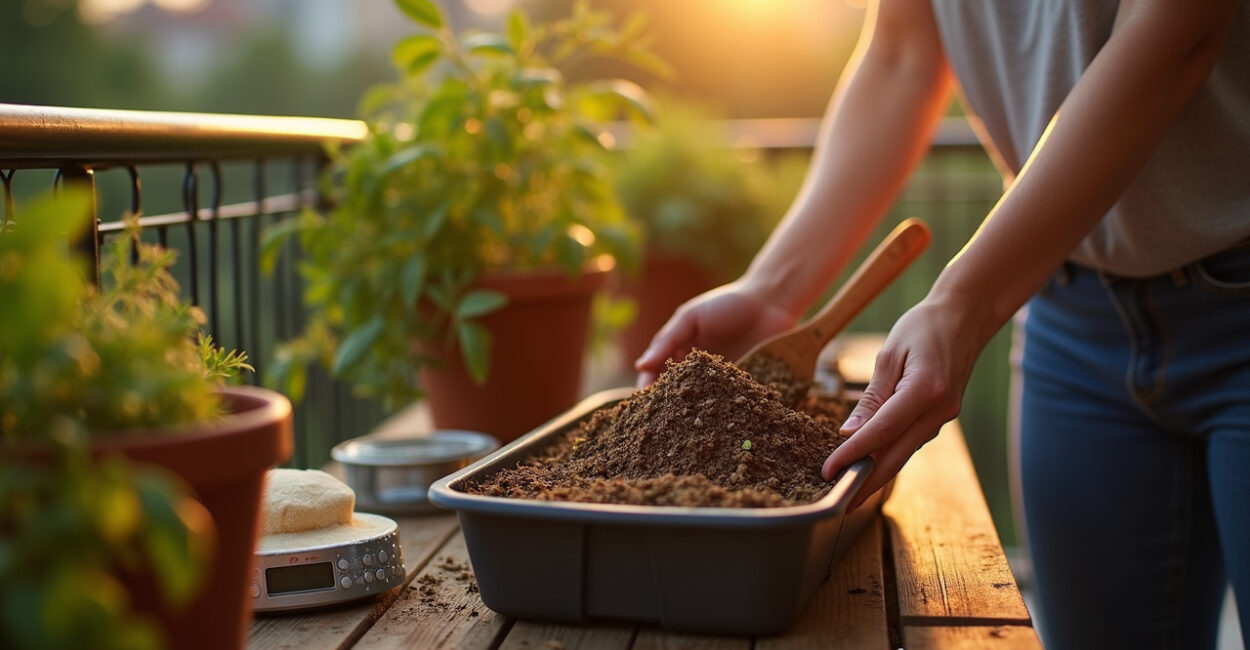
Are intentionally formulated growing media designed to maximize plant-available volume in small containers by balancing particle size, porosity, water retention, and nutrient-holding capacity. Unlike garden loam or loose potting soils, these mixes compress to reduce dead space while keeping enough pore continuity for roots, oxygen, and drainage—critical for balcony growers who need high yields from limited media volume.
The pressure on urban growers to produce predictable yields on balconies has risen with smaller living spaces and higher food costs. Affordable, compact soil mixes let growers reduce pot size without sacrificing yield, cut water and fertilizer waste, and avoid frequent repotting. This article gives tested recipes, lightweight amendments, fertilization strategies, and troubleshooting guidance that work in 6–20 L containers typical of balcony setups.
Pontos-Chave
- Compact soil mixes trade bulk volume for optimized pore structure: target 30–40% total pore space with 10–20% readily drained macropores and the rest as available water-holding micropores.
- Use lightweight mineral amendments—expanded perlite, pumice, and calcined clay—to retain structure while reducing weight and improving drainage; avoid >30% perlite in mixes for long-term stability.
- Recipes: a universal budget mix (peat-free), a high-yield vegetable mix, and a low-water mix for warm exposures with exact volumetric ratios and expected N-P-K baseline needs.
- Fertilize with a two-part approach: baseline slow-release granular and a weekly dilute soluble feed; monitor EC and adjust by crop stage to prevent salt build-up in compact media.
- Common failures—compaction over time, anaerobic pockets, and inconsistent moisture—are solvable with periodic top-dressing, structured repot rotations, and root-zone aeration techniques.
Why Pore Architecture Defines Success for Compact Soil Mixes
Pore architecture—the size distribution and connectivity of pores—controls aeration, drainage, and water availability in compact soil mixes. In small containers, roots quickly exploit the available pore network; if pores collapse or are too fine, oxygen tension drops and yields fall. Quantifying pore space lets a grower predict watering frequency and root stress.
Target Pore Fractions and Their Plant Effects
A practical target is 30–40% total porosity: 10–20% macropores (>0.05 mm) to ensure drainage and gas exchange, and 20–25% micropores for water retention. Media with <25% porosity often show root-bound hypoxia within weeks. Adjust these targets by crop: leafy greens prefer higher water-holding micropores, fruiting crops need more macropores to avoid blossom end rot from inconsistent moisture.
Measuring Pore Space in the Urban Garden
Simple field methods include the container saturation-drainage test: saturate a known-volume sample, let drain 30 minutes, measure retained water to estimate available water-holding porosity. For greater precision, labs at land-grant universities offer particle-size and porosity tests; see extension services like Extension.org and USDA guidance on substrate testing at USDA AMS.
Practical, Budget Recipes for Compact Soil Mixes
Recipes must balance cost, weight, and performance. Below are three tested mixes tailored to common balcony scenarios: budget general purpose, high-yield vegetables, and a low-water mix for hot, exposed balconies. Volumetric measures are most reliable for DIY mixing.
Budget General-purpose Compact Mix (best for Mixes with Container Sizes 10–15 L)
Recipe (by volume): 4 parts coir dust (pre-wetted), 2 parts screened compost, 1 part screened builders sand (coarse), 1 part perlite (coarse). Expect bulk density ~350–450 g/L and porosity ~32–36%. This mix is peat-free, low-cost, and supports most herbs and greens.
High-yield Vegetable Compact Mix (tomatoes, Peppers in 15–20 L Pots)
Recipe: 3 parts coir, 2 parts well-matured compost, 1 part pumice or crushed lava, 1 part calcined clay (e.g., Turface) and 0.5 part worm castings. This increases cation exchange capacity and buffering for heavier feeders. Anticipate higher nutrient demand; pair with structured feeding (see fertilization section).
Low-water Compact Mix for Hot Balconies
Recipe: 3 parts coir, 1.5 parts pumice, 1 part calcined clay, 0.5 part compost, 0.5 part hydrogels or 0.1% polyacrylamide granules by weight. This reduces watering frequency while maintaining aeration. Avoid hydrogels >1% by volume to prevent overly gelled zones that reduce oxygen.

Lightweight Amendments and Their Specific Roles
Choosing amendments is a technical decision: each material affects porosity, nutrient retention, weight, and pH. Common affordable options are coir, perlite, pumice, calcined clay, and screened compost. Selecting the right combination prevents compaction while keeping costs low.
Mineral Amendments: Perlite, Pumice, and Calcined Clay
Perlite is cheapest and lightest but can float and break down; limit to 20–30% for long-term pots. Pumice and crushed lava are heavier but stable and improve long-term structure; use 10–25% where weight is not a constraint. Calcined clay increases water retention and cation exchange; 5–15% helps buffer salts and reduces compaction.
Organic Components: Coir, Compost, and Worm Castings
Coir provides stable water-holding capacity and resists compaction better than peat. Use washed, buffered coir to avoid sodium and high EC. Well-matured compost adds nutrients but can increase bulk and microbial oxygen demand; keep compost under 25% in compact mixes to prevent anaerobic zones.
Fertilizer Strategies Tailored to Compact Soil Mixes
Compact mixes require a two-part fertilization strategy: a baseline slow-release source to maintain steady N-P-K and a soluble feed to correct short-term deficiencies or support peak demand. Because compact mixes have high root density, salts accumulate faster; monitoring and management are essential.
Baseline Nutrition: Controlled-release and Mineral Amendments
Use a controlled-release fertilizer (CRF) rated 3–6 months at labeled rates for container volume. Incorporate 50–75% of the CRF rate when using high compost content to avoid overfertilization. For predictable uptake, include rock phosphate (slow P source) and lime for pH buffering if coir or compost acidifies the mix over time.
Supplemental Feeding and EC Management
Apply a dilute soluble feed (e.g., 150–200 ppm N) weekly during active growth or higher for heavy fruiting crops (200–300 ppm N). Flush containers with two container volumes of water every 4–6 weeks to prevent salt build-up, especially when using CRFs. Measure EC periodically; aim for 1.2–2.5 dS/m depending on crop tolerance.

Protocols to Prevent Compaction and Maintain Porosity over a Season
Compaction in compact soil mixes usually comes from repeated wetting/drying cycles, root matting, or heavy top watering. Simple protocols extend media life and sustain yields without full repotting every season.
Preventive Practices: Handling, Watering, and Top-dress
Use gentle showerheads and avoid flooding from height which mashes the mix. Top-dress annually with 1–2 cm of screened compost or calcined clay to renew nutrients and restore pore architecture. Rotate 20–30% of mix into new pots rather than replacing entirely to keep microbial diversity and structure.
Mid-season Corrections and Aeration Techniques
If drainage slows, insert an aeration probe (wooden dowel or chopstick) to loosen the root zone, then water lightly to settle. For severe compaction, remove the plant, tease roots, and replace half the media with a refreshed blend. Root pruning and repotting every 12–18 months prevent root-bound anaerobic patches in compact mixes.
Diagnostics: Identifying and Fixing Common Failures in Compact Media
Diagnosing failures quickly keeps yields from collapsing. Symptoms often look similar—yellowing, wilting, slow growth—but causes vary: salt toxicity, hypoxia, nutrient lock, or pathogens. A structured diagnostic approach narrows the cause and prescribes corrective action.
Symptom Mapping to Cause and Fix
1) Wilting between waterings with pale leaves suggests poor water retention or root damage—check porosity and root health. 2) Persistent yellowing with marginal burn points to salt build-up—flush and cut CRF rates. 3) Stunted, slow recovery after watering often signals hypoxia from compaction—loosen media and increase macropore fraction next mix.
When to Test and What to Test For
Test substrate EC and pH when symptoms persist for >2 weeks. For systemic issues, send a media sample to a university lab for nutrient and particle-size analysis; many state extension services provide tests—search your local USDA NIFA extension contacts for testing options. Use results to adjust amendment ratios and fertilizer plans.
How to Scale Compact Soil Mixes for Different Container Sizes and Crops
Scaling is not linear: as container volume shrinks, the impact of pore architecture and nutrient reserve increases. Design mixes and feeding schedules by container class (small: <6 L, medium: 6–15 L, large: 15–25 L) and by crop demand.
Mix Tweaks by Container Class
Small containers: increase micropore fraction and use slow-release fertilizers conservatively to avoid burn. Medium containers: use balanced recipes from earlier sections. Large containers: you can afford more coarse amendments and higher compost; structural stability matters less but nutrient drawdown over time is greater.
Crop-specific Scaling Rules
Leafy greens: prioritize water-holding micropores and lighter feeding cycles. Fruiting crops: prioritize macropores and higher potassium during fruit set. Root crops: avoid too many fines; provide friable media to allow tuber expansion. Keep container depth in mind—roots require both volume and vertical space for optimal fruiting.
Next Steps for Implementation
Start by choosing one recipe and testing it in a single container to benchmark watering frequency, EC, and yield. Measure the mix’s drainage and retained water using the saturation-drainage test, then adjust perlite/pumice ratios if retention is off by more than ±15% from targets. Track yields and root health over two growing cycles before changing the base recipe.
Longer term, build a small inventory of key amendments (coir, pumice, calcined clay, controlled-release fertilizer) and aim to reuse aged media by rejuvenating 30–50% each season. This lowers costs and preserves beneficial biology. For technical reference on substrate testing and nutrient rates, consult regional extension services linked above.
FAQ
How Often Should I Water Compact Soil Mixes in 10–15 L Balcony Pots?
Watering depends on mix composition and weather, but a compact mix with target porosity (30–40%) commonly needs water every 2–4 days in warm weather for 10–15 L pots. Monitor weight: a full container loses 10–20% of weight before plant stress. Use the finger test or tensiometers for precision. Avoid daily light watering; instead, irrigate to near-drainage to maintain uniform moisture and reduce salt concentration gradients in the root zone.
Can I Make Compact Soil Mixes Without Peat, and Will They Behave the Same?
Yes—peat-free compact mixes using coir perform similarly in water retention and structure if the coir is properly buffered and rinsed to remove excess salts. Coir has better long-term structural stability and is renewable, but it may require calcium and magnesium supplementation to balance cation exchange. Expect to adjust baseline lime or dolomite rates and monitor pH during the first months of use.
What Signs Indicate Salt Build-up in Compact Soil Mixes, and How Do I Remedy It?
Salt build-up shows as marginal leaf burn, stunted growth, and white crust on the media surface. Confirm with an EC test; values >3 dS/m often harm sensitive crops. Remedy by flushing with two container volumes of low-EC water, reduce CRF rates, and switch to a lower-salt soluble feed. Replace 20–40% of the media for severe, persistent salt issues and use amendments like calcined clay to improve buffering.
How Long Do Compact Soil Mixes Remain Effective Before Repotting or Rejuvenation?
With good practices, compact mixes last 12–24 months for heavy feeders and 24–36 months for lighter crops. Degradation drivers include root matting, organic matter breakdown, and compaction. Rejuvenate by top-dressing with compost or calcined clay, replacing 20–50% of the mix annually, and pruning roots during repotting. For continuous high yields, plan for partial media refresh every season.
Which Tests Should I Use to Optimize My Compact Soil Mix and Feeding Program?
Key tests are substrate EC, pH, and a basic nutrient panel (N, P, K, Ca, Mg) from a university lab. Perform an EC/pH test monthly during active growth and a full nutrient and particle-size test annually or when problems arise. Use results to adjust fertilizer rates and amendment ratios. Many land-grant extensions provide affordable substrate testing and actionable interpretation tailored to container production.