

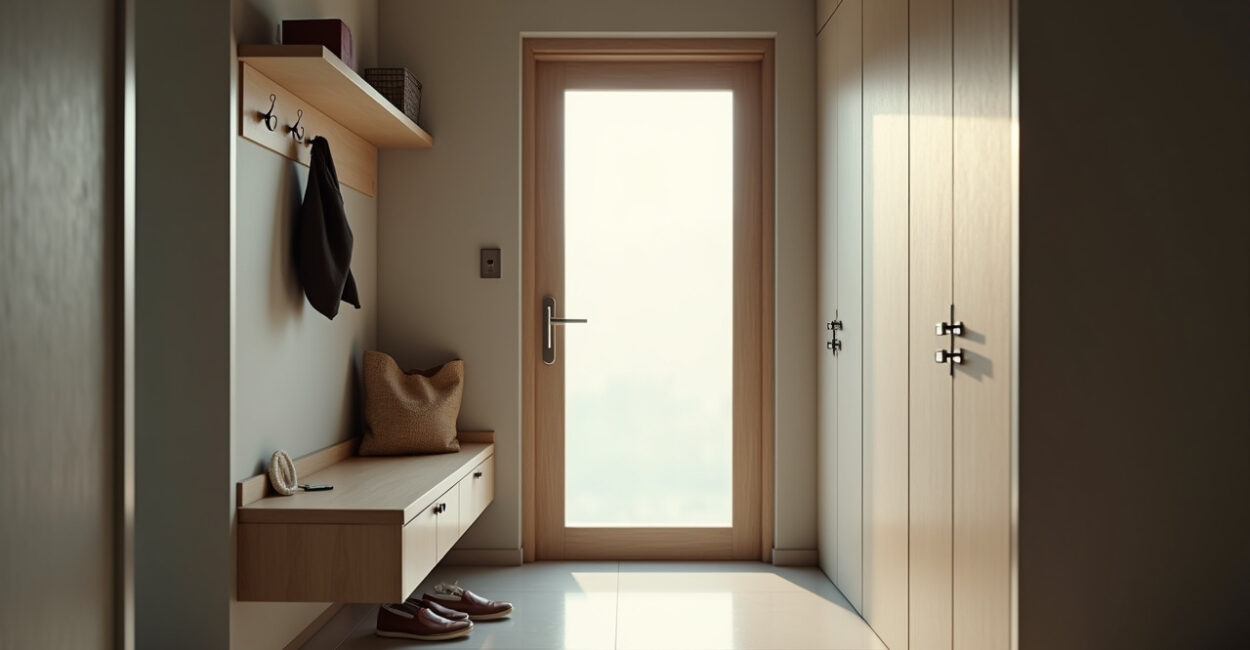
When a hallway is barely wider than your shoulders, clutter multiplies fast: one pair of shoes becomes a traffic jam, mail turns into a paper pile, and keys disappear at the worst possible moment. The best entryway organization ideas for narrow hallways are not about adding more storage everywhere; they are about creating a tight, reliable drop zone that keeps the floor clear and the first few feet of your home functional.
The technical idea here is space-efficient circulation planning—designing storage so it supports movement instead of blocking it. In plain English, every item needs a place that matches how often you use it and how quickly you need it. That means prioritizing wall-mounted, shallow, and vertical solutions over bulky furniture, while setting up a routine that keeps daily clutter from spreading into the rest of the house.
What You Need to Know
- A narrow hallway works best when storage depth stays slim and the walking path stays uninterrupted.
- The most effective drop zones separate “arrive items” like bags and keys from slower-moving items like seasonal shoes and coats.
- Wall-mounted hooks, floating shelves, and shallow benches solve more problems than deep cabinets in tight spaces.
- Clear rules for mail, shoes, and keys matter as much as the furniture itself, because systems fail when every surface becomes temporary storage.
- The right setup depends on traffic patterns: a family of four needs a different layout than a one-person apartment.
Entryway Organization Ideas for Narrow Hallways That Protect Walking Space
The first rule is non-negotiable: if storage narrows the passage, it is the wrong storage. A narrow hallway usually needs a clear walking lane of at least 30 to 36 inches, and that number matters because even a modest bench or console can make the space feel cramped if it intrudes too far. The goal is not to “fill” the entry; it is to shape the entry so it works under daily pressure.
In practice, the best layouts use the wall like a service corridor. Hooks sit high enough for coats and bags, a shelf or small tray catches keys and mail, and shoes stay in a defined lower zone instead of spreading across the floor. The National Park Service’s accessibility guidance is useful here because circulation width and clear path thinking translate well to home layouts: if a route feels awkward to pass through, people stop using it correctly.
The best storage for a narrow hall is the kind you stop noticing during a busy morning.
Measure Before You Buy Anything
Do not shop by style first. Measure the usable width of the hallway, then subtract the space people actually need to turn, open doors, and remove shoes. This is where many entryways fail: a piece looks slim in a product photo but still blocks the natural flow when a door swings open or a backpack hangs from a hook. A tape measure and painter’s tape on the floor beat guesswork every time.
Choose Wall Space over Floor Space
Wall-mounted systems solve the biggest problem in narrow halls: floor congestion. Hooks, ledges, and narrow shelves keep the center path open while still giving every family member a landing spot. If you have baseboards, radiators, or a thermostat, plan around them before installing anything. Those small obstacles are often the reason a hallway setup feels polished in theory but messy in real life.
Shallow Furniture That Actually Works in Tight Spaces
Shallow furniture earns its place only when it gives you a true function, not just visual order. A console that is 10 to 12 inches deep can work for mail, sunglasses, and a bowl for keys, but once it grows deeper than that, it starts competing with the hallway itself. A bench is even trickier: if it is used, it needs to support shoe removal; if it is not used, it becomes visual clutter with legs.
For most homes, the winning pieces are narrow shoe cabinets, floating consoles, and slim storage benches with hidden bins. The best versions do two things at once: they hold the items you reach for every day and they keep visual noise low. That matters because narrow hallways already feel busier than they are. A heavy-looking cabinet can make even a tidy entry seem crowded.
| Storage Piece | Best Use | Typical Depth | Watch-Out |
|---|---|---|---|
| Floating Shelf | Keys, mail, small decor | 4–8 in | Can collect clutter if it becomes a catchall |
| Shallow Console | Daily drop zone | 10–12 in | May block circulation if placed opposite a door |
| Slim Shoe Cabinet | Hidden shoe storage | 7–13 in | Not ideal for bulky boots unless shelves adjust |
| Storage Bench | Sitting, baskets, seasonal items | 12–15 in | Only useful if you actually sit to remove shoes |
When a Bench Helps—and When It Does Not
A bench helps when shoe removal is part of your routine and the seat depth is realistic for the user. It fails when it exists only as a decorative object. If your household already kicks shoes off at the door, a bench with storage can be useful. If people walk past the entrance and keep moving, a bench just becomes another surface for bags, groceries, and unopened envelopes.

Hooks, Peg Rails, and Vertical Zones for Daily Items
Hooks are the backbone of a narrow hallway system because they match human behavior: people need somewhere to land quickly. A peg rail or row of hooks gives bags, jackets, dog leashes, and umbrellas a predictable home without asking anyone to open a door or bend down. That makes the system more likely to survive a rushed weekday morning.
What matters is spacing. If hooks sit too close together, coats overlap and bags collide; if they sit too high or too low, children and shorter adults will not use them consistently. A practical layout assigns one hook per person, then adds one or two extras for guest items, reusable bags, or wet weather gear. The point is not maximum capacity. The point is friction reduction.
Vertical storage succeeds when it matches the way people enter and leave the house, not when it looks symmetrical on the wall.
Use Zones, Not Just Hardware
Think in zones: upper hooks for coats, mid-level hooks for backpacks, and a lower shelf or basket for shoes and umbrellas. This arrangement creates a clean sequence from top to bottom and keeps items from drifting into the wrong category. If you group everything by owner instead of by function, the space often becomes harder to maintain, especially in busy households where multiple people arrive at different times.
Keep Guest Storage Separate
One of the easiest ways to make an entryway feel orderly is to give guests a temporary zone that is clearly separate from the household system. A small hook, tray, or basket for visitors prevents borrowed space from taking over the main family setup. That distinction sounds minor, but it saves the entry from looking permanently half-finished.
Shoes, Boots, and the One-in, One-out Rule
Shoes are usually the first category to overwhelm a narrow hall because they move in and out constantly. The fix is not simply “more shoe storage.” It is limiting what stays in the entry. Keep only the shoes worn most often by the people who actually use the doorway daily. Everything else belongs in a closet, under-bed bin, or seasonal storage.
A strong shoe system uses a simple rule: one pair out, one pair away. That means the pair you wore today returns to the rack or cabinet before another pair enters the floor zone. The rule sounds small, but in a narrow hallway it prevents pileups better than any oversized organizer. For households with muddy weather, a boot tray or washable mat is worth including because it keeps moisture from turning the entry into a maintenance problem.
- Use open racks for fast-drying shoes that need air circulation.
- Use closed shoe cabinets for visual calm and dust control.
- Use boot trays for wet seasons and athletic gear.
- Store off-season footwear outside the hallway altogether.
Who works with homes every day knows that shoe clutter is rarely a storage problem alone. It is a behavior problem with storage symptoms. If the hallway is the only place shoes have ever been allowed to land, no organizer will stay tidy for long without a rule that limits what gets left there.

Keys, Mail, Chargers, and the Small Stuff That Turns Into Mess
The smallest objects create the fastest clutter. Keys disappear, mail spreads, earbuds vanish, and cords tangle around whatever surface is available. A narrow entryway needs a dedicated micro-zone for these items, ideally no larger than one shelf, one tray, and one charging point. When the system grows larger than that, it becomes another place to dump random things.
A good setup often includes a wall shelf, a lidded tray, and a drawer or bin for paper sorting. Mail should be handled in one step: keep, file, shred, or recycle. If it sits in the entry for days, the whole space starts looking neglected even when the larger furniture is neatly arranged. For paper handling, the Federal Trade Commission’s guidance on disposing of personal information is useful because it reinforces a simple rule: sensitive mail should never linger in open view.
Build a 10-Second Drop Zone
The best mail-and-keys station is one people can use in ten seconds or less. That means a tray for keys, a slot or basket for incoming mail, and a charger if phones tend to die during the commute. If the process takes longer than that, people will skip it, set items on the nearest horizontal surface, and undo the whole system. Simplicity is not optional here; it is the mechanism.
A Small Family Example
In one townhouse entry I worked on, the hallway was just wide enough for a person and a small dog to pass comfortably. The family kept losing keys and stacking mail on top of a radiator cover. We replaced that setup with two wall hooks per adult, one shallow shelf, a slim shoe cabinet, and a tray for outgoing mail. Within a week, the floor stayed clear because there was no longer any ambiguity about where each item belonged.
Lighting, Mirrors, and Visual Calm in a Tight Hall
Organization is not only about storage capacity. It is also about what the space feels like when you walk into it. A narrow hallway can look cluttered even when it is technically tidy if the lighting is poor or the wall finishes create visual chaos. That is why mirrors, brighter bulbs, and simple color choices matter more than people expect.
A mirror expands the sense of width and gives you a last-minute check point before leaving the house. Good lighting makes hooks, trays, and shoes easier to use, which matters in a hallway that may not receive much natural light. If you want the entry to feel calmer, keep finishes consistent and avoid too many small decorative objects. Busy surfaces make narrow spaces feel even smaller.
In a narrow hallway, visual restraint is a storage strategy as much as a style choice.
Choose One Reflective Surface
One mirror is usually enough. More than that can make the hall feel fragmented, especially when the walls are already crowded with hooks and shelves. A single vertical mirror works well because it adds height and useful function without competing with the storage layout. If you need a practical cue, place it where natural light or a lamp can bounce through the entry rather than reflect a cluttered corner.
How to Keep the System Working After the First Week
This is where most entry projects succeed on day one and fail by day ten. The furniture is not the issue; the maintenance rhythm is. A narrow hallway stays organized only when every household member knows what happens with shoes, mail, bags, and keys after they come through the door. Without that agreement, the entry slowly turns back into a holding area for everything unresolved.
Set a simple reset routine: clear the floor nightly, return items to their assigned zone, and process paper before it stacks. If the system is too complicated to reset in two minutes, it is too complicated for a busy house. That does not mean it must be rigid. It means the rules should be easy enough to follow on tired evenings and rushed mornings.
- Reset the entry at the same time each day, usually after dinner or before bed.
- Keep only active, daily-use items in the hallway.
- Revisit hooks and shelves after one month and remove anything unused.
- Adjust the layout if the season changes the type of clutter coming in.
That last point matters more than people think. Winter boots, umbrellas, sports gear, and school bags all change the load on an entryway. A system that works in July may fail in January, and that does not mean the design was bad. It means the household’s needs shifted.
Próximos Passos
The smartest approach is to treat the hallway like a control point, not a display area. Once the space is designed around movement, daily drop-off habits, and honest limits on what can stay there, the rest becomes much easier to maintain. The most effective narrow-entry setups are usually the least dramatic ones: shallow, vertical, and strict about what belongs in the zone.
Start by measuring, then remove one category of clutter from the floor, then add only the storage that solves a real problem. That sequence will outperform a prettier but less disciplined setup every time. If the goal is a calmer home, test the layout for a full week before adding more furniture or decor.
Frequently Asked Questions
What is the Best Storage Depth for a Narrow Hallway?
For most narrow hallways, the safest range is about 4 to 12 inches for wall-mounted or shallow furniture, depending on what the piece does. A floating shelf can stay very slim, while a console or shoe cabinet may need a little more depth to be useful. The key is not the number alone; it is whether the piece leaves enough room for a person to pass, turn, and open nearby doors without turning the entry into a squeeze point.
Should I Use Open or Closed Storage in a Small Entryway?
Open storage is better for fast access items like coats, bags, and daily shoes because it supports quick drop-off. Closed storage is better for visual calm and for hiding items that would otherwise make the hallway feel busy. In many homes, the best answer is a mix: open hooks for active items and a closed shoe cabinet or drawer for everything that does not need to stay visible. That balance keeps the space functional without looking overloaded.
How Do I Keep Shoes from Spreading Across the Floor?
Give shoes one specific landing spot and make the rule simple enough to follow every day. A slim shoe rack, boot tray, or closed cabinet works well when it is close to the entrance and easy to use without extra steps. The important part is limiting what stays in the hallway to the pairs in regular rotation. Seasonal or rarely worn shoes should move elsewhere so the floor zone does not become a permanent pile-up area.
What Should Go in a Narrow Entryway Drop Zone?
A narrow drop zone should hold the items people need immediately when they enter or leave: keys, mail, bags, sunglasses, and perhaps a charging spot for a phone. It should not become a catchall for unopened packages, random paperwork, or spare household objects. A tray, hook, and small basket usually cover the essentials without crowding the area. The best drop zones are easy to reset, which is why they stay useful long after the initial setup.
How Can I Make a Cramped Hallway Feel Less Crowded?
Use fewer objects, better placement, and one consistent visual line. Wall-mounted storage keeps the floor open, a mirror helps the space feel larger, and limited decor prevents the eye from getting overloaded. Light colors and good lighting also matter because dark, cluttered walls make a narrow hall feel tighter than it is. The goal is not to make the hallway look empty; it is to make every item earn its place.