

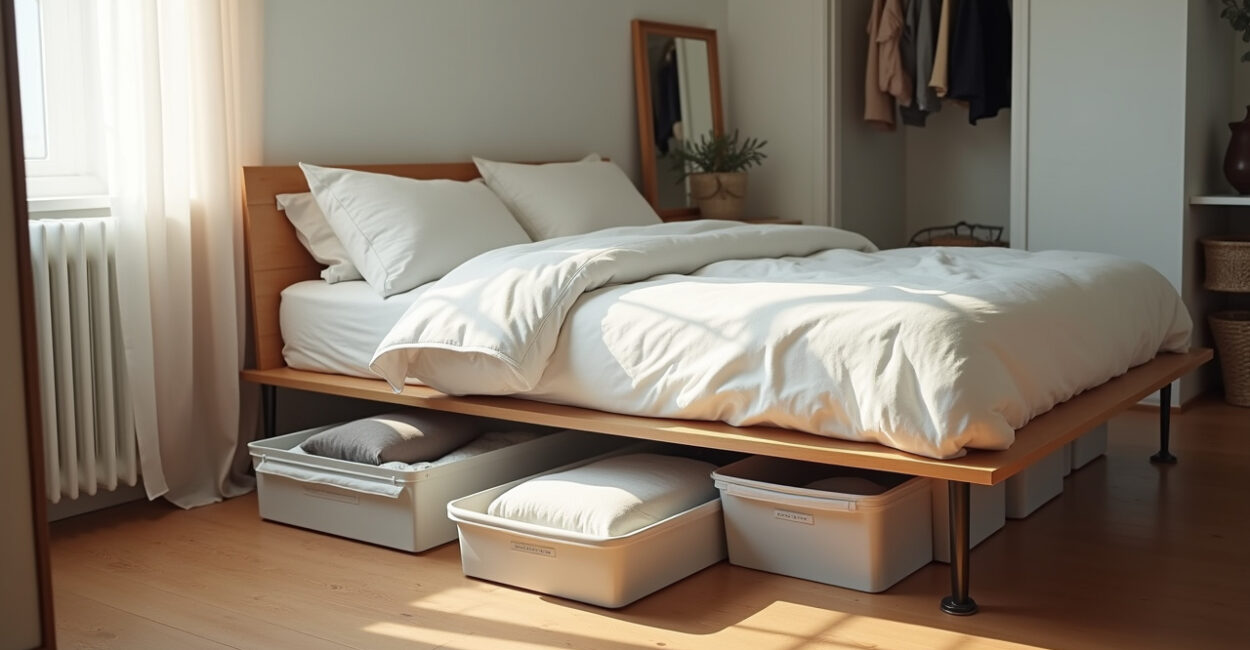
When a bedroom is short on floor space, the area under the bed becomes valuable real estate—not a dumping ground. The best under-bed storage ideas for tiny bedrooms turn that dead space into organized capacity for off-season clothes, spare bedding, shoes, gift wrap, and bulky items that would otherwise crowd your closet.
The trick is not just “use bins.” It’s matching the container to what you store, how often you need it, and how much clearance your bed frame actually gives you. In practice, the wrong container creates more friction than it solves: lids that catch, bins that won’t slide, and bags that trap dust or moisture. This guide breaks down what works, what fails, and how to set up storage that stays useful after the novelty wears off.
Quick Takeaways
- The most effective under-bed storage is low-profile, labeled, and easy to slide out without lifting the mattress.
- Clear bins work best for frequent access, while fabric bags and vacuum bags are better for seasonal textiles.
- Bed clearance matters more than container style; measure the usable height before you buy anything.
- Storage on casters is worth it only when the bed frame has enough height and the floor surface is smooth.
- Moisture control, dust control, and access speed matter more than maximizing every last cubic inch.
Under-Bed Storage Ideas for Tiny Bedrooms That Actually Fit Real Life
“Under-bed storage” is a space-planning strategy that uses the horizontal void beneath a bed frame for secondary storage. In plain English: it’s the easiest place to hide items you do not need every day, without adding another dresser to a room that can barely hold one. The best setups respect three limits at once—height, accessibility, and airflow.
That last part matters. A bed on tall risers can hold a lot, but if the container rubs the frame or blocks movement, you will stop using it. A low bed can still work if you choose shallow drawers, under-bed boxes, or soft containers that compress slightly. The goal is not maximum volume. The goal is storage you can actually live with.
Under-bed storage works best when the container matches the item’s retrieval frequency: daily items need open access, seasonal items can live in sealed bins, and fragile fabrics need breathable protection.
For a deeper look at safe room organization and indoor conditions, the EPA’s indoor air quality guidance is useful because dust, humidity, and poor airflow affect what you store below the bed. For space-saving design ideas in small rooms, Better Homes & Gardens has practical examples that reflect real bedroom constraints rather than staged magazine perfection.
Choose the Right Container for the Job
Not every storage container belongs under a bed. The container should be chosen by item type, not by whatever is cheapest or most available.
Best for Seasonal Clothes and Linens
Flat lidded bins and zipper-top fabric cases are the safest default for sweaters, blankets, and extra sheets. They protect from dust and keep stacks from slumping. If you store knits or bedding for months at a time, add acid-free tissue or a cotton layer so items keep their shape.
Best for Shoes, Accessories, and Miscellaneous Items
Clear drawer-style bins are better when visibility matters. They let you see what is inside without opening everything. This is the right pick for shoes, scarves, sports gear, or cables that tend to disappear in opaque containers. Labeling still helps, because clear plastic does not solve category drift.
Best for Bulky, Rarely Used Items
Vacuum storage bags are efficient for comforters, winter coats, and guest bedding. They shrink volume dramatically, but they are not ideal for anything that wrinkles easily, needs airflow, or gets accessed often. Use them for long-term compression, not for items you rotate every week.
| Container Type | Best Use | Main Tradeoff |
|---|---|---|
| Clear lidded bin | Frequently accessed items | Can look messy if overfilled |
| Fabric under-bed bag | Soft goods and linens | Less structure, easier to sag |
| Vacuum bag | Seasonal bulk storage | Compression can damage delicate items |
| Rolling drawer | Easy pull-out access | Needs enough clearance and smooth flooring |
The wrong container wastes more space than no container at all, because a bin that does not clear the frame or slide smoothly becomes dead weight.

Measure Bed Clearance Before You Buy Anything
This is where most small-bedroom setups go wrong. People buy storage first and measure later, then discover the bed skirt hides the opening, the frame has crossbars in the way, or the bin fits on paper but not in real life. Measure the vertical clearance from floor to the lowest obstruction, not just from floor to mattress base.
A reliable setup leaves a small buffer so the container does not scrape the floor or snag the frame. For many rooms, 6 to 8 inches of clearance opens up low bins; 10 to 12 inches gives you more flexibility; 14 inches or more can support rolling drawers or taller organizers. These are practical thresholds, not universal rules. Platform beds, metal frames, and adjustable bases all behave differently.
Who works with compact storage every day knows that a half-inch matters. I have seen people force containers into a space that was technically “close enough,” only to make the whole system annoying enough to abandon within a month. Measure twice, buy once, and check the path the bin must travel—not just its final resting place.
Build a Layout That Makes Retrieval Easy
Under-bed storage only helps if you can access it without dragging half the room out of the way. The smartest layout places high-use items near the outer edge and long-term items farther back. That sounds simple, but it changes how the room feels in daily use.
Zone the Space by Frequency
- Front zone: items you need monthly, such as spare pillowcases or workout gear.
- Middle zone: seasonal clothing and guest linens.
- Back zone: long-term overflow, holiday decor, or keepsakes that rarely move.
Use Labels That Survive Real Use
Paper labels peel, marker fades, and “miscellaneous” becomes a black hole. Use sturdy tags or printed labels with a clear category name and a date range, such as “Winter Bedding 2025” or “Shoes – Rarely Worn.” That small detail prevents the under-bed area from turning into an unsearchable archive.
A simple example: one studio renter I worked with kept four flat bins under a full-size bed—two for off-season clothes, one for extra towels, and one for cables and camera gear. The change was immediate. The floor cleared, the closet stopped overstuffing, and the items that used to migrate across the room finally had a fixed home. Nothing fancy. Just a layout that respected how often each thing was used.

Protect What You Store from Dust, Moisture, and Damage
Under-bed space is not the cleanest storage environment. Dust collects there, airflow can be limited, and some rooms—especially basements or humid apartments—create moisture problems that fabric bins alone will not solve. That is why container choice should include protection, not just capacity.
If the room runs humid, avoid storing anything that molds easily in cardboard or open fabric. Use sealed plastic bins for textiles, and add moisture absorbers if the space tends to feel damp. For practical indoor moisture guidance, the CDC’s mold and moisture resources explain why damp storage spaces create long-term problems for clothes, paper goods, and soft furnishings. For a broader home-safety angle, University of Minnesota Extension has straightforward storage advice that applies well to compact rooms.
What to Keep Out from Under the Bed
- Anything food-related, because pests and odor are not worth the risk.
- Documents or photos unless they are sealed in archival-grade protection.
- Delicate fabrics that crease badly when compressed for long periods.
- Items you need every few days, since frequent access destroys the system.
There is one exception: if your climate is dry and the room is very clean, soft bins can work fine for blankets and clothing. The method is not wrong; it just fails when the environment is wrong for it.
Make the Storage Blend Into the Room Instead of Cluttering It
A tiny bedroom feels smaller when the storage itself looks chaotic. That is why visual discipline matters almost as much as capacity. Matching bins, consistent labels, and a single color family create the impression of a calmer room, even if the actual volume of stuff has not changed.
Two design choices make the biggest difference. First, choose containers with a low visual profile: matte finishes, neutral fabric, or clear sides with clean edges. Second, keep the bed skirt or frame line intentional. If the storage is visible, it should look planned, not improvised.
In a tiny bedroom, storage that looks intentional is more valuable than storage that merely holds more stuff.
This is also where a lot of people overdo it. Decorative baskets look nice, but they are often worse than a plain bin because they waste inches and collect dust faster. A cleaner system wins every time if the room is small enough that every visual detail matters.
Set Up a System You Will Keep Using
The best under-bed storage ideas for tiny bedrooms are the ones that survive real habits, not ideal habits. If it takes two people and ten minutes to access a bin, it will not stay organized. If it requires rearranging the whole bed just to reach one sweater, you will eventually stop putting things back where they belong.
Start with one category and build from there. Seasonal bedding is usually the easiest win because it is bulky, predictable, and low-access. Once that works, add one more category only if the first system still feels easy. Overfilling is the fastest way to ruin under-bed storage, so leave a little breathing room in each container.
The best test is simple: can you pull out, identify, and return one item in under a minute? If not, the layout needs to change. That standard is practical, not perfectionist, and it keeps the system honest.
Practical Setup Rules for Tiny Bedrooms
If the room is truly tight, use these rules as a filter before buying anything. They save money and prevent the common mistakes that turn smart storage into hidden clutter.
- Store by frequency of use, not by category alone.
- Measure clearance at the lowest obstruction, not the mattress edge.
- Use sealed containers for dust-prone spaces and breathable ones for short-term textile storage.
- Keep a label on every bin, even if you think you will remember what is inside.
- Leave at least one container slot empty if your room changes seasonally.
If you apply those rules, under-bed space stops being an afterthought and becomes a functional part of the room’s layout. That is the real win: not more stuff hidden away, but a bedroom that feels easier to live in.
Next step: measure your bed clearance, choose one storage category to move first, and test whether the container slides out cleanly for a full week. If it does not, change the container before you fill it.
Frequently Asked Questions
What is the Best Thing to Store Under a Bed in a Tiny Bedroom?
The best items are seasonal and low-access, such as extra bedding, winter clothes, spare pillows, and guest linens. These take up a lot of space but do not need to be reached every day. If you store frequently used items there, the system becomes annoying fast. The best under-bed storage is not about hiding everything; it is about moving the right items into the most awkward space so the rest of the room stays usable.
Are Vacuum Bags Good for Under-bed Storage?
Yes, but only for certain items. Vacuum bags are strong for compressing bulky textiles like comforters, duvets, and winter coats, especially when space is extremely limited. They are a poor choice for delicate fabrics, wrinkle-prone clothing, or anything you need to access often. Compression also makes the contents less breathable, so they work best for long-term storage rather than active rotation during the season.
How Do I Keep Under-bed Storage from Getting Dusty?
Use lidded bins or zippered storage cases, and avoid open baskets if dust is a serious issue. Cleaning the floor under the bed before placing containers helps too, because dust already sitting there will get kicked up every time you slide something out. In humid or dusty rooms, sealed containers outperform fabric-only options. If the space is hard to vacuum, a taller bed frame or rolling drawer setup can also make maintenance easier.
Can I Use Open Bins Under the Bed?
You can, but they only make sense in very clean, dry spaces and for items you use often. Open bins are easier to grab from, yet they expose contents to dust and visual clutter. They work best for shoes, sports gear, or items that need to breathe. For most tiny bedrooms, lidded or zipper-closed containers give a better balance of cleanliness, appearance, and long-term usefulness.
How Much Clearance Do I Need for Under-bed Storage?
It depends on the container, but a few practical thresholds help. Around 6 to 8 inches of clearance supports shallow bins, 10 to 12 inches opens up more flexible storage, and 14 inches or more can handle rolling drawers or taller organizers. Measure the lowest point under the frame, not just the mattress height. If the container fits only when forced, it is probably the wrong container for that bed.