

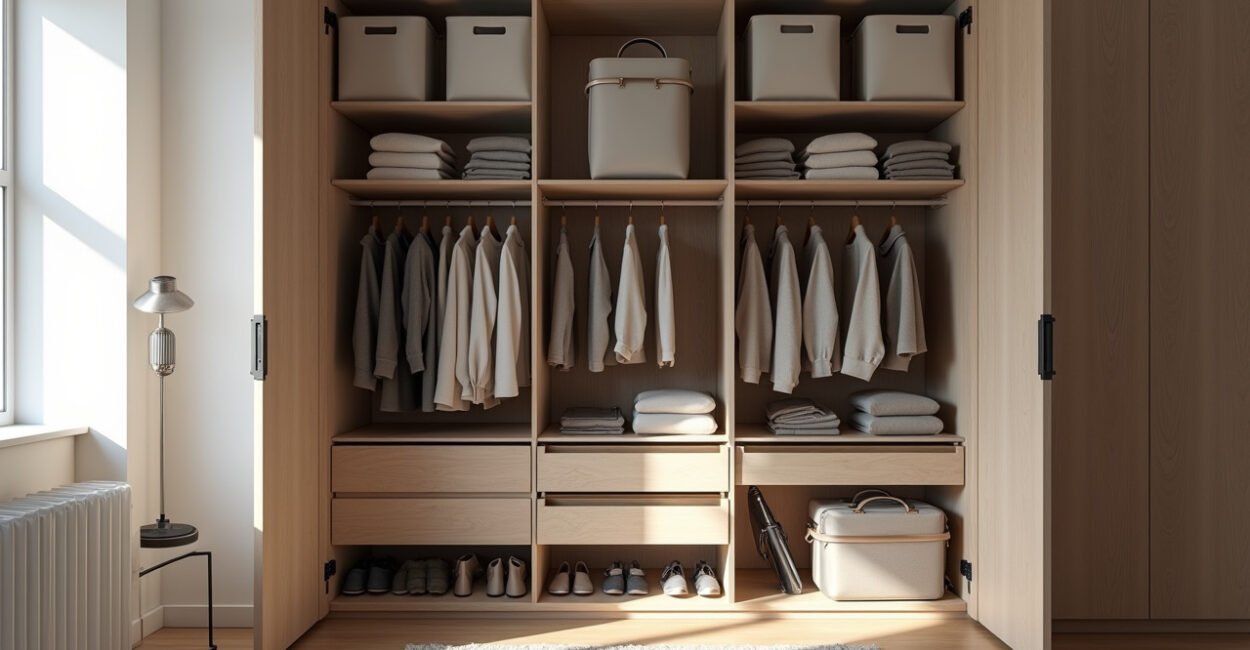
A closet does not need to be large to work hard; it needs a system that matches the space. The best small space closet organization ideas are not about buying more bins—they’re about reducing wasted inches, separating daily-use items from occasional storage, and using vertical space with intention.
In practical terms, a small closet becomes usable when every category has a fixed zone: hang, fold, sort, and store. That means shorter hanging sections, shelf dividers, matching hangers, labeled containers, and a clear rule for what stays in the closet versus what gets moved out. This article breaks down the methods that actually hold up in daily use, not just on a perfect Saturday reset.
O Essencial
- The fastest way to gain capacity is to stop treating the closet as one open cavity and start dividing it into zones by item type and frequency of use.
- Double hanging rods, shelf dividers, and slim hangers usually create more usable space than oversized storage containers.
- Vertical storage works best when the heaviest, most-used items stay between eye level and waist level.
- A closet stays organized only if the sorting rules are simple enough to follow when you are in a hurry.
- Small closets fail when seasonal overflow, donation piles, and “maybe later” items are allowed to live inside them.
Small Space Closet Organization Ideas That Turn One Tight Closet Into Three Functional Zones
The technical term for good closet organization is space zoning: assigning fixed areas to specific categories so items have a predictable home. In plain English, that means your closet should not behave like a single pile with a door on it.
The most efficient small closets usually have three zones: hanging, folded, and overflow. The hanging zone handles shirts, dresses, blouses, and jackets. The folded zone holds knits, denim, workout clothes, and sweaters that would stretch on a hanger. The overflow zone is for seasonal pieces, spare bedding, or rarely used accessories.
Start with a Category Audit, Not a Storage Shopping Trip
Before adding baskets or organizers, count what actually lives in the closet. If the rod is packed with short tops and long garments mixed together, you lose height. If the shelves hold three different item types, you lose clarity. A fast audit reveals the real problem: most closets are under-designed, not under-equipped. That distinction matters because the right fix might be removing a shelf, not buying another one.
Use Frequency to Decide Placement
Items you reach for five times a week belong at the easiest height. Off-season clothes, formalwear, and sentimental keepsakes belong higher up or elsewhere. This is where many people get it wrong: they organize by category first and convenience second. In a tiny closet, convenience has to win.
Small closets work best when the most frequently used items are placed at eye level and the least-used items are pushed upward or out of the closet entirely.
Make Vertical Space Work Harder Than Floor Space Ever Will
Closet floor space disappears fast, especially once shoes, hampers, and storage boxes start competing with each other. Vertical space, on the other hand, is often underused because people stop at the original rod and shelf.
According to U.S. Department of Energy storage-efficiency guidance, reducing clutter and improving access also helps households use space more efficiently in the home. That principle translates well to closets: if you can see it, reach it, and sort it quickly, the system lasts longer.
Add a Second Hanging Level
A double hanging setup is one of the highest-return changes you can make in a compact closet. Short items like shirts and folded pants can hang in two rows, which nearly doubles rod capacity. It does not work as well for long dresses or coats, so keep those on the taller side of the rod. The trade-off is worth it in most reach-in closets and apartment bedrooms.
Use the Top Shelf for True Overflow Only
The top shelf should not become a graveyard for random objects. Store labeled bins there, and make each bin do one job: extra linens, winter accessories, out-of-season shoes, or backup handbags. If the bins have to be moved every day, they are in the wrong place. The farther up the shelf is, the less often the contents should be needed.
In a small closet, height is more valuable than depth because vertical stacking preserves access while deep stacks bury the item you need first.

Use Folding Systems That Prevent Shelf Collapse and Clothes Drift
Folding is not about making stacks look neat for a photo. It is about keeping fabric stable, visible, and easy to remove without collapsing the whole pile. That is why shelf dividers and file folding often outperform loose stacks.
Na prática, what happens is this: a beautiful pile of sweaters becomes one unstable block after three mornings of rushing. The pieces at the bottom get forgotten, and the top stack slumps. A folding system solves that by making each item independently reachable.
File Fold the Categories That Disappear in Piles
T-shirts, leggings, sleepwear, and workout shorts are ideal candidates for file folding. When they stand upright in a drawer or bin, you can see every item at once. The technique is especially useful in tiny closets where drawer space is limited and shelf depth is shallow. It works less well for bulky knits, which should usually stay folded flat.
Separate Sweaters from Heavy Cotton
Sweaters lose shape if they hang too long, but they also lose order if they are stacked with heavier cotton pieces. Keep them on a dedicated shelf and use one divider if the stack tends to drift. If the shelf is too high to access comfortably, move the sweaters lower. Accessibility matters more than symmetry.
For a research-backed look at why visual clutter affects decision-making and stress, see Stanford’s coverage of clutter and cognitive load. A closet that forces constant scanning makes daily routines slower, even if the closet technically has enough room.
Choose Hanging Tools That Save Inches Without Wasting Rod Space
The wrong hanger can waste more space than a whole storage bin. Thick velvet, padded, or bulky plastic hangers are fine in moderate-sized closets, but in a compact one they eat width fast. Slim, uniform hangers create visible breathing room and help clothes hang at the same height.
Match the Hanger to the Garment
Use thin non-slip hangers for tops, contoured hangers for blazers, and sturdy support for heavier coats. Do not use one hanger style for everything if it makes clothes stretch or crowd together. A tiny closet needs consistency, but it also needs respect for garment structure. That balance keeps pieces looking better for longer.
Use Hooks and Clip Accessories for Edge Space
Hooks on the inside of the door, the side wall, or unused rod edges are useful for belts, scarves, hats, and tomorrow’s outfit. Clip-style accessories can hold jeans or shawls without forcing them onto the main rod. This is where many small closets quietly gain capacity: not by adding more volume, but by using leftover edges.
| Tool | Best For | When It Fails |
|---|---|---|
| Slim hanger | Shirts, blouses, lightweight jackets | Very heavy garments |
| Double hanging rod | Short clothing items | Long dresses and coats |
| Shelf divider | Sweater stacks, denim, folded sets | Overstuffed shelves |
| Door hook organizer | Accessories, belts, bags | Heavy bulk storage |

Sort Accessories by Retrieval Speed, Not by Sentiment
Accessories create chaos because they are small, irregular, and easy to toss anywhere. The fix is not more storage; it is better sorting rules. If an item is used every week, it should be visible. If it is seasonal or formal, it can be boxed.
Keep Belts, Scarves, and Bags in Separate Micro-Zones
Belts do not belong in a bin with scarves, and scarves do not belong in a pile with handbags. Each category has different retrieval habits. Belts are easiest on hooks or a slim organizer. Scarves work better folded or rolled in a drawer. Bags should keep their shape with tissue or inserts if they are stored long term.
Use Clear Containers Only When Visibility Matters
Clear bins help for sunglasses, gloves, ties, or jewelry because the contents matter more than the container. For visually messy items, opaque bins reduce noise. The rule is simple: if you need to identify the item at a glance, go clear; if the category is self-explanatory, label an opaque container. That limit keeps the closet from looking over-engineered.
A practical example: one renter with a 5-foot-wide reach-in closet replaced three mismatched bins, added a second rod, and moved accessories to the inside door. The closet did not grow. The usable space did. The difference came from taking bags off the shelf, putting sweaters in dividers, and leaving one empty box for donation overflow. Within a week, getting dressed stopped feeling like a scavenger hunt.
Control Seasonal Overflow Before It Takes over the Entire Closet
Seasonal rotation is where small closets either stay manageable or collapse. Winter coats, boots, and heavy knits can crowd out everyday clothes if they stay in the main zone all year. The solution is to rotate by season and store off-season items elsewhere whenever possible.
There is no perfect system for every household, and that is worth admitting. If you live in a climate with long shoulder seasons, you may need a mixed closet all year. If you share a closet with a partner, the seasonal boundary gets blurry fast. The rule still stands: protect the daily-use zone first.
Pack Off-Season Items in Labeled, Breathable Bins
Use breathable fabric bins or hard-sided boxes with labels for items that are not needed for months. Vacuum bags can work for bulky bedding, but they are not ideal for every garment because some fabrics crease badly. For wool, leather, and structured pieces, allow room and avoid over-compression.
Use a One-In, One-Out Rule for Storage Pressure
If the closet is at capacity, a new sweater or jacket should trigger a swap, not a squeeze. One-in, one-out is not trendy language; it is a practical guardrail. Without it, even a well-designed system becomes overloaded. That is one reason many organizers say the hardest part of closet organization is not arranging items—it is limiting what is allowed back in.
Build a Maintenance Routine That Keeps the System from Slipping
The best closets are maintained with tiny resets, not dramatic reorganizations. Ten minutes once a week usually prevents the drift that turns order into clutter. Put things back where they belong, remove one stray item, and check whether any zone has become crowded.
Do a Weekly Reset and a Monthly Edit
During the weekly reset, straighten hangers, refold stacks, and remove obvious non-closet items. During the monthly edit, look for items you have not used and decide whether they should stay, move, or leave. This habit matters more than most people expect because small closets have no buffer. A little drift becomes a lot of friction very quickly.
Track Failure Points Instead of Blaming Yourself
If one shelf keeps collapsing, the shelf is overloaded or poorly divided. If shoes end up on the floor, they need a better landing zone. If laundry piles appear in the closet, the closet is being used as a temporary holding area rather than a storage system. That kind of diagnosis is more useful than guilt, and it leads to fixes that actually last.
For a home organization perspective grounded in storage safety and accessibility, the University of Maryland Extension on home storage practices is a useful reference. It reinforces a point that applies here too: accessible storage is safer, faster, and easier to maintain than stacked chaos.
What to Do Next
The smartest small closet strategy is not “fit more in.” It is “make the right items easy to reach and everything else less disruptive.” If you start with zoning, add vertical capacity, and keep categories separate, the closet becomes easier to use every single day. That is the real test.
Pick one change to implement first: a second hanging rod, shelf dividers, or a seasonal purge. Then measure whether the closet gets easier to navigate before you buy anything else. The best small space closet organization ideas are the ones that survive a busy morning, not just a before-and-after photo.
FAQ
What is the Best First Step for Organizing a Small Closet?
Start by removing everything and sorting it into categories: hang, fold, seasonal, accessories, and donation. That gives you a true view of what the closet has to hold, which is more useful than guessing. Once you see the volume by category, you can decide whether you need a second rod, shelf dividers, or fewer items in the space. Most bad closet setups come from storage decisions made before the inventory was clear.
Are Drawer Organizers or Shelf Bins Better for Tiny Closets?
Neither is universally better; the right choice depends on what you store. Drawer organizers work well for small, flexible items like socks, underwear, and tees because they prevent loose piles. Shelf bins are better for category-based storage such as scarves, workout gear, or seasonal accessories. If the item needs to be seen quickly, a bin with a label is usually the smarter choice.
How Do I Keep My Closet Organized If I Share It with Someone Else?
Divide the closet by function first and by person second. One side can hold short hanging items, while the other handles long garments or shelves. Shared systems work best when each person has one clearly owned zone and both agree on where accessories and seasonal items belong. If one person has more clothing volume, that person should get the more flexible storage section.
Do Vacuum Bags Help in a Small Closet?
They help with bulky, compressible items like comforters, winter blankets, and some puffer jackets. They are not the best choice for delicate or structured clothing because compression can create deep wrinkles or change the garment’s shape. Use them for volume reduction, not for everything you own. If an item needs to keep its form, breathable storage is safer.
How Often Should I Reset a Small Closet?
A quick weekly reset and a deeper monthly edit is a realistic rhythm for most households. Weekly maintenance keeps clutter from spreading, while the monthly review catches items that are no longer being used. If the closet starts feeling crowded before the month is over, that is a sign the system needs adjustment. The goal is to catch drift early, not wait for a full overflow problem.