Warning: Cannot modify header information - headers already sent in /home/u278635817/domains/myhousegarden.com/public_html/wp-content/plugins/artigosgpt/artigosgpt.php on line 28454
The single best trick to reclaim square footage in a tiny apartment isn’t a bigger counter or fewer appliances — it’s going vertical. Small kitchen storage done right turns blank walls, the sides of cabinets, and the gap above your fridge into functioning real estate. Read on: this piece lays out seven precise vertical installs — rails, floating shelves, magnetic racks, pegboards, over-sink shelves, slim tall units, and ceiling-hung solutions — with sizing tips and clear load limits so you add storage without wrecking the aesthetic.
Wall Rail Systems That Hold More Than Hooks
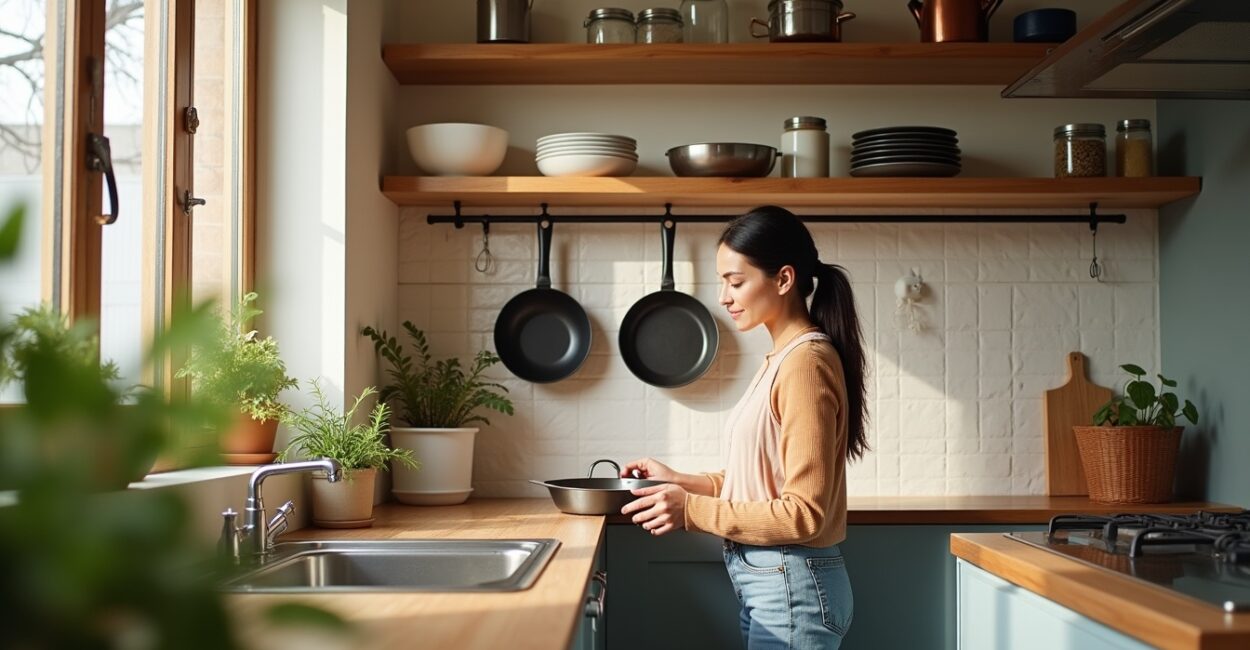
Wall rails can hold 20–50 lbs per linear foot when properly anchored, turning a 3-foot stretch into a command center for pots, cutting boards, and spice rails. Pick a rail with a 16-gauge steel profile and mount into studs; for drywall-only installs use toggle anchors rated for at least 50 lb each. Keep pans under 10–12 inches in diameter on hooks to reduce torque. Imagine swapping a cluttered drawer for a visible, reachable wall—cooking becomes faster and the counter stays clear.
Floating Shelves That Feel Light but Carry a Lot
Floating shelves with internal steel brackets can support 30–70 lbs depending on depth and mounting. Use 8–10″ depth for plates and bowls, 12–14″ for small appliances. The key is spacing: stagger shelves so the lip of the lower shelf doesn’t block access to the upper one. A good rule: place frequently used items on shelves between 36–60″ from the floor. Before you buy, compare shelf depth vs. appliance footprint—expect a surprising 30% gain in usable surface by choosing vertical layering instead of one wide shelf.
Magnetic Racks and Bars: Small Things, Big Impact
Magnetic knife strips and spice bars free up drawer volume without heavy hardware. A magnetic knife strip needs at least a 6–8″ overlap with the blade to be secure; most hold 5–10 knives safely. Magnetic spice rails with steel-can lids simplify labeling and access. Avoid sticking heavy cast-iron to magnets—it’s a common mistake. Instead, reserve magnets for stainless steel and light items. The result: immediate visual order and a 40–60% faster meal prep because everything is where your hands expect it.
Pegboards and Modular Panels for Clothesline-style Flexibility
Pegboards convert blank vertical space into a custom grid that adapts as needs change. Opt for metal or heavy-duty hardboard and use pegs rated per kit—typically 10–25 lbs per peg depending on material. The advantage is modularity: baskets, hooks, and shelves can be moved without resizing. A small experiment: swap a lower rack to hold a cutting board and a basket above for linens; later move them to fit a blender. That resilience is the point—pegboards grow with your kitchen.
Over-sink and Over-stove Shelves That Respect Steam and Grease
Over-sink shelving should be corrosion-resistant and allow airflow. Stainless steel or powder-coated racks 6–8″ above the faucet keep drying racks and soap accessible without splashing. Over-stove shelves require a non-flammable material and a minimum clearance that follows your hood’s specs—normally 24–30″ above the cooktop. A frequent error: installing closed shelves above a stove where heat and grease accumulate; open wire or slatted shelves avoid grime buildup and make cleaning painless.
Slim Tall Units: Storage That Fits a Narrow Gap
A 6–12″ wide pull-out pantry often uses spaces you didn’t know you had. These slim tall units typically hold 30–80 lbs per shelf when anchored to floor and wall. Fit one between fridge and wall or beside a counter. Use pull-out baskets and adjustable shelves so heavy cans live lower and spices higher. Before drilling, measure the gap at three heights—floors and walls shift—and subtract ¼” for clearance. The payoff: pantry-level storage in a footprint the size of a broom closet.
Ceiling-hung and Rail-mounted Pot Racks for Visual Drama
Ceiling-hung pot racks free cabinet space but demand careful load planning. A single rack with six medium pots can easily weigh 35–60 lbs; anchor to ceiling joists or use toggle systems rated well above the expected load. For apartments where anchors are limited, consider rail-mounted alternatives attached to studs on an inner wall. The visual effect is bold—your cookware becomes part of the room’s design—so balance aesthetics with safety: heavier, low handles toward the back; lighter pans forward.
Common mistakes to avoid:
- Mounting heavy rails into drywall alone—use studs or proper anchors.
- Putting closed cabinetry over stoves where heat and grease accumulate.
- Overcrowding shallow shelves so items fall forward.
- Ignoring clearance for appliance doors and drawer swings.
Quick comparison (expectation vs. reality): many people assume maximizing cabinets is the answer; in reality, adding vertical systems like rails and magnetic strips often frees more usable space than a single extra cabinet because items stay visible and accessible. One mini-story: a friend living in a 420 sq ft studio hung a 4-foot rail and two floating shelves; within a weekend the counter was clear, the toaster found a home, and he stopped using a storage cart—suddenly cooking didn’t feel like reorganizing a closet.
For measurements and safety specs, consult manufacturer load charts and trusted building guides. For example, Consumer Reports covers appliance clearances and safety, and NIOSH provides data on safe lifting and load handling that helps when estimating shelf loads.
Install vertical storage with a plan: map where you reach naturally, measure clearances in three spots, and prioritize anchors over aesthetics when strength is required. Do it once, do it right, and your small kitchen will feel like a well-edited space rather than a crowded one.
Think of vertical storage as intentional architecture: it dictates how you move, cook, and live. A single well-placed rail can change how you use the entire kitchen—so pick anchors, measure twice, and let the walls work for you.
How Deep Should Floating Shelves Be for Everyday Dishes?
For everyday plates and bowls, 8–10 inches of depth is usually enough; it keeps items visible and reachable without creating a heavy overhang. If you plan to store small appliances like a blender or toaster oven, increase depth to 12–14 inches and ensure brackets or internal supports are rated for the added weight. Always mount into studs when possible; if you must use anchors, pick heavy-duty toggles rated above the combined expected load. Finally, leave 10–12 inches of vertical spacing between shelves for bowls and short appliances.
Can Magnetic Knife Strips Damage My Knives or Wall?
Magnetic strips are safe for stainless and carbon-steel knives if installed properly. Use a strip with sufficient magnetic depth so blades sit securely without sliding; a 6–8 inch contact along the blade is ideal. To protect knife edges, position the strip so you lift blades straight off rather than dragging them sideways across the magnet. Mount into studs or use strong anchors to prevent the strip from pulling away. Avoid placing heavy cast-iron on magnets—those can slip and damage both the magnet and underlying wall surface.
What Clearance is Needed for Over-stove Shelving and Why Does It Matter?
>Over-stove shelving must respect heat and grease; typical clearance recommendations are 24–30 inches above the cooktop to prevent heat damage and reduce fire risk. Use non-combustible materials or stainless steel for durability and easy cleaning. Open or slatted shelves work better than closed boxes because they don’t trap heat and grease, which can degrade finishes and create a cleaning nightmare. Always check your hood manufacturer’s specs, since individual ranges and ventilation systems may require different clearances.Are Slim Pull-out Pantries Sturdy Enough for Canned Goods?
Yes—properly built slim pull-out pantries are designed for canned goods and typically support 30–80 lbs per shelf when anchored to floor and wall. The trick is weight distribution: put heavy cans on the lower shelves, lighter items like spices or snacks higher up. Ensure the unit has quality glides with ball bearings for smooth movement under load and check that the pantry can be fixed to studs or floor brackets to avoid tipping. Measure the gap in multiple places to guarantee a snug but functional fit.
How Do I Decide Between Ceiling-hung Racks and Wall-mounted Systems?
Choose based on load, ceiling structure, and visual impact. Ceiling-hung racks create a dramatic, restaurant-style look and are great for heavy cookware if joists are strong and anchors are correctly installed. Wall-mounted rails and pegboards are safer in rentals or when ceiling anchoring isn’t possible; they’re easier to reconfigure and usually require less invasive installation. Consider how you cook: if you frequently need pots within immediate reach, a ceiling rack can be ideal, but for versatility and lower installation risk, wall systems often win.