

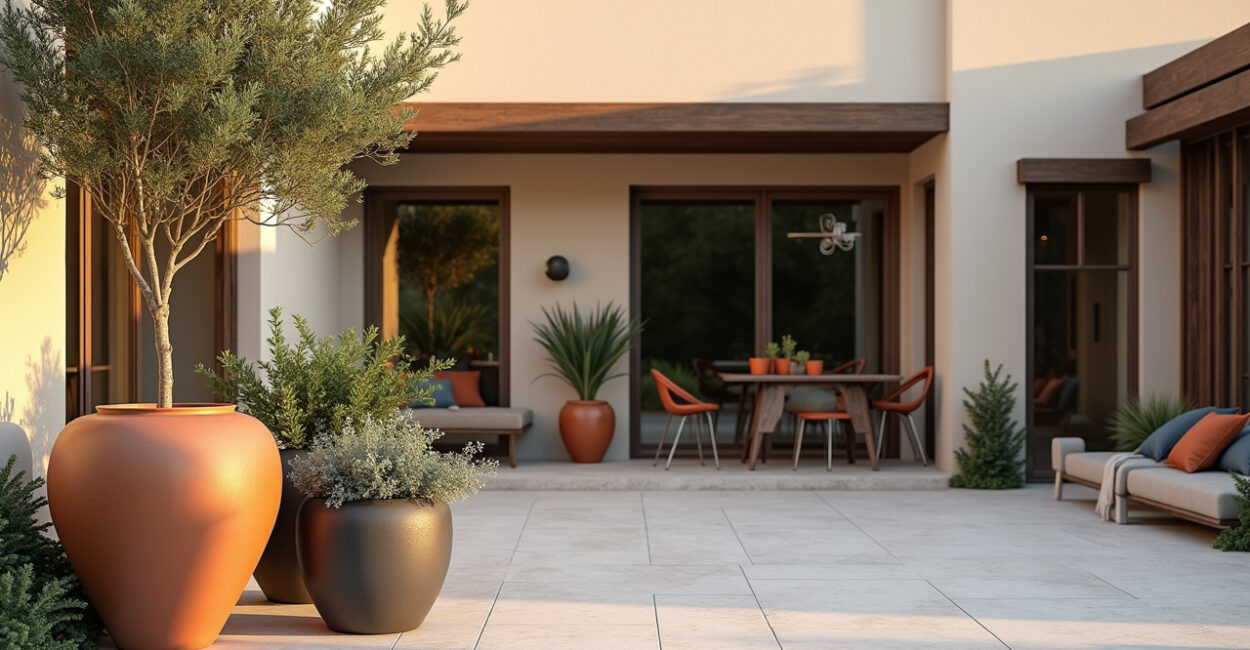
A patio can look finished with just three well-placed containers, or it can look crowded with ten. The difference is not how many pots you buy; it is how you style potted plants for patios so the arrangement feels deliberate, scaled to the space, and tied to the architecture around it.
That is the practical side of container design: shape, height, color, repetition, and breathing room. In this guide, you will get a clear, usable system for making patio pots look intentional instead of random, with ideas you can apply on a small balcony, a hardscaped courtyard, or a large outdoor dining area.
O Essencial
- Patio containers look high-end when they repeat a limited color palette, vary height on purpose, and leave visible negative space.
- The best pot arrangement starts with scale: a few larger containers usually outperform many small ones because they anchor the eye.
- Matching the plant’s growth habit to the container shape matters more than choosing trendy pots; upright, mounded, and trailing forms should each have a role.
- Most weak patio setups fail because the pots are treated as separate objects instead of one composition tied to furniture, pathways, and light.
- Good container styling is seasonal, not static. Replacing one or two plants or accessories is enough to refresh the whole patio.
How to Style Potted Plants for Patios with Proportion and Flow
The formal definition is simple: container styling is the planned arrangement of plant material, vessels, and surrounding objects so the composition reads as one visual unit. In plain English, it means your pots should look like they belong together and belong on that patio.
The first decision is scale. A tiny planter beside a large sectional will disappear; a massive urn in a narrow passage can choke the space. On compact patios, two or three substantial containers usually work better than a scatter of small ones. On larger patios, you can build a stronger rhythm by repeating one pot shape in different sizes.
Start with the Sightlines, Not the Plants
Walk the patio the way a guest would. Where does the eye land first? Around a dining table, the most successful containers usually sit at the edges, not in the center, because they frame the room without interrupting it. Near a doorway, a pair of pots can mark the transition and make the area feel finished before anyone notices the individual plants.
Use Repetition to Create Calm
Repetition is what stops a patio from looking pieced together. Repeating the same pot material, the same family of leaf shapes, or the same color tone gives the eye a path to follow. That is why a row of terra cotta pots with mixed herbs often looks more refined than a dozen unrelated containers, even when the plants themselves are ordinary.
What makes patio containers look intentional is not variety alone; it is controlled repetition with one clear visual rule.
Choose Pots That Match the Patio’s Style
Pots are not just vessels. They are part of the design language of the space. A glazed ceramic urn says something very different from a black fiberstone cylinder or a weathered terracotta bowl. If the patio already has strong materials such as concrete, brick, or natural stone, the container finish should either complement that texture or provide a clean contrast.
For a modern patio, matte finishes and simple silhouettes usually read best. For a farmhouse or Mediterranean look, terracotta, aged metal, and more sculptural shapes fit naturally. If the patio furniture is visually busy, keep the planters quiet. If the furniture is minimal, the containers can carry more personality.
Pick One Dominant Pot Material
The easiest way to avoid visual clutter is to commit to a dominant material and use it repeatedly. That could be ceramic, terracotta, concrete, or resin. Mixing materials can work, but only when the mix is intentional and limited. Too many finishes make even expensive pots look like leftovers.
Let the Pot Shape Echo the Architecture
Rounded pots soften sharp patios. Square or tapered containers reinforce clean lines. Tall cylinders work well near steps or railings because they extend the vertical rhythm of the structure. This is a small detail, but it changes the whole read of the patio.
For patio-safe placement and drainage planning, the Iowa State University Extension and Outreach guidance on drainage is worth a look; poor drainage is one of the fastest ways to ruin a container display.

Build Color Stories That Feel Intentional
Color is where many patio arrangements go off the rails. A great patio usually follows a restricted palette: one neutral base, one plant-foliage tone, and one accent color. That approach creates cohesion without making the space feel stiff. If everything is bright, the containers compete. If everything is neutral, the patio can feel flat.
Use flowers as accents, not as the foundation of the design. Foliage is what holds the composition together across the season. Silver leaves, deep burgundy, chartreuse, and glossy green each create a different mood, and they often do more work than blooms do.
Repeat One Accent Color in at Least Two Places
If you choose cobalt blue pots, echo that blue in a cushion, side table, or lantern. If you choose warm terracotta, repeat it in a pillow stripe or outdoor rug detail. That echo is what makes the patio feel designed instead of decorated in separate passes.
Keep Bloom Colors Aligned with the Container Finish
White flowers look crisp in black, gray, and cobalt pots. Coral and red flowers feel richer in clay and bronze finishes. Lavender, sage, and white combinations usually work almost anywhere because they bridge warm and cool surfaces. This is one reason designers lean on restrained palettes: they are easier to sustain over a long season.
A patio palette feels expensive when the pot color, foliage color, and furniture tone all support the same mood.
For a broader horticultural reference on plant selection and seasonal performance, the Penn State Extension garden resources are reliable and practical, especially when you want to match plant choices to sunlight and care demands.
Layer Height and Texture Like a Designer
Good container design has a vertical structure. The formula is straightforward: thriller, filler, and spiller. That older framework still works because it maps to how the eye reads a container from a distance. The thriller gives height, the filler builds mass, and the spiller softens the edge.
Not every pot needs all three roles, though. A single sculptural grass in a tall planter can be enough. A low bowl of mixed succulents may not need a spiller at all. The rule is not to force a formula; the rule is to create a clear silhouette that looks stable from the patio seating area.
Mix Leaf Textures Before You Mix Flower Colors
Texture is what makes a planting feel full even when bloom time is over. Pairing glossy leaves with feathery foliage, or broad tropical leaves with fine trailing stems, gives the container depth. Who works with container gardens long enough learns this quickly: texture carries a design through weather, gaps, and seasonal lulls better than flowers do.
Use Height Changes to Guide Movement
One tall planter near a corner, two medium pots along a wall, and a low planter near seating create an easy visual progression. That progression matters because it helps the patio feel bigger and more orderly. Flat, same-height arrangements tend to look static, while layered heights create momentum.
- Use the tallest container as a focal point near an entry, corner, or end of a path.
- Place mid-height pots where they can frame furniture without blocking conversation.
- Keep low bowls or trailing plants near edges, steps, or tabletops.
Arrange Containers Around Furniture and Traffic Paths
A common mistake is styling pots as if the patio were a plant showroom. In practice, the patio has jobs: people walk through it, sit in it, and set things down on it. Containers should support those functions, not fight them.
Leave enough room for chairs to pull back and for feet to move without brushing foliage. If a planter sits in a traffic lane, it will feel annoying no matter how beautiful it is. The best patio arrangements create edges, corners, and anchors rather than obstacles.
Use Pairs to Frame, Singles to Punctuate
A pair of containers works well beside a doorway, on both sides of a bench, or at the entrance to an outdoor room. A single bold pot is better when you need a punctuation mark, such as at the end of a path or beside a sculptural chair. The difference is subtle, but it changes the whole rhythm of the space.
Mini-example: a narrow townhouse patio with one dining set and a grill looked cluttered with six small pots. When the layout was edited to two large planters by the fence, one narrow trough along the back wall, and a single herb pot on the table, the patio felt larger immediately. Nothing magical changed. The circulation cleared, the eye had fewer targets, and the plants finally read as a composition.
Seasonal Refreshes That Keep the Patio Polished
A polished patio is not frozen in one look. It changes with the season, but the structure stays consistent. That is why the most successful container gardens keep a stable backbone of pots and swap out secondary plants, accent flowers, or accessories as weather shifts.
This is where many people overdo it. You do not need a full redesign every few months. Changing one thriller, replanting the front edge, or updating the pot groupings can be enough to make the whole space feel current.
Plan for Three Seasonal Jobs
- Spring: add fresh color and faster-growing plants that fill out quickly.
- Summer: prioritize heat tolerance, watering consistency, and fuller silhouettes.
- Fall: use richer foliage, grasses, and sturdier textures that hold up as temperatures drop.
Know When the Method Fails
Not every patio benefits from a dense plant display. Very windy sites can shred soft foliage. Deep shade can make flowering containers underperform. Extremely hot, reflective patios can dry out pots too quickly unless irrigation is consistent. In those cases, fewer containers with tougher plants usually look better than forcing a lush scheme that constantly struggles.
The best seasonal container display is the one that still looks composed after heat, wind, and watering mistakes.
Low-Maintenance Plant Combinations That Still Look High-End
Low-maintenance does not mean plain. It means choosing plants that hold form, tolerate the site, and keep looking tidy between waterings. For many patios, that means combining one structural plant with a mass of reliable filler and a trailing edge where appropriate.
If your patio gets strong sun, consider herbs, ornamental grasses, succulents, lantana, or compact flowering annuals that handle heat well. For shade, ferns, coleus, begonias, heuchera, and ivy can provide strong texture and color. The key is matching the plant to the light level before worrying about the color story.
Build Around a Maintenance Level You Will Actually Keep
| Patio condition | Better plant approach | Why it works |
|---|---|---|
| Full sun, high heat | Grasses, succulents, herbs, heat-tolerant annuals | They hold shape and recover faster between waterings |
| Partial shade | Coleus, begonias, heuchera, mixed foliage containers | Color stays strong without constant bloom dependence |
| Deep shade | Ferns, ivy, shade-loving foliage plants | Texture and form matter more than flowers in low light |
A Simple Styling Plan You Can Use Right Away
If you want a reliable way to style potted plants for patios without overthinking it, use this sequence: choose one pot family, choose one palette, vary height, and repeat a few materials instead of introducing new ones every time. That order keeps decisions small and the result coherent.
Think of the patio as a room. The pots are not accessories you place at random; they are part of the architecture of the room. Once that clicks, the rest becomes easier: fewer containers, better scale, cleaner lines, and a space that feels finished even before the furniture is perfect.
The smartest next step is to edit, not add. Pull out one pot that feels off-scale, keep one color group, and regroup the rest into a tighter composition. Then stand back from the doorway and look at the patio as a whole. That viewpoint tells the truth fast.
FAQ
How Many Potted Plants Should a Patio Have?
There is no fixed number, but most patios look better with fewer, larger containers than with many small ones. Two to five well-chosen pots often create more visual order than a crowded collection. The right count depends on the patio’s size, how much walking space you need, and whether the pots are acting as focal points or background structure.
What is the Easiest Way to Make Patio Pots Look Expensive?
Use repetition and restraint. Stick to one or two pot materials, repeat a limited color palette, and vary height on purpose. Expensive-looking container styling usually comes from editing rather than adding, because visual calm reads as more polished than random abundance.
Should All Patio Planters Match?
No, but they should relate to one another. Matching exactly can feel flat, while unrelated pots can look chaotic. A better approach is to share one common thread, such as color, finish, shape family, or material, so the containers feel coordinated without looking identical.
Which Plants Are Best for a Sunny Patio?
Choose plants that tolerate heat and recover well between waterings. Herbs, ornamental grasses, succulents, lantana, and many compact annuals work well in full sun. The exact choice should still match your watering routine and local climate, because even tough plants struggle in containers that dry out too fast.
How Do I Keep Potted Plants from Making the Patio Look Cluttered?
Give every pot a clear job. One can frame a doorway, another can anchor a corner, and another can soften a seating area. If a container does not improve the sightline or the circulation path, it is probably in the wrong place. Clutter usually comes from adding pots without a layout plan.