

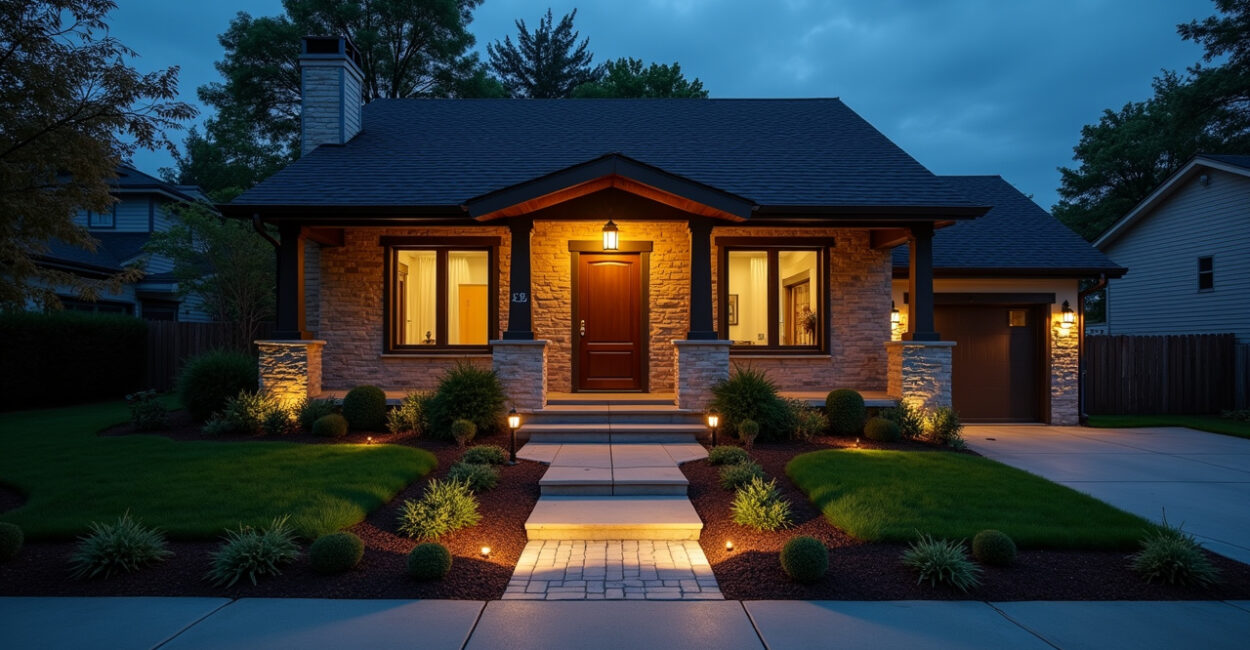
A dark front yard doesn’t just hide your home after sunset — it can also flatten the architecture, make walkways harder to read, and invite avoidable trips. Good DIY front yard lighting ideas solve three jobs at once: safer movement, stronger curb appeal, and a more defined entry that looks finished at night.
The technical term for this kind of lighting is layered exterior lighting: a mix of path lights, accent lights, and entry lighting placed at different heights so the yard feels balanced instead of overlit. In practical terms, that means you do not need a full electrical overhaul to get a big visual upgrade. A few well-placed fixtures, a clean power plan, and the right beam angle can change how the entire front of the house reads from the street.
Quick Take
- Low-voltage and solar fixtures are the fastest DIY options, but low-voltage systems usually give you more consistent brightness and better long-term performance.
- The best front-yard lighting is layered: use path lights for safety, uplights for trees or columns, and a softer glow near the entry.
- Placement matters more than brightness; bad angles create glare, while shielded fixtures make a home look more expensive and calmer at night.
- LED lamps pay off because they run cool, last longer, and reduce maintenance compared with older halogen setups.
- For most front yards, the most common mistake is adding too many fixtures instead of improving spacing, beam spread, and control.
DIY Front Yard Lighting Ideas That Improve Curb Appeal and Safety
If you want the front yard to look intentional after dark, start by thinking in zones: the walkway, the entry, the planting beds, and any architectural focal point such as a porch column or tree. That’s the core of effective DIY front yard lighting ideas; each fixture should have a job, not just exist for decoration.
Who works with this kind of layout every day knows the same rule keeps showing up: light the route first, then the feature. If guests cannot see where to step, a pretty uplight does little good. On the other hand, a path with no visual anchor can still feel flat. The best result usually comes from a simple stack: path lights, one or two accent points, and a modest glow at the door.
Front-yard lighting looks expensive when it is quiet, layered, and directional; it looks cheap when every fixture competes for attention.
What “layered” Means in Real Life
Layering is not a design buzzword. It means using multiple light sources at different heights so the eye can read depth. A low path light marks movement, a mid-height fixture can wash shrubs or a wall, and a narrow-beam uplight can frame a tree or facade. This is the same principle used in professional landscape lighting, just scaled down for a homeowner-friendly install.
Pick the Right Lighting Type for Your Yard
Solar, Low-voltage, and Hardwired: The Practical Differences
Solar lights are the easiest to install because they need no trenching or transformer, which makes them ideal for renters, quick weekend projects, or low-traffic areas. The tradeoff is consistency: winter sun, shade from trees, and cloudy weather can cut output. Low-voltage lighting, by contrast, uses a transformer and 12-volt cable, and it usually gives better brightness control, more fixture options, and a more polished result. Hardwired lighting is the most permanent, but it is rarely the best first DIY move unless an existing circuit already supports it.
| Lighting Type | Best For | Main Tradeoff |
|---|---|---|
| Solar | Fast installs, budget projects, low-use areas | Performance depends on sunlight and battery quality |
| Low-voltage LED | Reliable path lighting, accent lighting, longer runtimes | Requires transformer and cable layout |
| Hardwired | Permanent fixtures and integrated porch lighting | Higher complexity and often more code considerations |
For outdoor electrical safety basics, the U.S. Consumer Product Safety Commission has useful guidance on home wiring and outdoor hazards: CPSC outdoor electrical safety tips. For any buried cable or fixed electrical work, local code and permit rules still matter.
When Solar Works—and When It Does Not
Solar path lights are a smart choice if the front yard gets full sun for most of the day and you only need gentle illumination. They fail when you expect them to behave like wired fixtures under a covered porch, under dense trees, or in northern climates with short winter daylight. In those cases, low-voltage LEDs are the more dependable option, even if the setup takes longer.

Map the Layout Before You Buy Fixtures
Measure the Walking Line, Not the Lawn Edge
A lot of lighting plans fail because they follow the border of the yard instead of the actual route people take. Measure the path from driveway to door, the step edges, and any turns where someone naturally slows down. That gives you the line that matters. For a walkway, spacing often works best when fixtures are placed to guide movement without creating a runway effect. You want a rhythm, not a wall of light.
- Mark the entry path with painter’s tape or stakes before buying anything.
- Identify dark transitions: curb to walk, walk to step, step to porch.
- Check where tree shadows or porch overhangs will cut brightness.
- Decide which feature should be visible from the street first.
Here’s where experience matters: I’ve seen homeowners buy ten path lights for a short front walk and end up with a busier yard but worse visibility. Fewer fixtures, placed with intention, almost always look better. That rule breaks only when the walkway is unusually long, winding, or split by planting beds.
The right lighting plan is built around movement, not decoration; if the route reads clearly at night, the yard already feels upgraded.
Install Path Lights the Way Professionals Think About Spacing
Beam Spread and Spacing Control the Look
Path lights are not just markers. Their beam angle, shield shape, and mounting height decide whether the walk looks elegant or cluttered. A warmer color temperature — usually around 2700K to 3000K — tends to feel more natural around homes than a stark white beam. That warmer tone also reduces the “parking lot” effect that makes residential lighting look harsh.
For regulatory and safety context, the National Fire Protection Association offers homeowner resources on electrical safety and outdoor equipment use: NFPA electrical safety guidance. It’s also worth checking transformer load limits and outdoor-rated connectors before extending any low-voltage system.
A Simple Installation Sequence
- Lay out every fixture before digging or staking.
- Test the spacing at dusk, not in full daylight.
- Adjust positions until the light pools overlap without creating hot spots.
- Hide cable slack and keep connectors above standing water.
- Angle fixtures slightly downward to cut glare and preserve night vision.

Use Accent Lighting to Highlight Plants and Architecture
Trees, Shrubs, and Columns Need Different Treatment
Accent lighting works only when it matches the object. A tree often looks best with an uplight placed off-center at the base so the trunk and canopy get dimension. Shrubs usually need softer, wider light from a lower angle. Porch columns and stone details often benefit from narrow beams that create shadow and texture instead of washing everything flat.
The University of Florida IFAS Extension has practical landscape guidance that helps homeowners think about plant form and placement: UF/IFAS Extension landscape resources. That matters because the plant itself should drive the fixture choice, not the other way around.
A Small Real-world Example
A homeowner with one maple, two boxwood beds, and a narrow front porch tried to light everything at once. The result felt busy. We cut the plan down to three fixtures: one uplight on the maple, two low path lights at the steps, and one soft bulb near the door. The yard looked larger, the porch felt more welcoming, and the eye had a clear place to land. That kind of restraint is often the difference between “lit up” and “well lit.”
Power, Timers, and Smart Controls That Keep the System Useful
Control Matters as Much as the Fixture
A lighting system without control turns into a maintenance project. Timers and photocells save energy and keep your yard from glowing all night when no one is outside. Smart plugs can work for simple setups, but outdoor-rated transformers with built-in timers are usually more reliable for permanent front-yard installations. Motion sensors make sense near garages or side entries, while steady path lighting makes more sense on the main approach to the door.
- Use a photocell if you want lights to turn on automatically at dusk.
- Use a timer if you want the system to switch off after a set number of hours.
- Use motion activation only where you need short bursts of light.
- Keep the transformer accessible so seasonal adjustments do not become a hassle.
There is a real limit here: smart controls are useful, but they do not fix bad placement or poor fixture choice. A weak solar lamp with a motion sensor is still a weak light. Start with the layout, then add automation.
Common Mistakes That Make Front Yard Lighting Look Worse
More Brightness is Not the Answer
The fastest way to make a front yard look amateurish is to overlight it. Too many fixtures create glare, flatten the facade, and make the landscaping disappear. Another common mistake is using mismatched color temperatures, which makes one area look warm and another look blue. Mixing solar fixtures with bright cool-white LEDs often creates that problem. Consistency matters more than raw wattage.
- Do not point lights directly into the eyes of visitors or drivers.
- Do not line every edge of the yard with identical fixtures.
- Do not choose a beam angle before measuring the object you want to light.
- Do not ignore maintenance access for batteries, lenses, and connectors.
One more caution: these methods work well for typical suburban front yards, but they can fail on steep lots, very dark rural drives, or homes with heavy shade. In those cases, brightness, cable runs, and fixture placement need more planning than a weekend project usually allows.
What to Do Next for a Cleaner Nighttime Look
The smartest move is to treat the front yard like a sequence, not a single scene. First make the path safe. Then give the house one or two visual anchors. After that, decide whether you want automation, solar convenience, or a more permanent low-voltage setup. That order keeps you from overspending on fixtures that do not improve how the property actually works after dark.
If you are starting from scratch, sketch the walk, pick one focal point, and install only the lights that serve those two jobs first. From there, refine the spacing and brightness after one full night test. That is the cleanest way to turn DIY front yard lighting ideas into a result that looks intentional instead of improvised.
Frequently Asked Questions
How Many Lights Do I Need for a Small Front Yard?
A small front yard often needs fewer fixtures than people expect. In many cases, four to six well-placed lights are enough to mark the path, define the entry, and add one accent point. The goal is coverage with restraint, not full brightness across every square foot. If the walkway is short and the porch is close to the curb, spacing and beam angle matter more than adding extra lamps.
Are Solar Lights Good Enough for Front Walkways?
Solar lights can work well on front walkways if the panels receive several hours of direct sun and the area does not need strong, all-night illumination. They are best for soft guidance and decorative effect. If you want dependable brightness in winter, under trees, or near a shaded porch, low-voltage LED fixtures usually perform better. The deciding factor is not the brand name; it is the amount of usable sunlight the fixture gets every day.
What Color Temperature Looks Best Outside a House?
For most homes, a warm color temperature between 2700K and 3000K looks most natural. It tends to flatter brick, stone, wood siding, and plantings without producing the bluish cast that can make a front yard feel cold. Cooler light can work in modern designs, but it is easier to overdo. Warm light also reduces glare in the eye, which is one reason residential landscape lighting often feels more welcoming at that range.
Can I Install Low-voltage Lighting Myself?
Yes, many homeowners can install a low-voltage system themselves, especially if the layout is simple and the transformer is outdoor-rated. The key is to plan the cable route, avoid overloading the transformer, and use proper outdoor connectors. If the job requires trenching near utilities, modifying household wiring, or hardwiring a new circuit, that crosses into territory where local code and permits matter. Simpler systems are the safest place to start.
How Do I Keep Front Yard Lights from Looking Harsh?
Use shielding, downward angles, and moderate brightness. Harsh lighting usually comes from bare bulbs, overly cool color temperatures, or fixtures aimed straight at the viewer. Keep the light focused on the object or path, not the eyes. In practice, a few softer pools of light with dark space between them often look more polished than a fully illuminated yard. That contrast is what gives the scene depth at night.