

Small Apartment Kitchen Storage Hacks That Clear Counters
How to clear clutter fast in a small apartment kitchen by maximizing vertical space, organizing cabinet interiors, using wall zones, and keeping counters for…
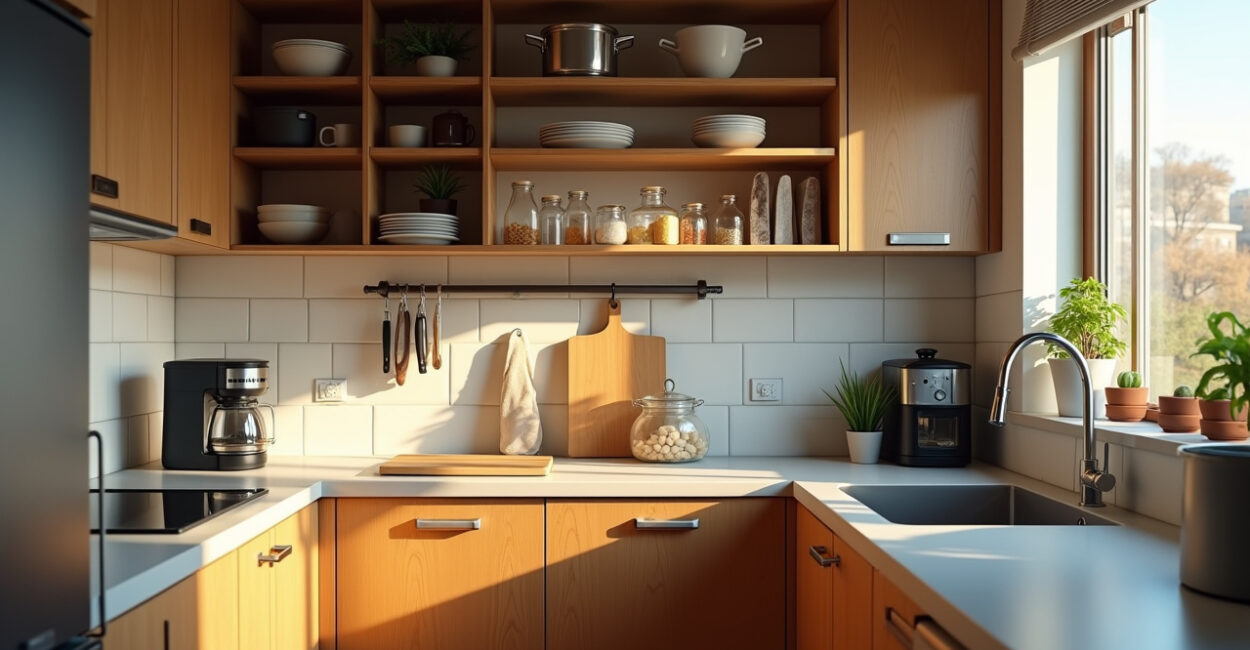
In a small kitchen, the real problem usually isn’t square footage—it’s wasted vertical space, dead corners, and items stored where they get in the way. The best small apartment kitchen storage hacks are not about buying more bins; they are about changing how the room works so counters stay clear and cooking feels less cramped.
That means using cabinet interiors more intelligently, moving a few tools onto the wall, and reserving counter space for the things you actually use every day. Done well, this turns a tight galley or studio kitchen into a room that feels calmer, faster to cook in, and easier to keep clean.
O Que Você Precisa Saber
- Storage in a small kitchen works best when you prioritize vertical space, cabinet interiors, and wall-mounted zones before adding new furniture.
- The biggest clutter win usually comes from removing duplicate tools and assigning every item a fixed “home” based on cooking frequency.
- Under-sink space is rarely a storage dead end; with the right risers and pull-out bins, it becomes one of the most useful zones in the kitchen.
- A small kitchen feels larger when countertops hold only daily-use items, because visual clutter affects how crowded the room feels.
- The best setup is not the one with the most containers; it is the one that lets you reach what you need without stacking, shifting, or unnesting three things first.
Small Apartment Kitchen Storage Hacks That Clear Counters Fast
Technically, kitchen storage optimization means increasing usable storage capacity without increasing the room’s footprint. In plain English, you are making cabinets, walls, doors, and gaps do work that your counters are doing now. That matters because counter space is the most visible “problem area” in a tiny kitchen, and once it fills up, the whole room feels smaller than it is.
In practice, the fastest wins usually come from three moves: lift items off the counter, group by task, and store vertically whenever the item allows it. A dish rack that never leaves the counter, a toaster that stays plugged in but not used daily, or a cutting board leaning against a backsplash all steal working room. Move those items into a defined storage system and the kitchen changes almost immediately.
If you want a reference point for safe, sensible food storage habits, the USDA’s FoodKeeper guidance is useful because it helps you separate what needs quick access from what can live deeper in a cabinet or pantry zone. That distinction matters more in a studio kitchen than in a large house.
The biggest space gain in a small kitchen comes from removing “temporary” counter items that never truly leave the counter.
Cabinet Organizers That Actually Change Daily Use
Cabinet organizers are worth it only when they reduce motion. If they make you bend, stack, or unstack more than before, they are decorative clutter. The best ones solve access problems: drawer dividers, shelf risers, pull-out trays, and lazy Susans. These are not fancy upgrades; they are friction reducers.
Use Shelf Risers to Double Usable Height
Shelf risers work well for mugs, small bowls, spice jars, and stacked plates because they turn one open shelf into two levels. They fail when you put oversized items under them and create a low, awkward gap that nothing fits in cleanly. That’s the tradeoff: risers add structure, but only if you measure the shelf first.
Choose Pull-Out Bins for Deep Cabinets
Deep cabinets are where items disappear. Pull-out bins solve that by bringing the back row forward, which is especially useful for wraps, snacks, cleaning supplies, and backup paper goods. Who works with small kitchens every day knows that “out of sight” quickly becomes “out of mind,” and then you buy duplicates without noticing.
- Use drawer dividers for utensils, peelers, and measuring tools.
- Store lids upright in a dedicated slot so they stop collapsing into piles.
- Keep the heaviest items on the lowest shelves to reduce awkward lifting.
- Reserve one cabinet for overflow only if you can still identify the contents in two seconds.
According to NFPA kitchen safety guidance, keeping combustible clutter away from heat sources is not just neatness; it reduces risk. That is one reason wall-mounted or cabinet-based storage beats counter piles near burners and toasters.

Wall-Mounted Solutions That Free the Most Counter Space
Wall storage is the most underused resource in apartment kitchens because renters assume it requires drilling everywhere. It does not. Between adhesive hooks, rail systems, magnetic strips, and over-the-door mounts, you can move several high-frequency items off the counter without a permanent remodel.
Magnetic Knife Strips Beat Bulky Blocks
A knife block consumes a surprisingly large footprint for the number of tools it holds. A magnetic strip frees that space and keeps blades visible, dry, and easy to grab. The only caution is placement: keep it away from splash-heavy zones and install it high enough that the knives do not block backsplash tasks.
Rails and Hooks Handle the “Always in Use” Tools
A slim rail with hooks can hold measuring cups, small strainers, tongs, or a drying brush. That works because these items are lightweight, repetitive-use tools, not bulky appliances. If you hang too much, the system collapses into visual noise, so the rule is simple: if it’s not used weekly, it probably does not belong on the wall.
Wall-mounted storage works best for light, repetitive-use tools; it fails when people try to hang everything they own.
Read also: Hidden Kitchen Storage for Tiny Apartments: 7 Spots Most People Miss
One renter I worked with had a 6-by-8-foot kitchen and no pantry at all. Her counter was permanently occupied by a utensil crock, a toaster, and a drying mat. We moved the knives to a strip, put mugs on a shallow shelf, and shifted baking tools into one labeled bin inside a cabinet. The counter did not get bigger, but the kitchen finally felt usable.
Under-Sink, Toe-Kick, and Other Hidden Zones
The hidden zones in a small kitchen are where the most efficient storage usually hides. Under the sink, toe-kick space, the side of a fridge, and the gap above upper cabinets can all carry useful items if you match the zone to the item’s shape and frequency. This is where many apartment kitchens either become organized or stay frustrating forever.
Use Under-Sink Space for Tall, Shaped Items
The cabinet under the sink is often split by plumbing, which makes people give up on it too early. It still works for spray bottles, trash bags, dishwasher tabs, microfiber cloths, and a slim caddy. Stackable bins help, but only if they do not block the pipes or make it hard to lift out the back row.
Turn Toe-Kick Space Into a Low-Friction Drawer
Toe-kick drawers are one of the smartest upgrades in very tight kitchens because they use a strip of space that is otherwise wasted. They are ideal for sheet pans, placemats, and flat backups. This is a niche solution, and it is not always cheap, so it makes most sense in a long-term apartment or a place where the kitchen will be used heavily.
| Hidden Zone | Best For | Not Ideal For |
|---|---|---|
| Under the sink | Cleaning supplies, liners, cloths | Food, paper items, anything moisture-sensitive |
| Toe-kick drawer | Flat trays, sheet pans, placemats | Bulky cookware or loose jars |
| Fridge side | Spice racks, thin shelves, hooks | Heavy items or heat-sensitive goods |
| Above cabinets | Rarely used serving pieces | Daily cooking tools |

How to Store Cookware, Dishes, and Pantry Items Without Stacking Chaos
Cookware storage breaks down when every item is stored by category instead of by use. Most people do not need “all pans together”; they need the one pan they use often to be reachable without moving four other things. The same logic applies to dishes and pantry items.
Store by Frequency, Not by Type
Everyday bowls, one skillet, one saucepan, and the most-used pantry staples should live in the easiest reach zone between waist and eye level. Special-occasion bakeware, extra casserole dishes, and backup gadgets can go higher or deeper. That simple shift cuts a lot of the reaching, lifting, and reshuffling that makes small kitchens feel exhausting.
Keep Pantry Categories Tight and Visible
Small pantries work best when categories are narrow: breakfast, cooking oils, baking, snacks, canned goods. The tighter the category, the easier it is to see what you already have. Clear bins help, but only if you avoid overfilling them; a packed clear bin is still a packed bin.
FDA guidance on food safety and storage is a useful check here because it reminds you to keep dry goods, perishables, and cleaning products separated cleanly. That separation matters even more in compact kitchens, where one messy shelf can spread across the whole room.
What to Stop Buying When Space is the Real Constraint
Small kitchens do not need more “storage products” by default. They need fewer low-value items. The fastest way to free space is to stop letting duplicate tools, oversized sets, and novelty gadgets claim precious cabinet real estate.
The Duplicate Trap
If you own three spatulas, two cheese graters, and a backup coffee setup, the problem is not storage. It is excess inventory. Duplicates are hard to justify in apartments because each extra item pushes another one into a less accessible spot, and then the whole system gets harder to maintain.
Bulk Sizes Are Not Always Smart
Buying in bulk seems efficient, but in a small apartment kitchen it can backfire fast. Large containers crowd shelves, block visibility, and create awkward dead space around them. A better rule is to buy the amount you can store cleanly, not the amount that looks cheapest per ounce.
- Replace large utensil crocks with a drawer organizer if the counter is crowded.
- Swap oversized storage containers for nesting sets with matching lids.
- Keep only one or two specialty appliances out at a time.
- Donate tools you have not used in the past six months unless they serve a clear seasonal purpose.
What Usually Fails in Small Kitchens, and What to Do Instead
Not every storage trick works in every apartment. Adhesive products can fail on textured walls, deep pull-outs can become junk traps, and over-the-door racks can interfere with cabinet doors if they are the wrong thickness. That is why the best small apartment kitchen storage hacks are not rigid rules; they are systems you adapt to the room you actually have.
What separates a workable setup from a frustrating one is not the number of organizers — it is whether each storage spot matches the object’s size, weight, and frequency of use. If a solution makes you bend, stack, or move three things to reach one, it will not last. In small kitchens, convenience is not a luxury; it is the mechanism that keeps clutter from returning.
There is also disagreement among organizers about whether open shelving is worth it in tiny kitchens. It can look airy and make daily items easy to grab, but it exposes every mug, plate, and jar to visual clutter. That tradeoff is real, and it depends on how disciplined you are about editing what stays visible.
What to Do Next
Pick one zone and fix it completely before moving to the next. Start with the counter, then the cabinet that frustrates you most, then the hidden space under the sink. If you try to reorganize the whole kitchen at once, you end up making a bigger mess before you make anything better.
The most effective approach is to test one change for a week and keep only the solutions that reduce effort, not just clutter. For anyone living in a rental, that means choosing reversible upgrades first: risers, bins, hooks, strips, and shelf inserts. The goal is a kitchen that stays functional on a busy Tuesday, not one that only looks good the day you finish organizing it.
FAQ
What is the First Storage Fix to Make in a Tiny Apartment Kitchen?
Start with the countertop. Remove anything that does not earn daily use, then move those items into a cabinet, drawer, or wall-mounted spot. The fastest improvement usually comes from eliminating one or two permanent counter occupants, such as a bulky utensil holder or a rarely used appliance. Once the counter clears, the rest of the kitchen becomes easier to assess because you can finally see where the real bottlenecks are.
Are Open Shelves Good for Small Apartment Kitchens?
They can be, but only if you are strict about what stays visible. Open shelves work best for attractive, frequently used items like plates, mugs, or a few pantry staples in matching containers. They fail when the shelf becomes a display for mismatched packaging and rarely used objects. In a very small kitchen, the visual effect matters almost as much as the storage capacity, so open shelving is a tradeoff, not a universal win.
How Do I Organize a Kitchen with Almost No Cabinet Space?
Use the walls, the inside of cabinet doors if possible, and any narrow gaps that can hold slim storage. A magnetic knife strip, rail hooks, adhesive shelves, and under-sink bins can recover a surprising amount of space. The key is to store by frequency of use, not by category alone. If an item is used daily, it needs the easiest access; if it is seasonal or backup-only, it can live deeper or higher.
What Should Never Be Stored on the Countertop in a Small Kitchen?
Anything that is not used almost every day should not live there. That includes extra appliances, duplicate utensils, decorative containers that hold nothing useful, and cutting boards that could stand in a cabinet slot instead. Counters should function like work zones, not overflow shelves. The more you keep them clear, the less crowded the kitchen feels and the easier it is to cook without shifting items around first.
Do Cheap Storage Organizers Work as Well as Custom Solutions?
Sometimes, yes. Cheap organizers work well when the problem is simple, like a drawer divider, shelf riser, or clear bin that improves visibility. They work poorly when they fight the shape of your cabinets or your daily routine. Custom solutions are better for unusual layouts, but they are not always necessary. In many apartments, a low-cost, well-placed organizer beats an expensive system that does not fit the way you cook.