

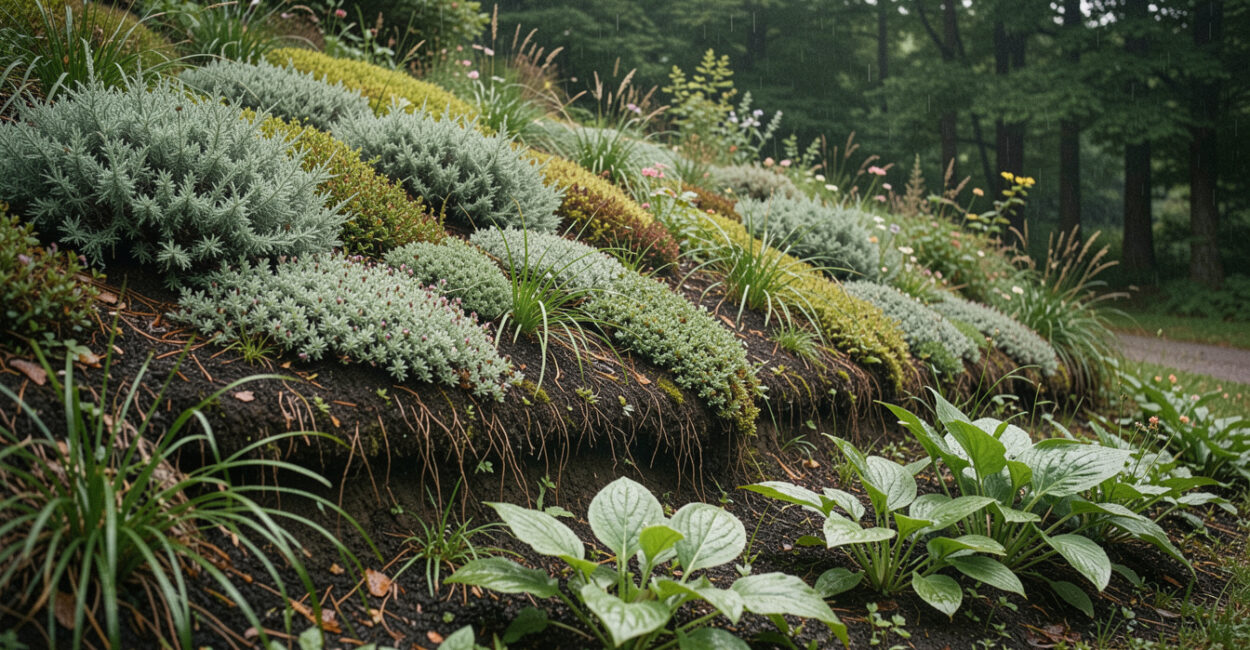
A steep bank can stay bare even when it gets plenty of rain: water may run off before roots have time to knit the soil together. The right slope groundcover depends on the site’s sun, moisture, climate, and how much upkeep you can manage.
For a sunny, dry bank, consider creeping juniper or a regionally native, deep-rooted perennial; for shade, look at Pennsylvania sedge or wild ginger where it suits your climate. On damp ground, choose plants that tolerate moisture, but first check that poor drainage—not a drainage or runoff problem—isn’t driving the erosion.
Before You Choose
- Track how many hours of direct sun the slope gets in summer.
- Check the soil after both a dry spell and a heavy rain: note whether it drains freely, stays moist, or becomes waterlogged.
- Identify your USDA hardiness zone and whether the site has compacted soil, runoff channels, or exposed roots.
- Decide whether you can water and weed during establishment, and whether fast-spreading plants are acceptable in your area.
1. Choose Slope Groundcover for the Site, Not the Slope Alone
The best groundcover for a slope is one that fits its light, soil moisture, climate, and maintenance demands while forming a dense network of roots. For a sunny, dry bank, creeping juniper may suit the site; for a shady, moist slope, wild ginger or Pennsylvania sedge may be better. No plant prevents all erosion, and steep or actively failing slopes may need professional assessment.
Groundcover is a low-growing plant layer that spreads across the soil surface. Its leaves slow raindrop impact, while roots bind soil particles near the surface; deeper-rooted plants can add further anchoring, depending on the species and soil. That protection takes time. A newly planted bank can still erode before plants fill in, especially where runoff concentrates into channels.
Match plants to the slope’s microclimates, too. The upper bank often dries first, while a lower section may collect water. A mixed planting can handle these differences more reliably than forcing one species across the whole incline. For options that also support pollinators, browse this guide to planning a native pollinator landscape.
2. Match Plants to Sunny Slopes
Full-sun slopes need plants that can handle direct light and the extra drying effect of wind and runoff. Creeping juniper (Juniperus horizontalis) is an evergreen choice for well-drained sites; once established, it spreads along the ground and requires little routine pruning. It is a poor fit for wet or persistently shaded soil.
For a flowering option, consider creeping phlox (Phlox subulata) in well-drained soil and a climate where it is hardy. It creates a low mat with spring blooms, though it may need trimming after flowering to keep a tidy edge. In regions where it is native and suited to the site, ground-hugging native perennials can offer stronger ecological value than a nonnative groundcover. The USDA Natural Resources Conservation Service provides regional conservation resources that can help guide plant selection.
Fast spread is not automatically a benefit. Before planting a vigorous groundcover, check whether it is invasive or discouraged locally; a plant that escapes the bank can become a long-term maintenance problem. For a broader approach to species choice, see these ideas for designing borders with native plants.

3. Select Groundcovers for Shady Slopes
Shade changes the shortlist, but it does not mean every shaded slope stays moist. Tree roots can compete for water, and the soil beneath mature trees may be dry even after rain. Pennsylvania sedge (Carex pensylvanica) can work in dry to average shade where it is regionally appropriate. Wild ginger (Asarum canadense) suits moist, shaded woodland conditions in parts of eastern North America, but its range and growing requirements matter.
For a ground layer with a different look, consider native woodland plants suited to your region rather than relying on one universal “shade groundcover.” Check mature height and spread, and leave room for plants to fill in. The University of Minnesota Extension offers research-based gardening guidance; consult your own state extension service for recommendations tailored to local conditions.
On a shady bank, the soil’s moisture and tree-root competition matter as much as the amount of sunlight.
4. Choose for Dry or Damp Soil
For a dry slope, prioritize plants that tolerate well-drained soil and the site’s winter temperatures. Creeping juniper is an option for sunny, dry banks; in shade, a suitable regional sedge may perform better. Even drought-tolerant plants need water while their roots establish, so plan for temporary irrigation rather than expecting new transplants to fend for themselves.
For consistently moist soil, select species that tolerate the conditions without assuming they can fix drainage. A plant suited to damp ground may still fail where water sits for long periods or flows in a concentrated stream. If the bank is saturated after ordinary rain, investigate the source of the water before planting.
Consider a common site: the top of a bank dries quickly beneath afternoon sun, while the bottom stays wet after storms. Planting creeping juniper from top to bottom would ignore those different conditions. A better plan would match the upper section to a drought-tolerant plant and reserve moisture-tolerant species for the lower area, provided the soil is not waterlogged.
For plants that support bees on sunny sites, this guide to native bee plants for sunny gardens can help you consider local options alongside erosion control.
5. Compare Spread, Upkeep, and Rooting
Spread and soil-holding ability are not the same thing. A plant may spread quickly by creeping stems but have shallow roots; another may establish more slowly while developing a useful root network. The table gives general tendencies, not guarantees: cultivar, soil, climate, and establishment conditions affect performance.
| Plant | Best-fit conditions | Spread and upkeep | Soil-holding role |
|---|---|---|---|
| Creeping juniper | Full sun; dry to average, well-drained soil | Moderate spread; low pruning once established | Low, spreading woody branches and roots cover the surface |
| Creeping phlox | Sun; well-drained soil | Moderate spread; occasional trimming | Forms a low mat that helps cover exposed soil |
| Pennsylvania sedge | Shade to part shade; dry to average soil in suitable regions | Gradual spread; generally modest upkeep | Fine, fibrous roots help bind surface soil |
| Wild ginger | Shade; moist, humus-rich soil in its suitable range | Gradual spread; little shaping needed | Rhizomes help create a spreading ground layer |
For erosion-prone sites, combine groundcover with other measures when appropriate. The U.S. Forest Service shares information on vegetation and land management, but the right treatment depends on the slope’s condition. A plant list cannot diagnose an unstable bank or substitute for drainage work where runoff is the main cause.
6. Plant and Establish the Groundcover
Planting technique matters because the most vulnerable period is the gap between installation and full coverage. Start by removing weeds and correcting obvious runoff paths; avoid broad, deep disturbance on a steep bank, which can loosen more soil. Plant on a cool, calm day when the soil is workable, and follow the nursery’s spacing guidance for the species and container size.
- Mark planting spots in staggered rows across the slope, rather than arranging straight lines downhill.
- Dig individual holes just deep enough for each root ball, firm the soil gently, and water each plant in.
- Protect exposed soil between plants with a suitable, erosion-control blanket or a thin layer of mulch that will not slide in rain.
- Water during establishment when the soil begins to dry, then adjust as roots grow and local rainfall allows.
A useful sign of progress is new growth combined with fewer bare patches and no widening rills after rain. Check the bank after storms. If water cuts channels between plants, add temporary surface protection and address how runoff reaches the slope; simply adding more plants may not solve the cause.
7. Avoid Common Failures and Adjust the Plan
Planting too sparsely is a common mistake. Widely spaced plugs can leave soil exposed for a long time, yet packing plants too tightly raises costs and may create crowding later. Use the recommended spacing for the chosen species, and remember that fast-growing plants may need edging or periodic thinning.
Another frequent problem is treating every bare patch as a plant-selection issue. Compacted soil, shade from overhanging trees, deer browsing, poor drainage, and concentrated roof or driveway runoff can all limit establishment. If plants repeatedly fail in the same strip, investigate the site before replacing them with more of the same.
Groundcover reduces erosion risk as it establishes; concentrated runoff and unstable soil may require more than planting.
Choose a plant suited to the slope’s toughest section, then check the rest of the bank for meaningful differences in sun and moisture. Before buying, verify regional hardiness and invasive-plant guidance, and make a simple sketch showing planting zones and water access. That small assessment gives roots a better chance to do their job.
📱 See this content as a Web Story
Frequently Asked Questions
How Quickly Will Groundcover Protect a Newly Planted Slope?
There is no single timeline. Fill-in depends on species, spacing, weather, and how well the plants establish; provide temporary erosion protection until the soil is covered.
Can I Plant Groundcover on a Very Steep Bank?
Often, but slope steepness, soil type, and water flow affect whether planting alone is appropriate. If the bank is slumping, cracking, or carrying concentrated runoff, get the cause assessed before relying on plants for stabilization.
Should I Use One Groundcover Across the Entire Slope?
Use one species only when the light, drainage, and soil conditions are fairly consistent from top to bottom. Many banks have a drier upper edge and a wetter toe, so separate planting zones may establish more successfully.