
Low-Carbon Commuting Options for Everyday Travel
How low-carbon commuting choices like walking, cycling, public transit, and carpooling reduce emissions by combining shorter car-free trips and better planni…
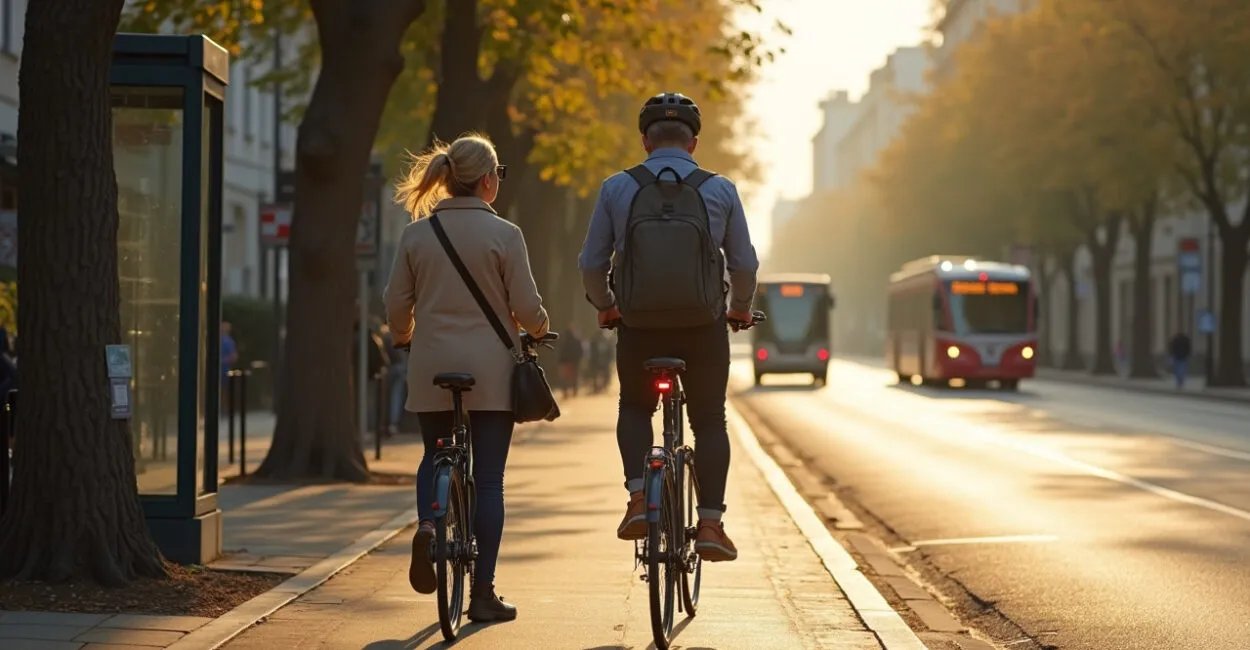 Commuters with a folding bicycle beside a city bus stop
The fastest way to cut commute emissions is often not buying a new gadget; it is changing the trip itself. The most effective low-carbon commuting choices for daily travel usually combine short car-free legs, fewer solo miles, and better trip planning, which is why they can reduce both pollution and monthly costs without making your schedule harder.
That matters because commuting is one of the few parts of daily life where small behavior shifts add up quickly. A two-mile drive every weekday does not sound like much until you stack it across a year, fuel prices, parking, and maintenance. This article breaks down the practical options, where each one works best, where it falls short, and how to choose the right mix for real-world routines.
Quick Take
- Walking and cycling have the lowest operating emissions of any commute option, and they also eliminate parking costs, which makes them the best choice for short urban trips.
- Public transit usually beats solo driving on carbon per passenger-mile, especially when buses and rail carry high occupancy and run on cleaner grids.
- Carpooling and ride-sharing can cut emissions substantially if they replace single-occupancy car trips, but the benefit shrinks when detours are long or riders are poorly matched.
- E-bikes and e-scooters can be the highest-convenience low-carbon option for middle-distance commutes, especially where hills, heat, or time pressure make regular cycling unrealistic.
- The lowest-cost commute is not always the lowest-carbon one; the best option is the one you can repeat consistently five days a week.
How Low-Carbon Commuting Choices for Daily Travel Actually Reduce Emissions
Formally, a low-carbon commute is any regular trip to work, school, or another fixed destination that produces fewer greenhouse gas emissions than a typical solo gasoline-car trip. In plain English, it means replacing unnecessary car miles with walking, cycling, transit, shared rides, or cleaner vehicles where those options fit your life.
The mechanism is straightforward: emissions drop when you remove fuel combustion, increase occupancy, or use electricity more efficiently per passenger. The numbers vary a lot by city, speed, occupancy, and energy source, so the “best” option is not universal. What works in a dense downtown can fail in a suburb with no sidewalks and a 6:45 a.m. start time.
The U.S. Environmental Protection Agency’s overview of transportation emissions is a useful baseline for understanding why commuting matters in the first place: EPA transportation and climate change. If you want the cleanest commute on paper, you usually want fewer vehicle miles traveled and more passengers per vehicle.
The biggest commute gains come from reducing solo vehicle miles, not from making the same drive feel slightly greener.
Why Distance and Frequency Matter More Than Most People Think
A commute of 1.5 miles is a completely different problem from a 15-mile trip. Short trips are where walking, cycling, and e-bikes become realistic; longer trips often push people toward rail, bus rapid transit, carpooling, or a hybrid approach. Frequency matters too. A three-day hybrid schedule can justify a different setup than a five-day office routine, because the daily pain point changes.
Walking and Cycling: The Cleanest Option When the Route Cooperates
For short trips, walking is the gold standard and cycling is the close second. Both options have near-zero operational emissions, no fuel cost, and no parking hunt. If your commute is under about three miles, these are often the simplest low-carbon commuting choices for daily travel because they avoid the “extra time tax” that makes other green options hard to sustain.
When Walking Wins
Walking works best when your route is direct, safe, and predictable. It is underrated for people who live near transit hubs, because a 10-minute walk to the station can replace a car trip entirely. It also helps when you need almost no gear and can tolerate weather with the right clothing.
When Cycling is the Smarter Move
Cycling tends to beat walking once distance rises beyond what you want to do on foot, especially if your city has protected bike lanes, low-speed streets, and secure parking. A commuter bike, city bike, or cargo bike can handle groceries, laptop bags, and even school drop-off. In practice, the ride becomes much more repeatable when the bike has fenders, lights, and a simple repair kit.
We have seen commuters give up on cycling not because the ride was hard, but because the arrival experience was miserable: no secure place to lock up, wet clothes, or no backup plan after a flat tire. Those details matter more than idealistic carbon math.
Walking and cycling are not “fitness lifestyle” choices first; they are transport choices that work best when the infrastructure makes them routine.

Public Transit, Rail, and Bus Networks as the Backbone of Lower-Carbon Commuting
Public transit usually delivers lower emissions per passenger than driving alone because it spreads energy use across many riders. The exact savings depend on occupancy and vehicle type, but a full bus or train nearly always outperforms a single-occupant car. That is why systems such as light rail, commuter rail, metro, and bus rapid transit can become the backbone of urban decarbonization.
The practical question is not whether transit is theoretically greener; it is whether it matches your schedule. A bus that runs every 7 minutes is a tool. A bus that comes every 30 minutes is a commitment. Riders notice the difference immediately, especially in bad weather or when a transfer is involved.
For a credible source on transit and climate benefits, the American Public Transportation Association’s transit and environment research is a solid starting point. You can also check your local transit agency’s service maps before deciding whether rail or bus is a realistic daily option.
Transit Works Best When You Combine It with a Short Access Mode
One of the most effective commute patterns is a “walk-bike-transit” chain: walk or bike to a station, ride rail or bus, then walk the last block. That reduces car dependence without requiring every leg to be perfect. This is where bike-share docks, secure station parking, and protected sidewalks add real value.
Commute option
Best use case
Main limitation
Bus
Flexible city trips with moderate distance
Traffic delays and schedule gaps
Rail
Longer corridors with high ridership
Station access and fixed routes
Bike + transit
Mixed-distance commutes
Weather and secure parking
Carpooling, Vanpooling, and Shared Rides That Still Fit Real Schedules
Carpooling cuts emissions by putting more people in each vehicle, which matters a lot when your only realistic alternative is driving. A well-run carpool can reduce per-person emissions dramatically, especially for suburban commutes where transit is sparse. Vanpooling goes one step further by using a larger vehicle with a fixed group and predictable pickup pattern.
Read also: Simple Ways to Cut Your Carbon Footprint Fast at Home
The catch is coordination. Shared rides work when schedules overlap, routes are compatible, and the social friction is low. They fail when one person’s meeting runs late every Thursday or when the pickup detour adds 25 minutes to everyone’s morning. That is why carpools often collapse after a few weeks unless someone sets clear rules.
Employer-supported commuter programs can help here, and some regions offer matching services through regional planning organizations or clean air agencies. If you want to see how transportation policy shapes these options, the U.S. Department of Transportation is a practical reference point for current programs and funding priorities.
The Right Shared-ride Setup is Boring, Not Heroic
The strongest carpools are the ones that feel almost boring: same departure window, same pickup point, backup access to a second driver, and a simple payment split. A commuter van is even easier when an employer or agency coordinates the roster. The more standardized the routine, the more likely people stick with it.
Carpooling saves carbon only when it replaces solo driving; if the route gets much longer or less reliable, the emission gains can disappear fast.
E-Bikes, E-Scooters, and Micro-Mobility for Middle-Distance Trips
E-bikes are one of the most practical low-carbon commuting choices for daily travel because they solve the biggest complaint about regular cycling: distance and sweat. An electric assist makes 4- to 10-mile commutes far more realistic, especially in hilly cities or places with hot summers. E-scooters can also work for very short urban trips, though they are usually less comfortable and less efficient over longer distances.
From an emissions standpoint, e-bikes use very little electricity compared with cars, even after you account for charging losses. They are also cheaper to operate than cars, motorcycles, or ride-hail trips. The main limit is infrastructure: if your city has no safe lane, no protected parking, or heavy traffic at key intersections, the best technology in the world will still feel annoying.
If you want a technical overview of bicycle and micromobility planning, university transportation centers are often better than marketing pages. The National Center for Transit Research at USF publishes practical work on multimodal mobility and commuter behavior.
A Small Example from Real Life
A commuter I know used to drive 5.8 miles to a downtown office and hate every minute of it: parking fees, traffic, and a constant fuel bill. She switched to an e-bike for three days a week, then used transit on rainy days. The result was not perfect purity; it was consistency. Her commute became cheaper, quieter, and easier to repeat, which is the part most people miss when they only compare tailpipe emissions.
Electric Cars and Hybrid Commuting When You Still Need a Vehicle
Sometimes the honest answer is that you still need a car. Child drop-offs, irregular shifts, medical appointments, or long suburban distances can make a full modal shift unrealistic. In those cases, an efficient hybrid or battery electric vehicle can reduce emissions compared with a conventional gasoline car, especially if the electricity grid is relatively clean and the trip mileage is predictable.
That said, a cleaner car is not a silver bullet. If you still drive alone for every trip, emissions drop but congestion, parking demand, and road wear remain. This is where some experts disagree: one camp focuses on cleaner vehicles, while another argues for mode shift first. Both are partly right. A cleaner car helps, but it does not solve the structural problem of too many solo trips.
For a neutral look at vehicle efficiency and emissions, the U.S. Department of Energy’s FuelEconomy.gov database is useful for comparing models before you buy or lease. If you are deciding between hybrid, plug-in hybrid, and full EV, range, charging access, and trip length matter more than badge prestige.
Where the Clean-car Strategy Falls Short
Electric and hybrid vehicles are strongest when they replace the highest-mileage gasoline commutes, not when they add another car to a household. They also depend on home or workplace charging in the EV case. Without that, the convenience equation can get messy fast, especially for renters and apartment dwellers.
How to Choose the Best Option for Your Commute Pattern
The right decision comes from matching the commute mode to distance, reliability, and daily friction. A low-carbon commute that looks good in a spreadsheet but collapses on Wednesday morning is not a good commute. Start with the route, not the ideology.
A useful rule is this: shorten the car portion first, then improve the vehicle, then improve occupancy. That sequence tends to deliver the biggest carbon reduction with the least daily hassle. If you can replace even part of the route with walking, cycling, or transit, the gains usually show up faster than people expect.
- Under 2 miles: walk, bike, or use a short transit connection.
- 2 to 6 miles: bike, e-bike, or bike-plus-transit often works best.
- 6 to 15 miles: transit, vanpooling, or e-bike on safe corridors becomes more realistic.
- 15+ miles: commuter rail, carpooling, or an efficient hybrid/EV may be the practical compromise.
This framework is not universal. Snow, heat, disability access, night shifts, and childcare logistics can change the answer completely. The point is to choose the lowest-carbon option you can actually sustain, not the one that sounds most virtuous for two weeks.
What to Change First If You Want Lower Emissions Without Losing Convenience
Start with the easiest substitution, not the most dramatic one. If your office has a shower and safe bike parking, test cycling one day a week. If there is a reliable bus that saves parking fees, try it on the least stressful commute day first. If you already drive, carpooling one or two days a week can cut fuel use with almost no lifestyle shock.
The strategic move is to build a commute stack: a primary mode, a weather backup, and a long-term improvement plan. That may sound unglamorous, but it is how people actually stick with greener travel. The strongest commute is the one that survives rain, overtime, and a broken alarm clock.
The best commute change is the one that lowers emissions without introducing a new reason to abandon it by Friday.
If you are evaluating your own commute, test one change for two weeks and measure three things: cost, time, and stress. That kind of small-batch testing beats guessing, and it usually reveals whether the greener option is a real fit or just an appealing idea.
📱 See this content as a Web Story
FAQ
Which Commute Option Cuts Emissions the Most?
Walking and cycling usually produce the lowest direct emissions because they do not burn fuel during the trip. If the distance is too long for that, public transit and carpooling are often the next-best choices because they reduce per-person emissions by spreading one vehicle’s impact across more riders. The best answer still depends on how often you can realistically use the option, because a perfect mode that you only use twice a month will not move the needle much.
Are E-bikes Really Low-carbon Enough to Matter?
Yes. E-bikes use very little electricity compared with cars, and they often replace short solo drives that are disproportionately inefficient. They are especially useful for hilly routes, hot climates, and commuters who want to avoid arriving sweaty. Their carbon benefit drops if they replace walking or if you still keep driving the same miles as before, so the savings come from substitution, not addition.
Is Public Transit Always Greener Than Driving?
Usually, but not always in every corner case. Transit is strongest when vehicles are well-used and routes are direct, because shared occupancy lowers emissions per passenger. A nearly empty bus on a very long detour can be less efficient than a compact car with several occupants. In real commuting decisions, transit is generally the cleaner choice, but route quality and ridership still matter.
What If I Need a Car for Part of My Commute?
That does not cancel the value of lower-carbon commuting. Many people use a mixed approach: drive to a park-and-ride, bike partway, carpool a few days a week, or switch to transit when traffic is worst. The key is to reduce solo driving distance where possible and avoid treating the car as the default for every trip. Even a partial shift can cut fuel use and monthly costs enough to matter.
How Do I Pick the Best Option Without Overthinking It?
Use a simple filter: distance, safety, schedule, and backup plan. If the trip is short and the route is safe, walk or bike. If it is medium-length and transit is dependable, test bus or rail. If you need a vehicle, compare carpooling, vanpooling, hybrid, and EV options based on the number of days you commute, not just the sticker price. The right choice is the one you can repeat without daily friction.