

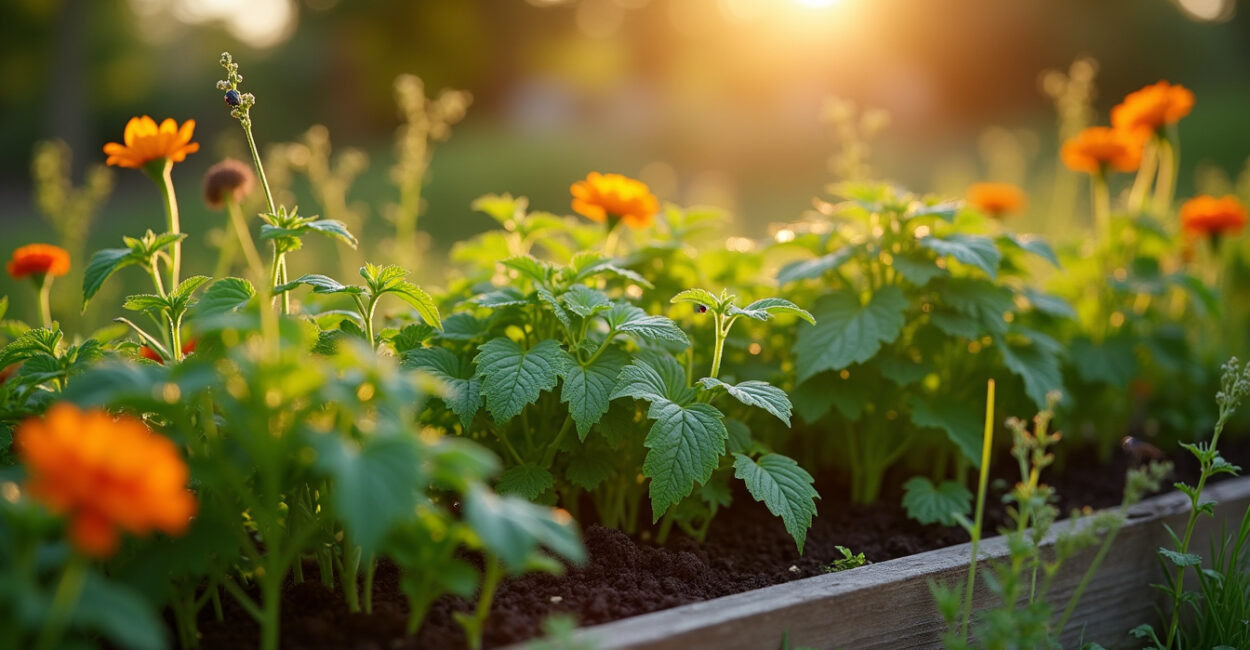
Some companion plants that repel aphids naturally do more than protect leaves: they pull in the insects that eat aphids, or they make your bed smell “wrong” to pests.
That difference matters. If you pick the right border plants, you can turn a vegetable bed into a small, self-correcting system instead of a weekly aphid cleanup job.
The Plants That Do the Heavy Lifting
The best companion plants are not one-trick plants. Some attract hoverflies, lacewings, and lady beetles; others confuse aphids with strong scents or visual clutter. That is why companion plants that repel aphids naturally work best when you use more than one strategy.
Near vegetables, the standouts are nasturtiums, marigolds, sweet alyssum, chives, garlic, dill, and coriander. Nasturtiums can act like a trap crop, drawing aphids away from peppers or beans. Sweet alyssum feeds hoverflies, whose larvae are avid aphid hunters. Chives, garlic, and other alliums add scent confusion along bed edges. Dill and coriander bring in tiny predatory wasps and lacewings.
In practice, the smartest border is mixed, not uniform. A bed lined only with marigolds looks tidy, but a mixed edge does more work. That is the surprising part: the most “beautiful” border is not always the best one. The most useful border looks a little busy.
Why Borders Beat Single-plant Fixes
Here is the mechanism people miss: aphids find hosts by smell, softness, and speed. If you plant one strong companion, you may block one cue. If you plant a mixed border, you change the whole neighborhood.
That is why companion plants that repel aphids naturally work best when they are placed at the edge of the bed, not buried in the center. The border creates a first line of defense. Beneficial insects arrive there first, then move inward once aphids show up. And the scent plants make the vegetable row less easy to map.
Think of it like noise and security together. One plant can confuse. Another can attract bodyguards. Together, they do both.
Mini-story: a gardener I know kept losing kale to aphids every spring. She kept planting more kale, spraying water, and hoping for the best. The shift came when she added alyssum, dill, and a strip of nasturtiums along the outer edge. The aphids did not vanish overnight, but lady beetles appeared within days, and the pressure dropped fast. The bed finally started balancing itself.

What to Plant Near Vegetables — And What to Avoid
Use companion plants that repel aphids naturally as a border strategy, not a decoration. Put taller scent plants where they will not shade crops. Put nectar plants where beneficial insects can find them fast. And do not crowd everything together; airflow still matters.
- For brassicas: dill, coriander, sweet alyssum, chives
- For beans and peppers: nasturtiums, marigolds, garlic
- For mixed beds: a strip of alyssum plus one or two herbs
What to avoid? Dense planting that traps moisture, giant companions that steal light, and the idea that one plant will solve every aphid problem. There is some disagreement about how much “repellent” effect each species really has, and that is fair. The more reliable win is indirect: drawing in beneficial insects and making it harder for aphids to settle. For an overview of ecological pest control, see USDA Agricultural Research Service.
The real goal is not zero aphids. It is a bed that stays below the damage threshold without constant intervention.
FAQ
Do Companion Plants Really Repel Aphids?
Sometimes, but not in a magical, all-purpose way. The strongest effect is usually indirect: the plants attract predators like hoverflies and lady beetles, or they make host plants harder for aphids to locate. That is why companion plants that repel aphids naturally work best as part of a mixed planting, not as a solo fix. If you want the most reliable result, combine scent plants with nectar plants and keep your bed open enough for beneficial insects to move through it.
Which Plant is Best for Aphids Near Vegetables?
If you want one flexible choice, sweet alyssum is hard to beat. It is small, easy to tuck into borders, and excellent at bringing in hoverflies. Nasturtiums are also useful, especially when you want to pull aphids away from a crop. The best pick depends on your bed layout: alyssum for insect support, nasturtiums for distraction, and chives or garlic for scent-based confusion around the edge.
Should I Plant Marigolds for Aphids?
Marigolds can help in a mixed border, but they are not the strongest aphid solution on their own. They work better as part of a layered planting that also includes nectar sources and herbs. Some gardeners expect a single row of marigolds to do all the work, and that is where disappointment starts. Use them as support, not the whole strategy.
Can I Use These Plants in Containers?
Yes, and containers can work well because the planting is concentrated. A pot of nasturtiums, a little alyssum, or a cluster of chives near your vegetables can still attract helpful insects and add scent confusion. The main limitation is space: containers dry out fast, and stressed plants attract more pests. Keep them watered and give them enough sun for steady growth.
What If Aphids Still Show Up?
That does not mean the companion planting failed. Aphids often arrive before predator populations build up. Give the system time, check new growth often, and remove the worst clusters by hand or with a strong water spray if needed. Companion planting works best when it lowers pressure over time. It is a shield, not an instant knockout.
In a good vegetable bed, the border is not filler. It is the part that decides whether pests feel welcome or lost.