

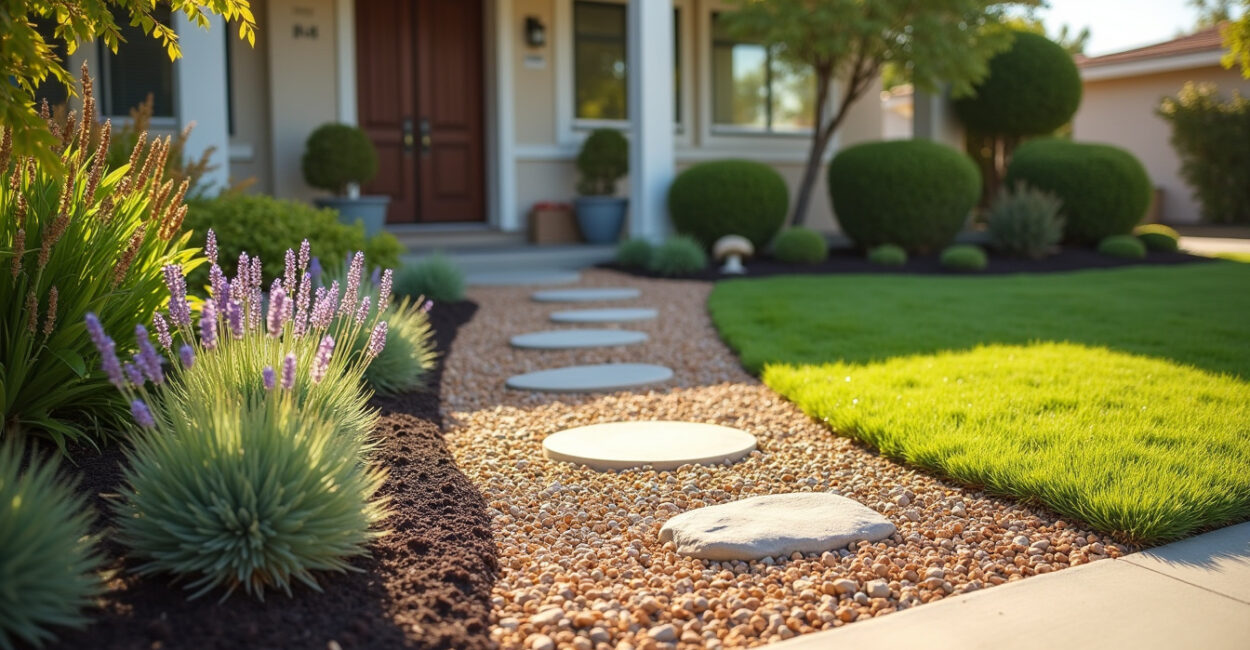
A front yard can look polished without drinking like a golf course. The most reliable version of drought tolerant landscaping for front yards replaces thirsty turf with plants, gravel, and ground covers that can handle heat, lean soil, and irregular watering while still making the house look finished.
The goal is not to build a yard that looks “xeriscaped” in the worst sense of the word. It is to design a front entry that holds curb appeal, cuts maintenance, and survives real summer weather. In this guide, you’ll get practical plant choices, layout rules, and material swaps that work in everyday neighborhoods, not just in show gardens.
Key Takeaways
- Front yards succeed with drought-tolerant design when the layout, irrigation, and plant selection work together; one good plant in the wrong place still fails.
- The fastest curb-appeal gains usually come from shrinking lawn, widening mulch or gravel beds, and using massed plants instead of scattered specimens.
- Soil prep matters more than most people expect because even drought-tolerant plants struggle in compacted, fast-draining, nutrient-poor ground.
- Drip irrigation and a 2- to 3-inch mulch layer often save more water than switching to “low-water” plants alone.
- The best front yard designs use repeatable plant groups, not a random collection of drought-resistant plants from different climates.
Drought-Tolerant Landscaping for Front Yards: The Smart Swaps That Work
Drought-tolerant landscaping for front yards is the practice of replacing high-water turf and thirsty ornamentals with plants, ground covers, and hardscape that stay attractive with less irrigation. The key is not to remove everything green; it is to choose species and surfaces that can handle heat, sun, wind, and seasonal dry spells without looking neglected.
In practice, that means swapping broad lawn areas for smaller, intentional planting beds, gravel accents, decomposed granite, and plants with lower water demand. The best designs are not bare or harsh. They read as deliberate, with clear lines, repeated textures, and enough contrast to make the front of the house look structured from the street.
What Makes a Front Yard “drought-tolerant” in Real Life
A yard qualifies when it can stay presentable with deep, infrequent watering after establishment, not when it never needs water at all. Even desert natives need irrigation during the first growing season, and some will need occasional deep watering during extreme heat.
That’s the part many homeowners miss. “Low-water” does not mean “no care.” It means lower demand, smarter placement, and fewer plant losses during hot weather.
What separates a drought-tolerant front yard from a dry-looking one is structure: repeated plants, clean edges, and enough mulch or gravel to protect the soil from evaporation.
Start by Cutting Lawn Where It Hurts the Most
The fastest way to reduce water use is to remove turf from the least useful parts of the front yard first. Narrow side strips, awkward corner patches, steep slopes, and areas under tree roots usually cost the most to maintain and contribute the least to curb appeal.
If you keep any lawn, keep it where it actually functions: a small welcome strip, a direct approach to the door, or a modest open space that balances the house facade. That approach keeps the yard from feeling overdesigned while still reducing irrigation demand.
Where Turf Usually Wastes the Most Water
- Small strips between walkways and foundations
- Slopes that shed irrigation before roots absorb it
- Shaded zones where grass thins out and invites weeds
- Hot curb-facing patches that dry out faster than the rest of the yard
For a useful comparison of how different front-yard systems affect maintenance and space use, see this guide on space-saving layouts. The principle is the same: remove dead space, then make the remaining space do more work.

Choose Plants That Earn Their Place
The best drought-tolerant plants for front yards are the ones that keep good shape, don’t flop onto walkways, and stay attractive after flowering. That usually means mixing structural shrubs, long-blooming perennials, and ground covers that cover soil without becoming a maintenance problem.
Good options depend on climate, but the design logic stays the same. Use one or two anchor shrubs, one repeated flowering plant, and one low ground cover to knit the bed together. Repetition makes the yard feel intentional; too much variety makes it look like a plant trial.
Reliable Plant Groups to Consider
- Lavender for fragrance, pollinators, and a neat gray-green form
- Salvia for color and strong drought performance after establishment
- Yarrow for flat-topped blooms and tough, airy texture
- Penstemon for seasonal flowers and upright structure
- Roses of Sharon or compact ornamental shrubs where a taller focal point is needed
- Creeping thyme or ice plant for living ground cover in the right climate
For species selection, local extension offices are the most trustworthy starting point. The U.S. Department of Agriculture provides climate and plant-related guidance, and university extensions such as Colorado State University Extension publish region-specific recommendations that are more useful than generic plant lists.
Use Gravel, Mulch, and Ground Cover to Control the Look
Hardscape and soil cover do more than save water; they define the style of the whole front yard. Gravel, decomposed granite, and mulch all suppress evaporation, but they behave differently visually and physically. Mulch softens the bed and works well around shrubs. Gravel reads cleaner and more modern, but it reflects heat and needs proper edging to avoid migration.
Ground cover is the middle path when you want less bare soil without turning the yard into a rock field. In many front yards, the most polished result comes from combining a mineral surface with pockets of living cover instead of using one material everywhere.
Gravel is a visual tool, not a cure-all; it looks best when it frames plants, while mulch performs better when the goal is soil protection around root zones.
How to Choose the Right Surface
| Material | Best Use | Main Tradeoff |
|---|---|---|
| Mulch | Shrub beds, root zones, softening a yard’s appearance | Needs refreshing over time |
| Gravel | Modern front yards, accent bands, low-maintenance areas | Can heat up and scatter without edging |
| Decomposed granite | Paths, sitting zones, natural-looking hardscape | Needs base prep to stay stable |
| Living ground cover | Soil protection and softer transitions | Species choice must match climate and sun |
One practical note from field experience: I’ve seen homeowners choose gravel everywhere because it sounds “low maintenance,” then spend the next year fighting weeds, heat glare, and wandering stones. The cleanest yards usually mix materials instead of relying on one.
Build the Bed Shapes Before You Pick the Plants
Good drought-tolerant design starts with shape, not shopping. A front yard looks more expensive when the bed lines are intentional: curved where the house is soft and traditional, straight where the architecture is modern, and wide enough to give plants a real mass rather than a thin border.
If the beds are too narrow, the design will fail no matter how good the plants are. Narrow strips dry out quickly, make irrigation awkward, and leave no room for root growth. Wider beds also let you repeat plants in groups, which is what gives the yard a finished look from the curb.
Simple Layout Rules That Hold Up
- Use one dominant line, not several competing curves.
- Keep tall plants away from windows and narrow entry paths.
- Repeat each major plant at least three times when possible.
- Leave open ground only where it serves a visual purpose.
For homeowners also trying to reduce maintenance inside the house, the same design principle shows up in storage planning: a few strong systems beat a dozen weak ones. That’s why articles like hidden kitchen storage ideas feel relevant here too. The yard, like a room, works better when every element has a job.
Water Less, but Water Better
Low-water landscaping fails most often because irrigation stays shallow. Frequent light watering encourages roots to stay near the surface, which makes plants more vulnerable during heat waves. Deep watering spaced farther apart trains roots to search lower in the soil where moisture lasts longer.
Drip irrigation is usually the best fit for front-yard beds because it delivers water directly to the root zone and reduces overspray onto sidewalks and driveways. Pair it with a timer, and you get consistency without standing outside with a hose every few days.
Watering Habits That Make the Biggest Difference
- Water early in the morning to reduce evaporation loss.
- Soak deeply, then let the soil dry partially before watering again.
- Adjust irrigation seasonally instead of using one schedule year-round.
- Check emitters after mulch refreshes or bed reshaping.
The Water Education Foundation has clear public education material on landscape water use, and the EPA WaterSense program offers practical guidance for efficient watering and irrigation habits. Those resources are useful because they focus on outcomes, not trends.
Make the Front Yard Look Finished from the Street
Curb appeal comes from contrast, repetition, and clean transitions. A drought-tolerant front yard should still have a focal point near the entry, enough contrast between foliage and hardscape, and a strong edge so the design doesn’t fade into the driveway or sidewalk.
That is where many projects go wrong. The planting may be drought-smart, but if the yard has no focal rhythm, it reads as unfinished. A single small tree, a larger boulder, a low bench, or a repeated cluster of flowering plants can give the design a clear center of gravity.
A Quick Before-and-after Example
A typical suburban front yard starts with a wide strip of thirsty grass, one overgrown foundation shrub, and bare soil under the mailbox. The better version removes most of the turf, adds two mulch beds with lavender and salvia, and finishes the approach with a gravel path and a compact ornamental tree. The water bill drops, but the real win is that the house finally looks intentional.
That pattern is why some older-home updates succeed and others feel forced. Design that respects the house usually wins. For a similar example of matching upgrades to an older structure, see this piece on historic homes and efficient upgrades.
Avoid the Mistakes That Make Low-Water Yards Look Cheap
Drought-tolerant landscaping can go wrong in predictable ways. The most common mistake is using too much visible gravel without enough plant mass, which creates a harsh look. Another is buying plants by label instead of climate fit; a plant can be drought tolerant in one region and struggle in another.
There is also a timing problem. If you install a new front yard in peak summer, stress goes up fast and survival rates drop. The safest window for planting is usually spring or fall, when temperatures are less punishing and roots can establish before extreme heat arrives.
Problems Worth Avoiding
- Ignoring soil compaction before planting
- Mixing incompatible plants with different water needs
- Leaving irrigation heads spraying pavement
- Using too many colors, materials, or plant types at once
- Skipping edging, which makes gravel and mulch look messy fast
That limitation matters: drought-tolerant landscaping for front yards works best when you respect the local climate and soil, and it fails when you treat every plant tag as a promise. If your yard has heavy clay, intense reflected heat, or a strict neighborhood aesthetic, the plan needs adjustment rather than blind rule-following.
What to Do Next If You Want a Better Front Yard
The smartest next step is to walk your front yard with a notebook and mark three things: where water disappears, where the eye lands first, and which areas add nothing but maintenance. That one pass usually reveals the lawn you can remove first, the bed that needs widening, and the spot where a focal plant would change the whole view.
Then build the yard in phases. Remove one problem zone, install the correct soil cover, and test plant spacing before expanding the design. That approach keeps costs in check and makes it easier to correct course before you commit to the whole front yard.
FAQ
How Much Lawn Should I Remove First?
Start with the least functional lawn, not the largest lawn. Narrow strips, shaded corners, and slope-heavy sections usually waste the most water and offer the least visual value. If you are hesitant, remove 20% to 30% first and watch how the yard performs for one season before expanding the project. That phased approach lowers risk and helps you see which areas truly need grass.
Are Gravel Front Yards Hotter Than Planted Front Yards?
Yes, gravel can raise surface temperatures because it reflects and stores heat, especially in full sun. That does not make it a bad choice, but it does mean gravel works best in moderated amounts and with plant canopy nearby. Use it as a framing material, not the entire design. In hotter climates, some shade, mulch, or ground cover nearby makes the yard much more comfortable visually and thermally.
Do Drought-tolerant Plants Need Fertilizer?
Usually only light feeding, and sometimes none at all once they are established. Overfertilizing can push soft, fast growth that needs more water and becomes less resilient in heat. A soil test is the better first step if growth seems weak. In many front yards, healthy mulch, decent soil structure, and proper watering matter more than fertilizer as long as the plants are suited to the site.
Can I Keep Some Grass and Still Save Water?
Yes, and in many neighborhoods that is the best compromise. A smaller lawn area can anchor the design while beds, gravel, and ground cover handle the rest. The key is to keep grass where it actually serves a purpose, such as a path edge or a small open area, and remove turf from the dry, awkward, or hard-to-maintain zones first. That gives you savings without a stark look.
What is the Biggest Mistake Homeowners Make with Low-water Front Yards?
The biggest mistake is treating plant choice as the whole project. A drought-tolerant front yard succeeds because of spacing, soil cover, irrigation, and repetition, not just because the plants are hardy. Many failures come from poor drainage, compacted soil, or a layout that looks cluttered from the street. If the structure is wrong, even good plants will look like a compromise instead of a design.