

Best Weatherproof Rug Colors for Sun-Drenched Spaces
How to choose weatherproof rug colors that resist fading and maintain depth on sunny patios, including which shades hide wear and complement outdoor furniture.
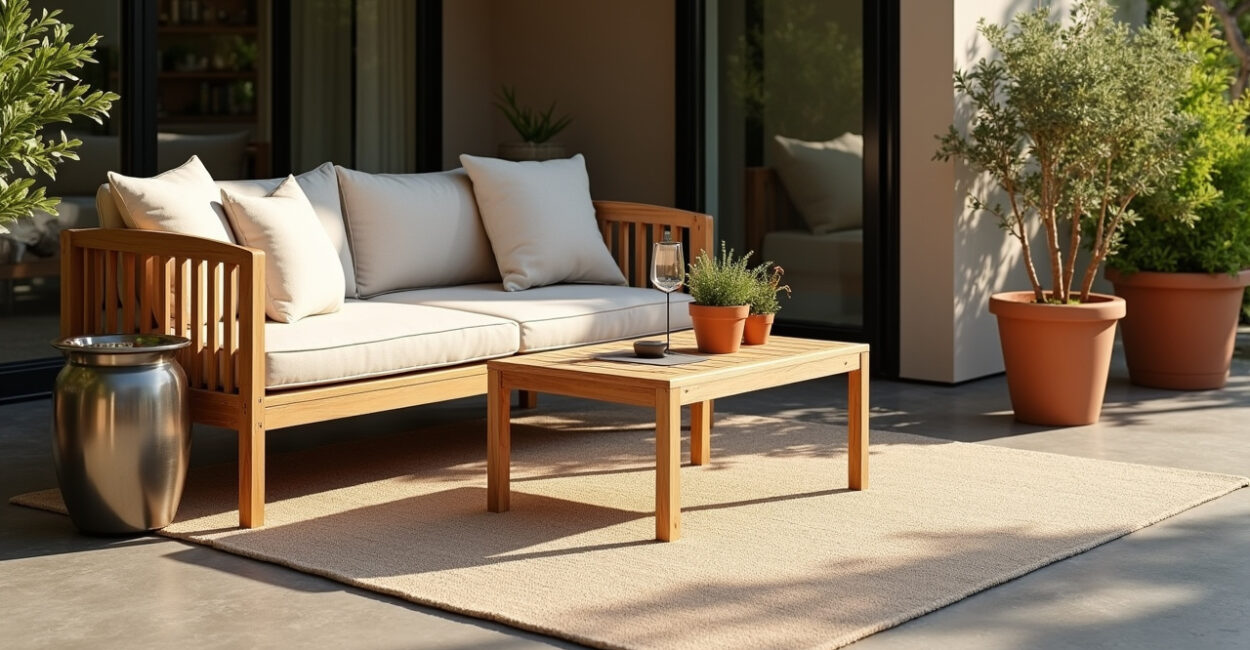
Direct sun does not just heat up a patio; it changes how every color reads. A rug that looks rich in a showroom can look washed out, chalky, or uneven after a single season outside, which is why the best weatherproof rug colors for sunny patios are the ones that keep their visual depth under UV exposure, glare, and dust.
In practice, color choice matters as much as the fiber itself. The right shade can hide fading longer, ground bright furniture, and make a small patio feel intentional instead of overheated. The wrong one can make even a durable polypropylene rug look tired by midsummer. Here is how to choose colors that stay stylish, how fading really shows up, and which shades hold their own in strong afternoon light.
O Que Você Precisa Saber
- Medium-to-deep neutrals usually age better visually in full sun because they lose contrast more slowly than very light tones.
- Heathered, mottled, and pattern-based rugs hide fade, dirt, and pollen better than flat solids.
- Bright whites and saturated jewel tones can be beautiful on sunny patios, but they show UV wear faster unless the dye and weave are engineered for outdoor use.
- Colorfastness is not the same as weather resistance; a rug can repel moisture and still fade quickly in direct sunlight.
- The most forgiving outdoor rug palettes usually echo the furniture, planters, or hardscape instead of fighting them.
Best Weatherproof Rug Colors for Sunny Patios: What Holds Up and Why
The technical term you want is visual fade resistance—how slowly a color looks tired when sunlight breaks down dyes, pigments, and the top layer of the fiber. That is different from structural durability. A rug can survive rain and still lose its good looks if the color sits too close to the bright end of the spectrum.
For sunny patios, I usually favor colors that already have some visual noise built in: sand, taupe, driftwood gray, charcoal, olive, and muted blue. These shades do not scream for attention, which is exactly why they keep looking intentional after months of UV exposure. The eye forgives a soft color shift. It notices a drastic one immediately.
Why Certain Colors Age Better in Direct Sun
Strong sunlight tends to flatten contrast first. Very pale rugs can start to look beige-gray and then just dirty. Very saturated reds, oranges, and bright blues often lose their punch and drift toward a faded pastel look. Mid-tone colors give you a bigger buffer because they can lose a little intensity without looking off.
That is also why textured weaves matter. A flat, single-color rug will show fading in broad patches if one side gets more sun. A heathered weave blends tiny variations in tone, so the eye reads the whole surface as consistent even when some fibers age faster than others.
On a sunny patio, the best rug color is usually not the one that looks brightest on day one; it is the one that can lose a little saturation without looking worn out.
The First Colors I’d Put on a Shortlist
- Charcoal: Hides dust, pollen, and light fading better than most neutrals, especially under modern outdoor furniture.
- Heathered gray: One of the most forgiving choices for high sun because small color shifts disappear into the weave.
- Sand or oat: Soft and warm, especially with teak, wicker, or black metal, though it can show stains more easily than darker neutrals.
- Olive or sage: Works well with plants and terra-cotta, and it tends to age gracefully because the eye expects natural variation.
- Muted navy or denim blue: Strong enough to anchor a space, but softer than electric blue, so fading is less obvious.
Colors That Look Good at First but Fade Faster Visually
The most fragile-looking choices are not always the least durable fibers; they are often the most visually demanding colors. Pure white, crisp black, neon-bright hues, and highly saturated reds can be dramatic, but they ask a lot from outdoor conditions. Under strong sun, they either show every bit of dirt or lose their original character quickly.
That does not mean you should never use them. It means you need to know the trade-off. A bright turquoise rug may still be structurally sound after two summers, but if the patio gets full afternoon sun, the color may read flatter and duller far sooner than a muted blue. That visual downgrade is what bothers most people, not fiber failure.
Where Solid Colors Tend to Lose
Solid colors make fading obvious because there is no pattern to absorb the change. Once the sun starts to bleach one section more than another, the difference shows up as a pale lane near the most exposed edge or a slightly washed center. In a shaded room that might not matter. On a sun-baked patio, it absolutely does.
There is a reason many high-end outdoor collections from names like Sunbrella lean on textured yarns, mélange effects, and subtle stripe work. The design is not just decorative; it helps the rug survive visually when the sun is relentless.
Flat, high-saturation rugs fail fastest in appearance because UV wear shows up as a color shift, not a structural collapse.

How Rug Material Changes Color Performance in Bright Light
Color choice cannot be separated from material. A solution-dyed polypropylene rug behaves differently from a piece-dyed natural-fiber lookalike, even if both are marketed for outdoor use. In solution-dyed fibers, the pigment is built into the material before the yarn is formed, which usually improves color stability compared with surface-dyed options.
If you want the science-backed version, outdoor color performance is tied to UV exposure and weathering. The EPA’s UV Index guidance is a useful reminder that strong sunlight is not a vague design problem; it is a measurable exposure level that can accelerate material breakdown. On the textile side, UV resistance and colorfastness are related but not identical, which is why a rug that claims “weatherproof” still needs a careful color choice.
Read also: Best Solar Path Lights for Backyard Ambiance and Safety
Read also: Weatherproof Outdoor Rug Styling Tips for Every Patio
Read also: How to Layer Weatherproof Rugs Correctly on a Small Patio
What to Ask Before You Buy
- Is the rug solution-dyed, or is the color only on the surface?
- Does the weave have heathering, flecking, or pattern variation?
- Is the backing designed for drainage and outdoor airflow?
- Does the brand specify UV resistance or colorfastness testing?
If a seller cannot explain how the color is built into the rug, I treat the marketing claim with caution. Weatherproof does not automatically mean sunproof.
Matching Rug Color to Furniture, Flooring, and Plants
The best patio rug does not just survive the weather; it works with the room you already have. On a sunny patio, the hardest mistake is picking a rug that competes with everything else. The eye gets tired fast when the rug, cushions, pots, and furniture all demand attention at once.
A smart approach is to decide whether the rug should blend or anchor. Blend means you echo the tone of the deck boards, stone, or concrete. Anchor means you choose a deeper contrasting shade to give the seating area a clear boundary. Both work. What usually fails is choosing a rug color that sits halfway between two jobs and does neither well.
Pairings That Rarely Miss
- Teak + sand or oat: warm, relaxed, and easy to live with.
- Black metal + charcoal or heathered gray: crisp, modern, and forgiving in bright light.
- White wicker + muted navy or olive: balanced without feeling overdesigned.
- Terracotta pots + sage or taupe: natural, soft, and visually calm.
A quick example from a real patio refresh: a client had a west-facing terrace with white cushions and a lot of terracotta. They wanted a bright coral rug, but every sample looked louder in the sun than it did indoors. We switched to a taupe rug with olive flecking, and the whole space suddenly felt cooler, larger, and far less fragile. Two months later, it still looked like it belonged there.
Patterns, Texture, and Marling: The Quiet Advantage
Pattern is one of the most underrated tools in outdoor design. A rug with a small-scale geometric, stripe, or tribal-inspired motif can handle sunlight better than a plain solid because the eye reads the design first and the fading second. The same is true of marling—the mixed-strand look that blends two or more tones in the same yarn.
This is where many people make a wrong assumption: they pick a solid beige rug because they want something safe, then are annoyed when it shows every footprint and every color shift. A patterned or heathered rug often looks more expensive over time because it ages with texture, not against it.
Pattern Types That Work Best
| Pattern Type | Why It Works in Sun | Best Pairings |
|---|---|---|
| Subtle stripe | Breaks up fading and stretches small patios visually | Neutral furniture, compact seating groups |
| Small geometric | Hides wear while keeping a clean look | Modern or transitional outdoor sets |
| Heathered solid | Softens dust, pollen, and uneven sun exposure | Teak, rattan, and natural textures |
One note of caution: busy patterns can look chaotic if your patio already has patterned cushions, umbrellas, and planters. The point is to create visual rest, not add another layer of noise.
Climate, Orientation, and Sun Intensity Change the Answer
South-facing and west-facing patios usually take the hardest hit because they spend more time in direct sun, especially in the afternoon when light is strongest. That is why the same rug can perform beautifully on a shaded north-facing porch and look exhausted on a broad open terrace. Placement matters as much as color.
The National Oceanic and Atmospheric Administration is a useful reference for understanding how weather and solar conditions vary by region. In hotter, brighter climates, I lean darker and more textured. In milder, mixed-light settings, I can get away with softer tans or muted color accents. The rule is simple: the more direct sun, the more the rug should rely on texture and tonal complexity.
Sun Exposure Rules of Thumb
- All-day sun: Choose charcoal, heathered gray, olive, or mixed-tone taupe.
- Morning sun only: Muted blue, sand, or warm neutrals stay attractive longer.
- Partial shade: You can safely use slightly brighter patterns without as much visual fading risk.
My Practical Ranking for Sunny Patios
If I had to rank the most reliable color families for bright outdoor spaces, I would start with heathered gray, charcoal, taupe, olive, and muted navy. Those shades give you the best mix of style, forgiveness, and long-term visual stability. They also play well with nearly every common patio material: wood, stone, concrete, wicker, and powder-coated metal.
Then I would move to sand and oat if the patio is only moderately exposed and the homeowner wants a softer look. Finally, I would place high-saturation colors, crisp white, and pure black lower on the list—not because they are wrong, but because they are less forgiving when the sun is relentless and the rest of the patio is changing with the seasons.
The safest outdoor rug color is the one that still looks intentional after the first hot summer, not the one that wins the first-day showroom test.
There is a limit here, though. If you are designing a covered patio, a pergola-shaded lounge, or a space that gets only filtered light, then some of these rules loosen. Sun exposure, cleaning habits, and furniture color all affect the final result. That is why the “best” choice is really the one that fits your exposure level and your tolerance for visible wear.
What to Do Before You Buy
Before you commit, compare the rug in bright outdoor light, not under store lighting. Bring a cushion sample, a paint chip, or even a photo of the patio at noon so you can judge whether the color still works when the sun is overhead. Then look at the rug from several feet away; tiny dye variations that seem invisible up close can change the whole look at distance.
If the patio gets hard sun for most of the day, prioritize a mid-tone, textured, or patterned rug over a flat solid. That single decision usually matters more than chasing a trend color that will look good for one month and tired for twelve. Choose for how the space lives, not for how it photographs.
Frequently Asked Questions
Do Lighter Outdoor Rug Colors Fade Faster in the Sun?
Lighter colors do not always fade faster in a technical sense, but they often show wear sooner because subtle color shifts are easier to see. A pale beige rug can look dingy long before the fiber is actually failing. In bright, open patios, light tones also collect visual dirt faster, so they lose that clean look more quickly than heathered mids or deeper neutrals.
Is Black a Good Choice for a Sunny Patio Rug?
Black can look sharp outdoors, especially with modern furniture and pale decking, but it is not the most forgiving option in direct sun. It may fade toward charcoal and can also absorb a lot of heat underfoot. If you want a dark look, charcoal or deep graphite usually gives you the same grounding effect with less visual harshness over time.
What Outdoor Rug Color Hides Dirt and Pollen Best?
Heathered gray, taupe, olive, and charcoal usually hide pollen, dust, and small debris better than crisp white or flat tan. The reason is simple: small variations in tone camouflage the things that settle on the surface. Patterned rugs do even better because the eye reads the design before it notices the mess.
Should I Choose a Patterned Rug or a Solid Rug for a West-facing Patio?
For a west-facing patio, patterned or heathered rugs usually outperform solids visually because afternoon sun tends to create uneven fading. A small-scale stripe, geometric design, or mixed-tone weave can disguise that shift for much longer. Solid rugs are still usable, but they need a more careful fiber choice and a higher tolerance for visible aging.
What is the Single Safest Color Family for a Weatherproof Rug in Full Sun?
If I had to pick one family, I would choose mid-tone neutrals with texture, especially heathered gray, charcoal, or taupe. Those shades are stable, versatile, and less likely to look tired after one harsh season. They also pair with most outdoor furniture finishes, which makes the whole patio easier to style without overthinking every piece.