

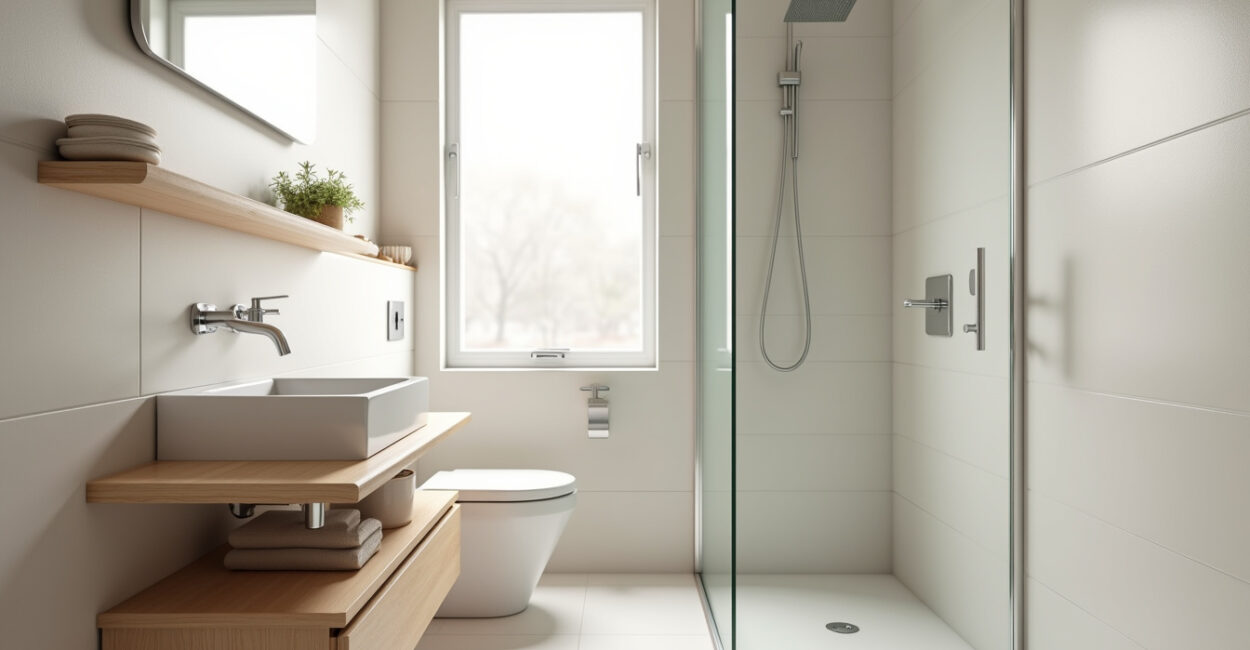
A tight layout, better tile choices, and smarter fixtures can make a tiny bathroom feel noticeably bigger without blowing your budget.
If your bathroom feels cramped the second you close the door, that usually isn’t a space problem alone. It’s a layout problem, a surface problem, and a fixture problem all at once. The good news: the cheapest wins are often the ones you can see immediately.
These budget bathroom renovation ideas for small spaces focus on changes that stretch the room visually first, then physically. That order matters.
Start with the Layout You Already Have
Before you shop for tile, look at what’s taking up visual and physical space. In tiny bathrooms, a few inches matter more than a dramatic style concept. A wall-hung vanity, a compact toilet, or a narrower sink can open up walking room fast. In practice, the room feels larger when you can see more floor.
The cheapest “expansion” is often removing bulk, not adding square footage. That’s why budget bathroom renovation ideas for small spaces work best when they cut visual clutter first. If a bulky cabinet blocks the eye the second you walk in, the bathroom will always feel smaller than it is.
- Swap a deep vanity for a floating one.
- Choose a pedestal or narrow sink if storage is already elsewhere.
- Replace a swinging door with a pocket or outswing door if possible.
One small renovation I’ve seen pay off repeatedly: a homeowner kept the same footprint, but replaced a thick vanity and old framed mirror. The room didn’t gain a single inch, yet it stopped feeling boxed in. That’s the kind of change you want.
Pick Tiles That Stretch the Room, Not Break It Apart
Tile can either calm a small bathroom or chop it into fragments. Large-format tile usually creates fewer grout lines, which makes walls and floors read as one continuous surface. That visual continuity is doing real work. So is a lighter color palette, especially when the room has limited natural light. According to the U.S. Department of Energy, brighter, efficient lighting also helps a room feel more open.
Use the same tile on the floor and in the shower if you can. It sounds too simple, but it often changes everything. One of the most effective budget bathroom renovation ideas for small spaces is to reduce visual stops: fewer color changes, fewer borders, fewer “here ends the room” moments.
Small rooms look bigger when your eye glides instead of stopping. That’s why matte, lightly patterned tile usually beats busy mosaics in tight layouts. If you love contrast, save it for a vanity pull or mirror frame, not the floor.
- Choose large-format tile with minimal grout lines.
- Use the same finish in adjacent zones.
- Keep the darkest color low or limited.
The trade-off: very large tile can be awkward in a badly sloped shower or uneven subfloor. That’s where restraint beats trend-chasing. According to the National Association of Home Builders, small-space design pays off most when materials fit the room instead of fighting it.

Upgrade Fixtures That Create Space You Can Actually Feel
Fixtures are where tiny bathrooms either win or lose. A glass shower panel instead of a curtain can instantly expose more of the room. A slim-profile faucet frees up counter space. A better light fixture can make the ceiling feel higher than it is. These are not glamorous upgrades, but they change how the room behaves.
Here’s the quiet rule behind the best budget bathroom renovation ideas for small spaces: replace anything that blocks sightlines or steals elbow room. That includes towel bars in awkward places, oversized mirrors with heavy frames, and shower hardware that sticks out too far.
In a small bathroom, the best design move is often the one you barely notice later.
Keep at least one finish consistent across the room so the eye has a place to rest. And if you’re choosing between a trendy detail and a cleaner silhouette, pick the cleaner silhouette. Trendy ages; space feels permanent.
Does a Floating Vanity Really Make a Bathroom Feel Bigger?
Yes, because exposing more floor creates a stronger sense of depth. The room reads as less crowded, even when the footprint stays the same. It also makes cleaning easier, which matters more than people expect in a small bathroom.
What Tile Size Works Best in a Tiny Bathroom?
Large-format tile usually works well because it reduces grout lines and visual breaks. That said, the best choice depends on the floor slope, shower size, and installation quality. A poorly installed large tile can look worse than a smaller tile done well.
What’s the Cheapest Upgrade with the Biggest Impact?
Lighting often gives the fastest payoff for the least money. After that, a new mirror and a simpler vanity can change the room’s proportions almost immediately. If your budget is tight, start where the eye lands first.
Should I Use Bright White Everywhere?
Not necessarily. Too much flat white can feel cold or clinical. A warmer white, soft stone tone, or pale greige often gives the same spacious effect with more warmth and less glare.
What Should I Avoid in a Small Bathroom Remodel?
Avoid heavy frames, dark contrast on every surface, and fixtures that protrude too far into the room. Those choices make a compact bathroom feel busier and smaller. Keep the visual field calm, and the room will feel larger without extra square footage.
Small bathrooms do not need miracle makeovers. They need fewer interruptions, cleaner lines, and smarter choices where space is tightest. Once you see that, the room stops feeling like a limitation and starts feeling like a design puzzle you can actually solve.