

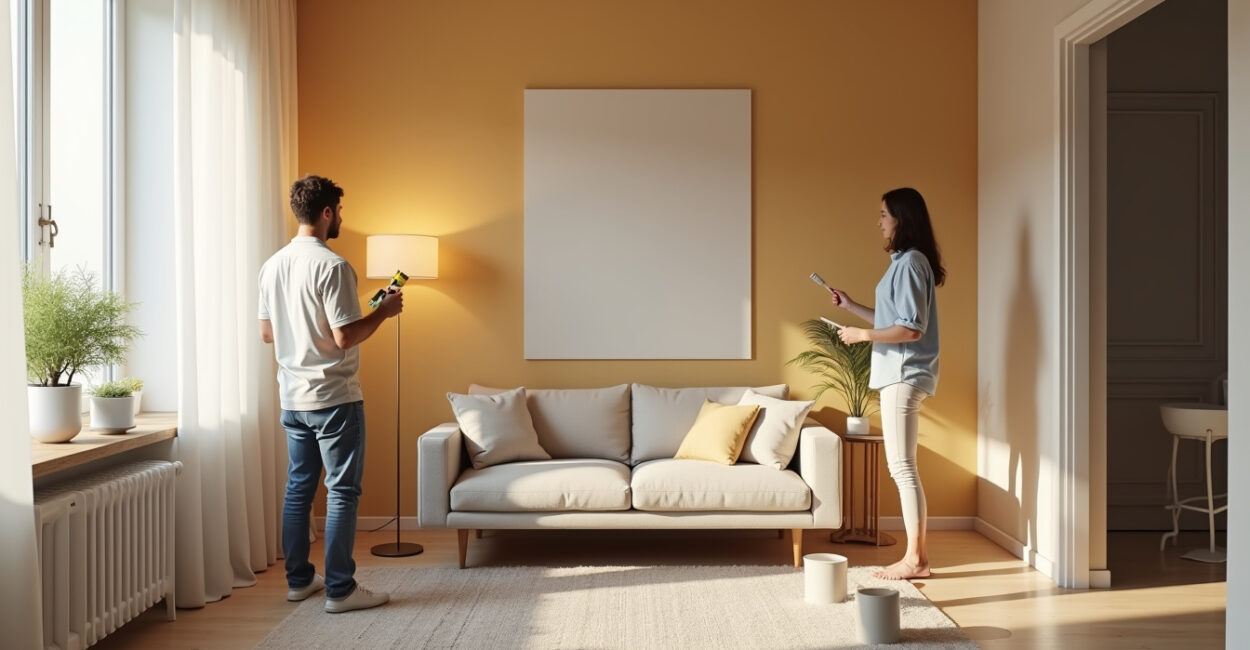
Simple paint choices and layered lighting can make a small house feel bigger—often for less than one major purchase.
Paint and lighting budget renovation tips work because your eye reads contrast, brightness, and depth before it reads square footage. That means you can change the whole mood of a room without moving a wall.
If your place feels cramped, the fix is usually not more stuff. It’s fewer colors, smarter sheen, and three light sources that do different jobs.
Why Paint Changes the Size of a Room Faster Than New Furniture
The technical idea is simple: color temperature, reflectance, and contrast control how spacious a room feels. In plain English, light colors bounce more light, while muddy undertones make walls recede in the wrong way.
For most small homes, the safest move is one soft neutral for main walls, one cleaner white for trim, and one deeper accent used sparingly. That combo gives the eye rest. It also makes old cabinets, narrow halls, and low ceilings look less busy.
The biggest mistake is choosing paint by chips alone. A warm beige can turn yellow in afternoon light. A cool gray can look flat at night. Test paint on at least two walls and check it in daylight and after sunset.
One of the best paint and lighting budget renovation tips is to repaint the trim before buying anything decorative. Fresh trim sharpens the entire room, and the cost is tiny compared with new flooring or a sofa.
Layered Lighting is the Upgrade People Notice First
Layered lighting means using ambient light, task light, and accent light together. That sounds technical, but the effect is easy: the room stops looking like one sad overhead bulb doing all the work.
Think of a small living room with a ceiling fixture, a floor lamp near the sofa, and a picture light or plug-in sconce on one wall. Suddenly the corners disappear less, and the room feels intentional. In practice, that matters more than buying one expensive statement fixture.
- Use warm bulbs in living areas.
- Put brighter task light where you read, cook, or work.
- Keep one corner darker if you want depth.
Brightness everywhere can make a small house feel smaller. The trick is contrast. A room with zones reads as designed; a room with identical light everywhere reads as exposed.

The Budget Plan That Delivers the Biggest Before-and-after
Here’s the order that usually pays off: paint first, bulbs second, fixtures third. That sequence lets each change reveal what the next one really needs.
A tiny kitchen, for example, may only need a brighter ceiling bulb, under-cabinet strips, and a cleaner wall color. I’ve seen people spend weeks shopping for a new pendant when the real problem was a yellow bulb and a wall color that swallowed light.
One good rule: if your budget is limited, avoid buying matching sets. Mixed light sources do more for a small space than one large purchase. That’s the heart of paint and lighting budget renovation tips—use contrast to create scale.
For a useful reference on light and color behavior, see the U.S. Department of Energy’s lighting guidance. For paint and indoor air choices, the EPA’s indoor air quality resources are worth a look.
Small rooms rarely need more money. They need fewer visual arguments.
FAQ
What Paint Colors Make a Small House Look Bigger?
Soft neutrals, warm whites, and muted greiges usually work best because they reflect light without feeling sterile. The key is not just the color, but the undertone. Test samples in morning light and at night, because the same paint can feel airy in one room and dull in another.
Is White Always the Best Choice for Small Spaces?
No. Pure white can look harsh under cool LEDs and can flatten a room with little natural light. Off-white, pale taupe, or a light gray with the right undertone often feels calmer and more expensive. The best choice is the one that works with your actual bulbs, not the one that looks clean on a card.
How Many Lights Does a Small Room Need?
Usually three layers are enough: one ambient source, one task light, and one accent light. That could be a ceiling fixture, a reading lamp, and a small sconce or table lamp. You do not need all three to be dramatic. You need them to create shape and reduce dark corners.
Should I Paint Before Replacing Lighting Fixtures?
Yes, in most cases. Paint changes how fixtures and bulbs look, so it helps you avoid buying the wrong finish or temperature twice. Once the walls are fresh, you can see whether the room wants warmer light, more focused task light, or a better fixture shape.
What’s the Cheapest Renovation Change with the Biggest Visual Impact?
Usually fresh paint plus better bulbs. That combination changes color, brightness, and mood at the same time, which is why it feels bigger than the cost. If you want the most noticeable lift for the least money, start there before you touch furniture or flooring.
In a small house, the best renovation is the one that makes everything else look more expensive. Paint can do that. Lighting can do that. Put them together, and the room stops feeling small—it starts feeling deliberate.