

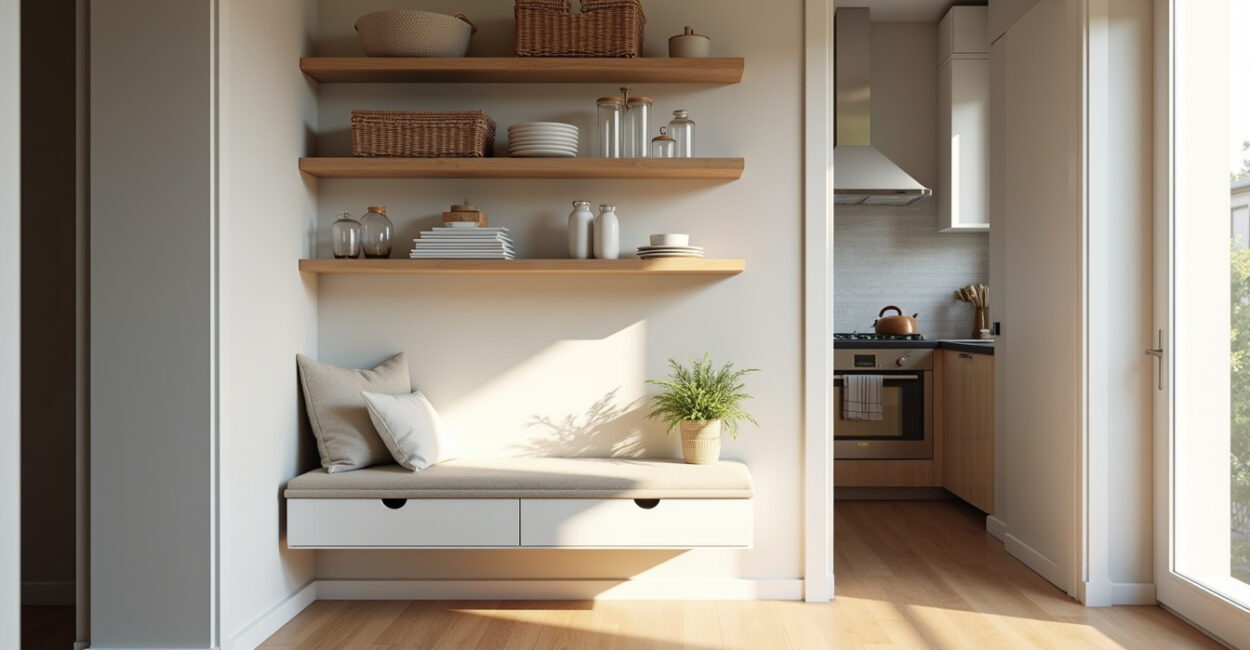
Space-saving storage ideas for small homes work best when they make clutter disappear without making rooms feel crowded.
If your home feels smaller at the end of the day than it did in the morning, the problem is usually not square footage. It’s layout. A shelf in the right place, a hidden drawer where dead space used to be, or one smarter furniture swap can change how a room breathes. The goal is not to cram more in. It’s to free up floor space, sight lines, and the daily friction that makes a small home feel chaotic.
Shelves That Work Harder Than Cabinets
Open shelves are one of the simplest space-saving storage ideas for small homes because they use vertical space without adding visual bulk. A cabinet creates a solid block; a shelf gives you storage and keeps the wall feeling lighter. That matters in tight kitchens, bathrooms, and entryways, where heavy furniture can make the room feel boxed in.
The trick is placement. Put shelves where your eyes already go—above a desk, over a toilet, beside a doorway, or near the ceiling. In practice, the best setups use the “dead” strip of wall most people ignore. Small homes feel larger when storage moves up instead of out.
- Use shallow shelves for books, bins, and folded linens.
- Keep lower shelves open so the room still feels airy.
- Mix one closed basket into a shelf run to hide visual clutter.
If you want a fast win, look for the one wall in each room that does almost nothing. That’s usually where the shelf should go.
Hidden Compartments Beat Visible Clutter Every Time
Hidden storage is where small-home design gets clever. Think under-bed drawers, ottoman storage, lift-top coffee tables, toe-kick drawers in kitchens, and benches with lids. These are not gimmicks. They are space-saving storage ideas for small homes because they turn structural emptiness into useful volume.
Here’s the comparison that surprises most people: a room with visible bins feels busier than a room with the same amount of stuff tucked away. Same objects. Different stress level. One looks like storage; the other looks like clutter. That’s why hidden compartments matter more than decorative organization hacks.
In a small home, the best storage is the kind you stop seeing.
Mini-story: one renter I saw had a narrow studio with piles under the bed, a crowded bookcase, and a coffee table covered in chargers. She replaced the table with a lift-top version and added one bench by the window. Nothing was renovated. Yet the room suddenly felt wider because the floor stopped carrying the mess.
One caution: hidden storage works best for things you use often but don’t need to display. If you bury everyday items too deeply, you create a different kind of clutter—harder to reach, not cleaner.

Layout Fixes That Make Tight Rooms Breathe
Sometimes the biggest storage gain comes from moving furniture, not buying more of it. Space-saving storage ideas for small homes often start with a layout audit: What blocks the walkway? What furniture is too deep? What sits in the middle of the room but could live against a wall?
Try these fixes first:
- Replace bulky sofas with slimmer frames and visible legs.
- Use nesting tables instead of one large coffee table.
- Choose wall-mounted lamps to free side tables.
- Keep the center of the room as open as possible.
The layout rule is simple: if an item doesn’t earn its footprint, it’s costing you space twice—once on the floor, and again in how cramped the room feels. For design guidance on healthier, more functional interiors, the National Institute of Standards and Technology has useful research on space use and built environments, while HUD offers practical housing and design context for smaller living spaces.
These fixes are powerful, but they are not magic. If a home is overloaded with things you never use, no shelf will save it. The real win is combining a cleaner layout with fewer, smarter storage points.
FAQ
What is the Fastest Storage Upgrade for a Small Home?
The fastest upgrade is usually vertical storage: shelves, wall hooks, or a tall narrow unit. These move items off the floor without eating into walking space, which gives an immediate visual payoff. If you only do one thing, start with the wall space you already have and the furniture that currently blocks it.
Are Hidden Compartments Worth It in a Rental?
Yes, if they are removable or built into furniture you can take with you. Storage ottomans, under-bed bins, and lift-top tables are renter-friendly because they solve clutter without permanent changes. Avoid anything that needs structural work unless your lease allows it.
Do Open Shelves Make a Room Look Messy?
They can, if you overload them. Open shelves work best when you limit the number of items and use baskets or matching containers to reduce visual noise. The point is not to display everything you own; it is to keep useful items accessible while the room stays light.
How Do I Decide What to Hide and What to Show?
Hide the items you need often but don’t need to see: chargers, paperwork, spare linens, cleaning supplies, and seasonal objects. Show only the things that are functional or genuinely decorative. If an object creates visual fatigue, it belongs in a compartment, not on display.
What’s the Biggest Mistake People Make with Small-home Storage?
They buy storage before they fix the layout. That usually means more containers, more furniture, and no real relief. Start by clearing pathways and removing oversized pieces, then add shelves or hidden compartments only where the room still needs help.
The best small-home storage doesn’t announce itself. It makes the room feel calmer, wider, and easier to live in before anyone notices where the clutter went.