

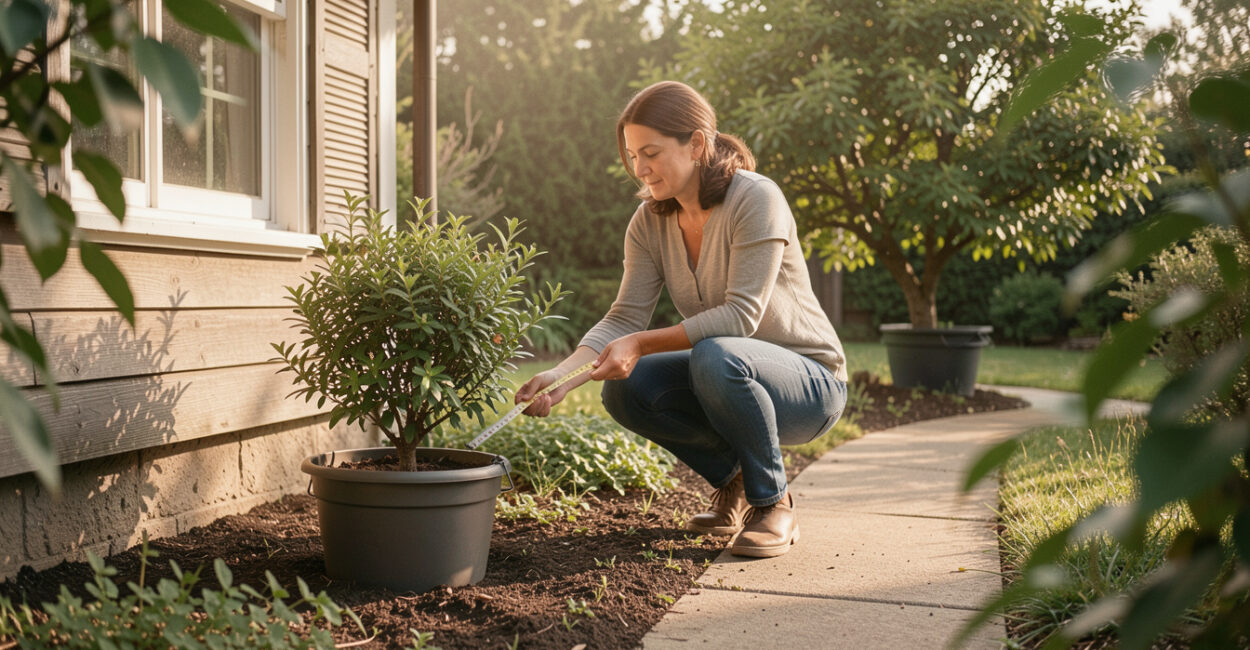
A shrub sold in a one-gallon pot can eventually press against a walkway, cover a window, or crowd a foundation. Compact native shrubs can suit a small yard, but “compact” describes a plant relative to its species or cultivar, not a guarantee that it will fit every tight spot.
Choose by mature height and width, growth rate, and the conditions at the planting site. The best low-maintenance choice is usually a locally native species or cultivar that can reach its natural size without regular pruning.
How to Choose Compact Native Shrubs for a Small Yard
To choose a shrub for a small yard, compare its mature height and spread with the space available, then check its growth rate, light, soil, and water needs. Pick a plant whose natural shape fits the site; routine pruning to hold an oversized shrub in place adds work and can reduce flowering or expose bare branches.
In horticulture, a shrub’s mature size is its expected height and lateral spread at an established age under typical growing conditions. In everyday terms, plan for the plant it can become, not the plant in the nursery pot. Cultivar descriptions help narrow the choice, but climate and growing conditions still affect the final dimensions.
Native also depends on place. A shrub native to the eastern United States may be non-native in the Southwest, where rainfall, soils, and seasonal temperatures differ. Check a regional native-plant list or the USDA PLANTS Database before treating a species as a local fit.
Why Nursery-Pot Size Gives a False Sense of Space
A small container tells you how the shrub is sold today, not how much ground its branches and roots will occupy later. Plant labels often show a mature-size range, and the upper end is the safer planning figure when a path, window, or wall leaves little room.
Use mature spread to estimate planting clearance. If a shrub is expected to reach 4 feet wide, its center generally needs to sit about 2 feet from the edge of the space it must not occupy. Add more room if branches arch or spread beyond the plant’s central outline. That simple radius check prevents a common nuisance: foliage that looks fine at planting but brushes passersby a few growing seasons later.
Growth rate matters, too. A slow-growing shrub can still outgrow a tight bed; it just takes longer. A plant that reaches its allotted space quickly may need more early monitoring, while a naturally spreading shrub may send up shoots well beyond its stated width.

Compare Compact Native Shrubs by Size and Care
The examples below are useful starting points for gardens in parts of the eastern United States. Their listed dimensions are approximate ranges for named cultivars or commonly grown forms; check regional availability and the nursery tag before planting. Cultivar size can vary with climate and care.
| Shrub and typical region | Mature height × spread | Growth habit | Light and moisture | Pruning needs |
|---|---|---|---|---|
| Inkberry holly (Ilex glabra ‘Gem Box’), eastern North America | About 2–3 ft × 2–3 ft | Evergreen, rounded to mounded | Sun to part shade; moist, acidic soil | Usually light shaping only; avoid cutting into bare wood |
| Virginia sweetspire (Itea virginica ‘Little Henry’), eastern North America | About 2–3 ft × 3–4 ft | Deciduous, spreading, with seasonal suckers | Sun to shade; moist soil, tolerates some wetness | Remove unwanted suckers; little routine shaping |
| Summersweet (Clethra alnifolia ‘Hummingbird’), eastern North America | About 2–4 ft × 3–4 ft | Deciduous, rounded, slowly spreading | Part shade to sun; moist, acidic soil | Generally low; thin or remove stray stems if needed |
| Black chokeberry (Aronia melanocarpa ‘Low Scape Mound’), eastern North America | About 1–2 ft × 2–3 ft | Low, mounded, deciduous | Sun to part shade; average to moist soil | Little pruning; occasional removal of older stems |
For a small evergreen native shrub, ‘Gem Box’ inkberry offers year-round foliage, but it still needs suitable soil and enough width to develop its natural shape. Virginia sweetspire and summersweet tolerate moist sites that would challenge many shrubs; their spread can still be a concern beside a narrow path. For more guidance on combining native shrubs and other plants, see these ideas for native plant borders with blooms across the season.
Place Shrubs Safely Near Paths, Windows, and Foundations
Near a walkway, measure from the shrub’s center to the path edge and allow for roughly half its mature spread, plus a little extra for arching branches or foot traffic. Along a foundation, leave space for airflow, access to siding, and maintenance such as painting or gutter work. A plant tag cannot account for every building detail, so use the widest mature-size estimate and check local guidance when planting close to utilities or structures.
Below a window, consider both the plant’s mature height and the view from inside. A shrub that stays low enough to preserve a sightline may still spread across a basement window well. Avoid placing dense foliage where it blocks an entrance, hides a meter, or makes a narrow side yard hard to inspect.
When a site needs year-round screening, a low evergreen may work better than a taller shrub repeatedly cut back to fit. For other design decisions around paths, compare planting needs with flowering plants suited to path edges.
Match Shrubs to Sun, Soil, and Water Conditions
Before selecting a plant, note how many hours of direct sun the bed receives, whether water stands after rain, and whether the soil dries quickly. A shrub suited to moist, acidic soil may struggle beside a hot foundation where reflected heat and roof runoff create a drier microclimate. Shade can also change a shrub’s form: some plants grow more open or flower less without adequate light.
Use local references to confirm native range and growing conditions. The NC State Extension Plant Toolbox provides plant profiles, while the Lady Bird Johnson Wildflower Center’s plant database can help identify native plants by region. These resources are useful starting points, but a plant’s performance in one state does not guarantee it will thrive in a different climate or soil.
To support pollinators, choose a locally appropriate shrub with flowers or fruit that suit your garden goals, then group it with compatible plants rather than squeezing it into a slot that is too small. This guide to a common native pollinator garden mistake offers related planning context.
Use a Planting Checklist to Prevent Overcrowding
- Confirm local suitability: Check the species’ native range and whether the named cultivar is available and appropriate for your region.
- Plan for the largest listed size: Record mature height and spread, then mark the shrub’s future footprint on the ground.
- Measure from the center: Leave about half the mature spread between the trunk or crown and the nearest path, wall, or other boundary, with extra clearance where access matters.
- Check neighbors: Account for adjacent shrubs, doors, windows, vents, and utility access before setting the plant.
- Group by needs: Place plants with similar light and moisture requirements together, and allow each one its own mature footprint.
If the mature footprint does not fit, choose a smaller cultivar or a different species. Pruning is not a reliable space-saving plan for a shrub that naturally grows far beyond its allotted area.
Keep Small Native Shrubs Healthy with Minimal Pruning
Compact varieties generally need the same basic care as larger shrubs of the same species: appropriate planting depth, water during establishment, and a site that matches their light and soil preferences. Keep mulch away from the stems, and water deeply during dry spells while roots establish; the exact duration depends on weather, soil, and the plant.
Prune to remove dead, damaged, or crossing branches, or to correct a small shape problem. For flowering shrubs, timing depends on whether the plant blooms on old or new wood; pruning at the wrong time can remove flower buds. Some cultivars also produce suckers, so removing unwanted shoots may be more useful than shearing the whole shrub.
There is no single mature-size figure that applies everywhere. Climate, soil, irrigation, and cultivar can shift a shrub’s dimensions, and nursery labels may use different ranges. Before buying, compare the tag with a regional extension or botanical reference, then measure the intended space at the plant’s full expected width.
How Can I Tell Whether a Shrub Will Fit Under a Window?
Check its mature height and spread, then compare those dimensions with the window sill and the available bed width. Leave room for branch growth and access to the window well; a low-growing label alone does not confirm that the shrub will stay clear.
Which Compact Native Shrubs Need the Least Pruning?
Well-matched cultivars such as ‘Low Scape Mound’ black chokeberry and ‘Gem Box’ inkberry usually need little shaping. Their maintenance still depends on site conditions, and inkberry can suffer if soil moisture or acidity does not suit it.
Do Smaller Native Shrubs Need Special Care?
They generally need the care appropriate to their species, not a separate “dwarf shrub” routine. The key is matching light, moisture, and soil needs, then watering during establishment and pruning only for a clear reason.