
How to Teach a Dog to Stay Calm When the Doorbell Rings
How to train your dog to respond calmly to the doorbell using gradual sound exposure, reward-based steps, and clear boundaries without relying on barking sup…
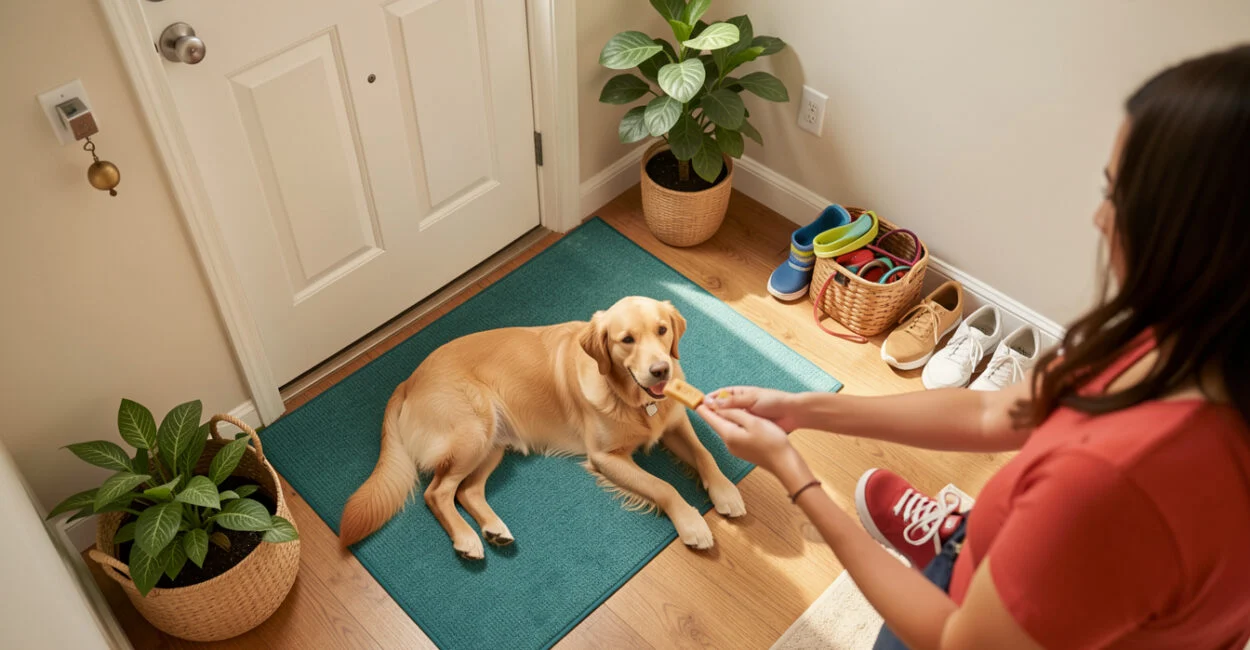 Rewarding calm away from the door
The doorbell rings, and your dog is already barking at the entryway. Good dog doorbell training teaches a different response through gradual sound practice, rewards, and a clear station away from the door. Start with a quiet recording or a helper at the door, and increase the challenge only while your dog can still eat and respond to you.
“Doorbell training” can also mean teaching a dog to ring a bell to ask to go outside. That potty cue solves a separate problem; it will not, by itself, teach a dog to stay calm when visitors arrive.
Key Takeaways
- Teach a calm action, such as going to a mat, rather than expecting your dog to understand “don’t bark.”
- Practice first with a low-volume doorbell sound and no visitor entering.
- Use a gate, closed door, or leash to prevent rushing while the dog learns.
- A potty bell signals an outdoor trip; it is a separate skill from calm behavior at the household door.
Dog Doorbell Training: Why Dogs React and What Calm Looks Like
Dog doorbell training is reward-based behavior training that changes a dog’s response to the sound of the household doorbell. The goal is a repeatable behavior, such as moving to a mat and waiting, while the sound and visitor activity happen. A brief alert bark may still occur; success means your dog can recover, follow a cue, and remain safely away from the door.
The chime can predict exciting or worrying events: a person appears, the door opens, voices enter, or the dog loses access to a territory it wants to monitor. That learned association is a form of classical conditioning. If the sound reliably precedes a visitor, the sound alone can trigger anticipation before anyone knocks.
Choose a definition of “calm” that your dog can actually perform. For one dog, it may be four paws on a mat; for another, it may begin with looking toward you and then taking a treat several feet from the entry.
Doorbell Calm Training Vs. Potty Bell Training
Calm training changes what a dog does when the household doorbell rings; potty-bell training teaches the dog to touch a bell to request an outdoor trip. They may both involve bells, but they have different cues, rewards, and outcomes. If the main problem is barking or bolting at visitors, train a station behavior; if the dog needs a clearer way to ask to go out, teach a potty signal near the exit.
Using one bell for both can blur the message. A dog that rings a hanging bell to go outside may still bark when the front doorbell sounds, because those sounds predict different events.
A doorbell can cue a calm station, while a potty bell can request an outdoor trip; teach each signal for its own purpose.
What to Prepare Before Training
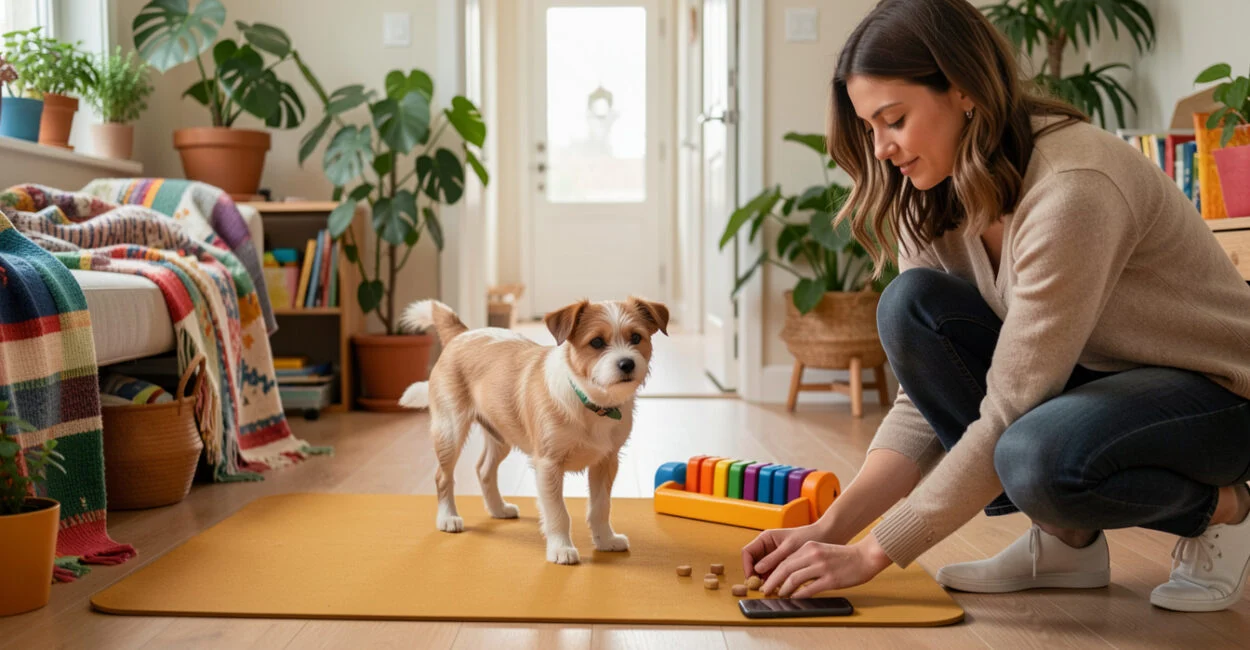
Set up the practice so your dog can succeed without reaching the door. You will need small, high-value treats, a mat or other designated station, and a way to control the sound. A phone recording works if it can play quietly; a helper can ring the real bell from outside while the door stays closed.
Pick a station far enough from the entry that your dog can settle without staring at the visitor. Keep the mat in place during practice, and decide in advance what the dog should do there, such as lie down or stand and look at you. A baby gate or exercise pen can provide a physical boundary without turning the session into a struggle.
Before playing the sound, note your dog’s starting point: can the dog take a treat, respond to its name, or move away from the door? If not, begin at a greater distance or with a quieter sound. The American Veterinary Society of Animal Behavior’s humane dog training position statement supports reward-based methods and cautions against aversive approaches.
How to Teach Your Dog to Stay Calm When the Doorbell Rings
Teach one small response at a time, pairing the sound with a behavior your dog already knows or can learn easily. Keep sessions brief and stop before your dog becomes too excited to eat or respond. This progression lets the sound become a cue to move to a safe station rather than a signal to charge the entry.
- Build the station behavior. With no doorbell sound, reward your dog for stepping onto the mat. Gradually reward a pause there, then add a cue such as “place.”
- Add a very quiet chime. Play the recording once at a low volume, then immediately guide or cue the dog to the mat and reward. If your dog barks, freezes, or stops taking food, make the sound quieter or increase distance.
- Practice the sound and station together. Give the cue as the chime plays, then reward the dog for going to the mat. Over repetitions, wait for the dog to start moving there before giving the cue.
- Increase realism in small steps. Raise the volume gradually, then have a helper ring the actual bell. Keep the door closed at first; later, practice opening it a few inches while the dog stays behind a barrier.
- Rehearse the full routine. Add a brief greeting only when your dog can remain at the station. Release the dog to greet only if that is safe and appropriate for the visitor.
Change one difficulty at a time: sound level, distance, door movement, or visitor activity. If you add all of them at once, it becomes hard to tell what overwhelmed the dog.
How to Handle Real Visitors While Your Dog Learns
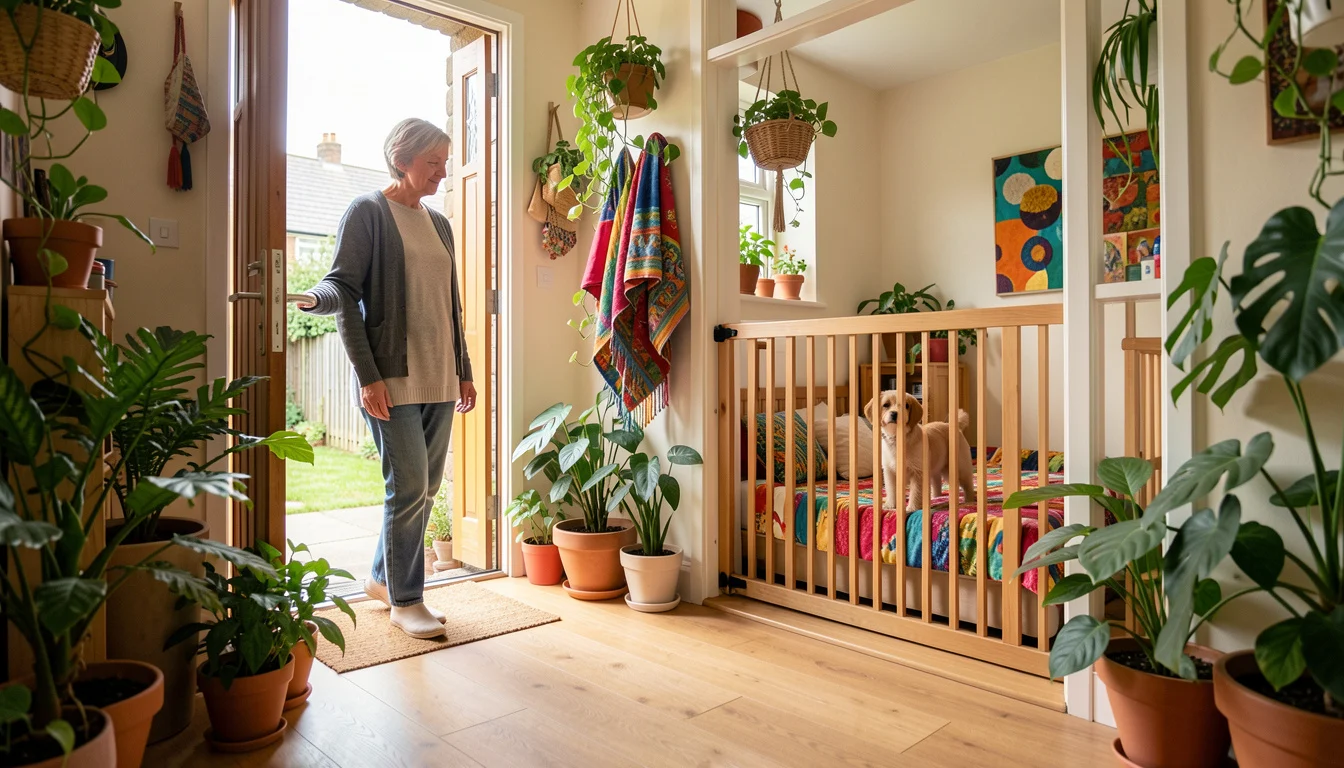
During real arrivals, manage access before the bell rings: put the dog behind a gate, in a comfortable room, or on leash at a distance where it can settle. Ask visitors to ignore the dog until it is calm, and do not open the barrier if the dog is jumping or pushing through. Training and management work together; management prevents the dog from rehearsing the rush while practice builds a new response.
A realistic routine might look like this:
The doorbell rings while the dog is behind a gate, away from the entry.
The owner cues “place” and rewards the dog for staying on the mat.
The visitor enters and waits without leaning over or reaching toward the dog.
For a dog that is frightened, growls, or has a bite history, skip visitor greetings as a training exercise. Keep a secure separation plan and seek help from a qualified reward-based trainer or veterinary behavior professional. The ASPCA’s guidance on common dog behavior issues can help owners recognize when behavior concerns call for added support.
Troubleshooting Barking, Jumping, and Slow Progress
If barking starts as soon as the sound plays, the practice is too difficult at its current volume or distance. Turn it down, move farther from the speaker or door, and reward a small response such as turning toward you. Do not keep replaying the sound at full volume in the hope that the dog will get used to it; repeated exposure without relief can intensify distress.
Jumping often persists because the dog still reaches the visitor, even after barking or bouncing. Use a gate or leash to prevent access, and reward four paws on the floor before the greeting begins. If the dog cannot settle when a visitor is present, end the greeting and try again later at an easier level.
A common training mistake is opening the door too soon. The door movement and person entering can be more exciting than the chime, so a dog that succeeds with a recording may still rush during a real arrival. Practice the sound, then the door opening, then a visitor entering, as separate steps.
Progress depends on the dog’s history, sensitivity, and the reliability of the visitor routine; there is no fixed timeline. If reactions are intense, worsening, or linked to fear or aggression, a generic practice plan may not be enough. Ask a veterinarian to rule out relevant health factors and consider a qualified behavior professional.
Choosing and Using a Bell for Potty Training
For potty-bell training, place the signal beside the door used for outdoor trips and teach the dog to touch it immediately before going out. Reward the outdoor elimination, not just the bell touch, so the signal stays connected to the purpose of the trip. The American Kennel Club’s guidance on teaching a dog to ring a bell to go outside describes this separate training goal.
Hanging bells and button-style devices can both work. Choose based on what your dog can reach and operate reliably, not on a product ranking; a small puppy may struggle with a stiff button, while a dog that mouths hanging bells may do better with a mounted button.
Option
How the dog signals
Best fit
Watch for
Hanging bells
Nose or paw nudges bells attached near the door
Dogs that can reach and comfortably touch a loose object
Some dogs chew, paw at, or ring them for attention
Button-style bell
Paw or nose presses a button that makes a sound
Dogs that prefer a fixed target or need a clear, consistent touch point
Button height, pressure, and sound should suit the dog
To teach either type, prompt a gentle touch, open the door right away, and take the dog outside. Keep the trip purposeful; if the dog rings and does not need to eliminate, return indoors after a short, calm opportunity rather than turning every signal into play. That reduces the chance that the bell becomes a general request for entertainment.
📱 See this content as a Web Story
Frequently Asked Questions
Should I Ignore My Dog’s Barking When the Doorbell Rings?
Ignoring barking alone may not teach the dog what to do instead, and it will not make a frightened dog feel safer. Prevent a rush to the door, lower the sound intensity during practice, and reward a specific alternative such as going to a mat.
Can a Puppy Learn to Use a Potty Bell?
Yes. During house training, prompt the puppy to touch the bell before each scheduled outdoor trip, then reward toileting outside. A puppy still needs regular trips; the bell does not replace a suitable schedule or supervision.
What If My Dog Rings the Potty Bell for Reasons Other Than Needing to Go Out?
Take the dog out calmly for a brief, purposeful chance to eliminate. If there is no toileting, return indoors without turning the trip into play, and continue using the bell before planned potty breaks.
For the next practice, choose one manageable starting point: a quiet recording, a station several feet from the entry, and treats ready before the sound begins. If the dog can eat and move to the station, repeat that level; if not, lower the volume or increase distance before trying again.