
Hydroponic Hanging Systems: Easy Setups for Beginners
How hydroponic hanging systems work: choosing crops, planning supports, and ensuring maintenance access for overhead soilless growing with nutrient solutions.
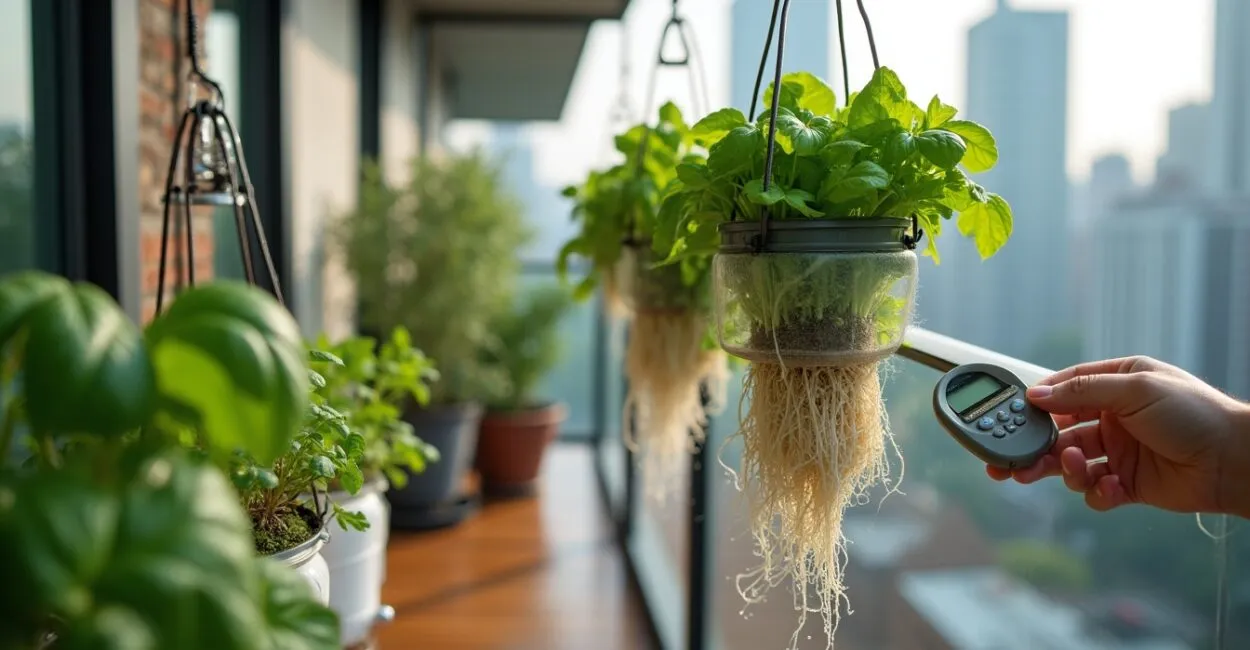 Herbs thriving in a balcony hydroponic system
📅 Updated on 10/11/2026
A suspended grow channel can look tidy from the floor and still be awkward to service overhead. Hydroponic hanging is a way to grow plants in containers or channels supported above the ground, with roots fed by a nutrient solution rather than soil. The right design depends on the crop, ceiling or frame strength, and how easily you can reach the plumbing.
For a first project, a short drip-fed line or a small suspended deep water culture (DWC) unit is usually easier to inspect than a long overhead nutrient film technique (NFT) channel. Each method has different water-flow and failure risks. Plan the support and maintenance access before buying pumps or plants.
Before You Start
- Choose the crops and estimate the mature weight of plants, channels, water, and hardware.
- Identify a support structure rated for the full load; get qualified advice if its capacity is uncertain.
- Mark a route for supply lines, return flow, power, and safe access for cleaning.
- Decide whether you can check the system daily and respond to a pump or leak problem.
1. What Hydroponic Hanging Means and How It Works
Hydroponic hanging is a soilless growing arrangement in which plant sites, channels, or reservoirs are suspended from a frame or building structure and supplied with water containing dissolved nutrients. In everyday terms, plants grow overhead or on a vertical plane while a pump, gravity, or both move solution through their root zone.
A recirculating hanging hydroponic system draws solution from a reservoir, sends it to the plants, then collects the runoff and returns it to the reservoir. The loop needs a pump, tubing, plant supports, a return path, and a way to monitor water level and nutrient conditions. Some designs instead drain to waste, which avoids returning runoff but uses more water and fertilizer.
Leafy greens, herbs, and some compact fruiting crops can suit suspended systems, depending on the support and method. Heavy crops or plants with large root masses need more space and stronger supports. The term “vertical hydroponics” describes the layout, not a specific irrigation method.
2. Choose Between NFT, Drip, and Suspended DWC
NFT, drip, and suspended DWC differ in how roots receive solution and how the system behaves when power or flow stops. For a first build, choose the method you can reach, inspect, and repair without moving a ladder around wet electrical equipment.
Method How it feeds roots Good fit Main limitation Hanging NFT A shallow, continuous film flows through a sloped channel. Light crops such as lettuce and herbs in a carefully leveled run. Roots can dry quickly if flow stops; channels need an even slope and clear return. Drip Emitters deliver solution to each growing site; excess drains back or away. Plants in baskets or containers, including crops needing individual support. Emitters can clog, and uneven pressure can leave some sites dry. Suspended DWC Roots hang into an aerated nutrient reservoir. A compact, accessible unit where a stable reservoir can be supported safely. Water weight is substantial; low oxygen or a warm reservoir can stress roots.
NFT depends on a thin moving film, so a blocked channel or failed pump can expose roots to air. Drip offers more control over individual containers, but filters and emitters require regular checks. DWC buffers short interruptions with a reservoir, yet puts the greatest water load directly overhead. The University of Minnesota Extension’s hydroponics resources provide useful background on soilless growing methods.
3. Plan and Install the Support, Plumbing, and Light
Start with a measured layout, not a shopping list. Leave room to remove a channel, lift a reservoir lid, inspect emitters, and catch runoff without standing beneath a leak. If the setup is above a living area, protect the floor and keep connections away from outlets and power strips.
- Confirm the load path. Include the filled reservoir, water held in channels, mature plants, supports, and a safety margin. Do not assume drywall anchors or an unverified ceiling joist can carry a suspended system; use suitable structural attachment and seek a building professional when needed.
- Set the slope and return. For NFT, use a stable, slight fall toward the drain and test the whole channel before planting. For drip, make supply tubing accessible and provide a return or drain that cannot overflow.
- Install and test irrigation. Place the pump where it can be removed for cleaning. Run clean water through every line, check each outlet, and watch the return for leaks or pooling.
- Plan lighting and access. Match grow-light coverage to the plant canopy, not just the channel length. Keep fixtures clear of splash and make routine tasks possible from a stable platform.
A common setup mistake is testing only the pump at floor level, then discovering that the elevated return line traps water or leaks at a fitting. Test at the installed height, with the system filled, before adding plants. Electrical work in damp growing areas should follow local code; the U.S. Consumer Product Safety Commission offers general electrical safety guidance.
4. Choose Equipment, Estimate Costs, and Scale Carefully
A basic build typically needs a reservoir, water pump, tubing, growing channels or containers, plant holders, and supports. Add an air pump and air stone for DWC, or filters and emitters for drip. A timer can control scheduled irrigation, while pH and electrical conductivity (EC) meters help monitor acidity and nutrient concentration.
There is no reliable single price for a basic hydroponic hanging setup: cost changes with the system’s size, materials, lights, structural work, and local prices. A small indoor unit using existing shelving and ambient light costs less to equip than a custom overhead frame with dedicated grow lights and professional installation. Include replacement tubing, nutrients, electricity, test solutions, and any repairs in the ongoing budget.
Scale in modules. Run one short channel or a few drip sites long enough to learn how your water, crop, and room behave before adding more. Larger systems add pump capacity, plumbing complexity, and the consequences of a failure; a commercial layout also needs dependable access, sanitation procedures, and a plan for downtime.
5. Match Crops to the Space and Accept the Trade-Offs
Suspending plants can free bench or floor area and make use of a wall or overhead frame. It does not automatically increase usable growing capacity: light may not reach lower foliage evenly, and dense planting can make airflow and harvesting harder.
Choose crops by mature size, root volume, and harvest method. Lettuce and many herbs are manageable in small channels. Fruiting plants may need trellising, stronger supports, larger root zones, and more frequent pruning. A hanging setup is a poor fit when the plants become too heavy to service safely or when the only way to fix a fitting is to work directly beneath a full reservoir.
Water and nutrient efficiency depend on design and operation. A recirculating loop can reuse solution, but leaks, frequent reservoir dumping, or poor management reduce that advantage. The USDA’s urban agriculture overview offers broader context for growing food in built environments; it does not establish that one suspended method suits every site.
A suspended system is only practical when its load, light, and maintenance access work together.
6. Run a Maintenance Routine and Troubleshoot Early
Check the system daily at first: confirm the pump runs, solution returns freely, plants are receiving water, and no fitting is dripping. Record reservoir level, pH, and EC on a consistent schedule. Refill and adjust according to the nutrient product and crop needs rather than making large corrections by guesswork.
- Dry plants or weak flow: Check reservoir level, pump intake, tubing kinks, timer settings, and blocked emitters. Clean filters before increasing pump output.
- Uneven growth in NFT: Inspect channel slope and flow across the full run. A low spot can hold water while sites farther along receive too little.
- Leaks or overflow: Shut off the pump, isolate power safely, and find the source before restarting. Test repaired joints with water while the system is empty of plants.
- Cloudy or foul-smelling reservoir: Inspect roots, remove debris, and clean the reservoir and lines using a method compatible with the equipment and crop cycle.
Keep a spare pump or a tested backup plan if a short interruption could leave roots dry. Follow product labels for nutrients and cleaning agents, and never mix chemicals unless their instructions say it is safe.
7. Use a Buyer’s Checklist to Select Your Setup
Before purchasing, answer these questions in order:
- Where will it hang? Verify the structure, clearance, light, and a safe route to inspect it.
- What will you grow? Match channel size, root space, and support strength to mature plants.
- Which failure can you manage? NFT needs dependable flow; drip needs clean emitters; DWC needs a secure water-bearing support and aeration.
- What can you maintain? Choose equipment you can reach for cleaning, measurement, and repair.
- What is the full budget? Price the frame, irrigation, lighting, instruments, recurring supplies, and installation separately.
For a first attempt, a small, reachable drip line is often the easiest way to learn irrigation and plant spacing. Choose NFT when you can maintain an even channel slope and reliable flow; choose suspended DWC only when the filled reservoir can be supported and serviced safely. Sketch the layout, verify the load, and test the plumbing with water before planting.