
Eco-Friendly Country Homes with Tesla Powerwall Cut Bills by 60%
How rural renewable energy combines solar, battery storage, and efficiency to reduce high utility costs amid shade, long lines, and local rates in country ho…
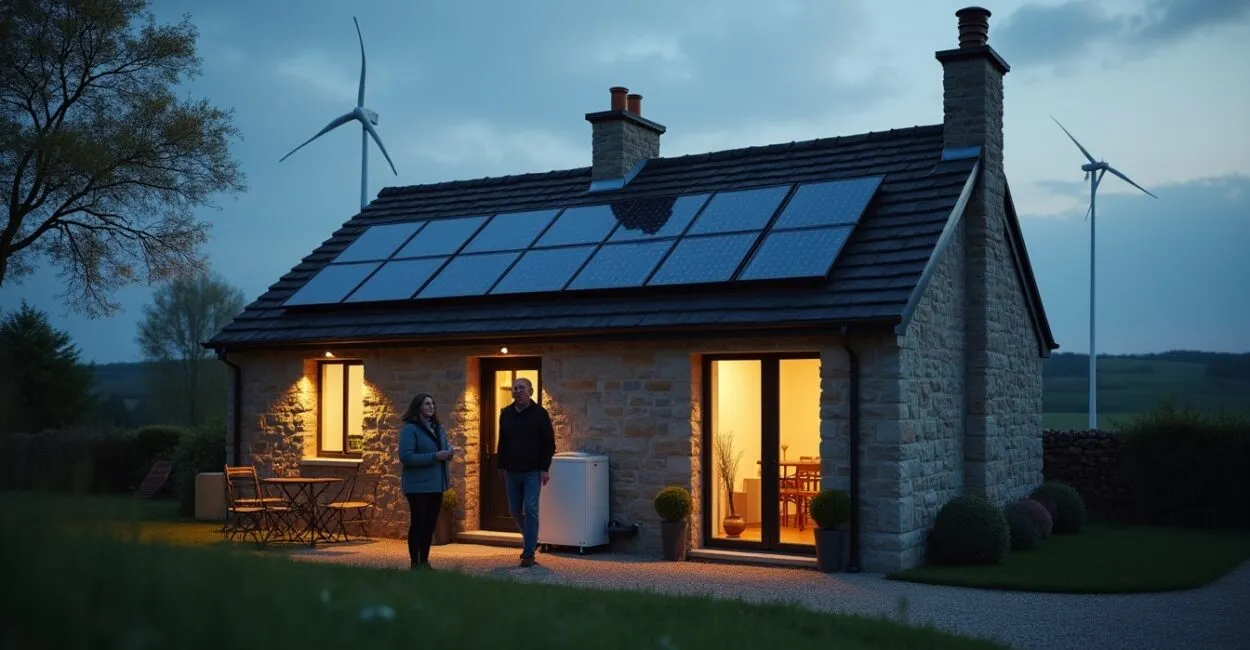 Couple beside renewable energy systems at their country home
📅 Updated on 10/21/2026
A rural home can have plenty of roof space and still face high energy bills: shade, long utility lines, electric heating, and local rates all affect the result. An eco country energy plan combines efficiency with renewable generation and, where useful, battery storage. Solar often leads the options, but a battery or wind turbine makes financial sense only when the property’s needs and conditions support it.
Annual bill savings of 50% to 60% may be possible for some homes, but that range is a scenario to test, not a dependable forecast. The outcome depends on how much power the system produces, when the household uses it, what the utility pays for exported electricity, and the total installed cost.
Quick Facts
- Search intent: Informational, focused on choosing and assessing rural renewable energy and understanding what makes a country environmentally friendly.
- Solar panels: Generate electricity from sunlight; output varies with orientation, shade, weather, and system design.
- Battery: Stores electricity for later use or backup; it does not generate power.
- Small wind: Requires a suitable site, verified wind conditions, permits, and ongoing maintenance.
- Off-grid design: Must account for seasonal generation, peak loads, and extended periods of low renewable output.
- Country rankings: Results depend on the index, indicators, and year; a national ranking does not predict a particular home’s energy costs.
Eco Country Energy Savings: What Solar, Batteries, and Efficiency Can Deliver
For a rural home, the most reliable route to lower energy costs is usually to reduce avoidable consumption, then size renewable generation to the remaining load and local utility rules. Solar can cut electricity bought from the grid; a battery can shift some of that solar power to evening use or provide backup. Savings depend on the property’s usage, solar conditions, rates, export credits, and equipment costs.
Start with twelve months of utility bills, not a rough estimate based on square footage. Look for seasonal peaks, demand charges, and the share of electricity used after sunset. An electric well pump, workshop tools, or resistance heating can create short, high loads that affect equipment sizing even when annual consumption seems moderate.
Efficiency changes the system you need. Sealing air leaks, adding insulation, and tuning heating and cooling can lower the energy demand that solar and storage must cover. A shaded roof section can reduce the output of a string of panels if the design does not account for shade. Ask the installer to show how shade affects the production estimate, rather than accepting a roof-area calculation alone.
For a useful comparison, ask for estimated monthly production and household consumption on the same chart. Annual totals can hide a winter shortfall or a summer surplus that receives little value under the utility’s export rules. Also request the assumptions behind the estimate, including weather data, system losses, and any expected change in electricity rates.
Bill savings come from matching generation and use, not from panel count alone.
Renewable Energy Combinations for Remote and Windy Rural Homes
Solar paired with grid service is often the simplest rural renewable energy option when the roof or a nearby ground-mount site has good sun. A solar-and-battery system adds evening use and backup, while a hybrid setup can combine solar, a generator, and batteries where outages are frequent. A small wind turbine can complement solar at a genuinely windy site, but a ridge location by itself does not prove that wind power will pay.
System
Best fit
Key limitation
Grid-tied solar
Homes with reliable grid access and a suitable solar site
Export compensation and utility rules affect savings
Solar with battery
Homes seeking backup or greater use of their own solar power
Storage adds cost and does not create electricity
Solar and small wind
Sites with strong, consistent winds and adequate solar access
Wind assessment, permitting, siting, and maintenance add complexity
Off-grid solar, batteries, and generator
Properties without practical grid service
Must handle seasonal shortfalls and backup-fuel needs
For a windy ridge home, first confirm wind speed and turbulence at the proposed turbine height using an appropriate site assessment. Trees, buildings, and terrain can disrupt airflow, even when the area feels breezy at ground level. The U.S. Department of Energy’s Small Wind Guidebook explains resource assessment, siting, and practical considerations for small wind systems.
Solar and wind can complement each other when local production patterns differ by season or time of day. That advantage is site-specific. Turbine noise, tower access, wildlife considerations, maintenance, and local planning rules can outweigh added generation at an unsuitable property.
A practical comparison for a ridge property should include three designs: solar alone, solar plus storage, and solar combined with wind. Compare monthly output, installed cost, maintenance assumptions, and the cost of any generator fuel. Do not compare a wind proposal based on estimated annual output with a solar proposal that includes a detailed site-specific production model.
Ask how the turbine’s projected output was calculated and whether the estimate reflects wind measured or modeled at the proposed hub height. A short observation at ground level is not a dependable substitute for a site assessment. Check local zoning and setback rules early, since a tower that cannot be permitted is not a workable design.
Tesla Powerwall Payback, System Costs, and Backup Needs
A Tesla Powerwall pays for itself only when the value of electricity shifted, avoided outages, and any applicable incentives exceeds the battery’s installed cost over its useful service life. There is no dependable universal payback period. The estimate changes with battery price, financing, utility rates, export credits, battery use, and how often the system cycles.
To estimate payback, compare two realistic bills: one with the proposed solar system alone and one with solar plus storage. Include installation, electrical work, permits, financing, and any required service-panel upgrades. Then estimate the annual value of stored power using the home’s actual time-of-use rates and export rules. Treat backup value separately; avoiding an outage can matter greatly to a household, but it is not the same as a utility-bill saving.
A simple estimate is the battery’s net installed cost divided by the annual bill savings attributable to the battery. Use the difference between the solar-only and solar-plus-battery cases, not the total savings from the entire solar project. If that annual difference is small or uncertain, the battery may be better justified by backup needs than by a projected bill payback.
For example, a proposal may show substantial savings from solar panels but only a modest additional reduction from adding storage. The battery’s payback calculation should use that smaller incremental benefit. If the utility already credits exported electricity favorably, compare the battery’s cost with the value of those credits rather than assuming every stored kilowatt-hour avoids a full retail-rate charge.
Backup sizing should begin with essential loads: refrigeration, well pump, communications, lighting, and medically necessary equipment. High-demand loads such as electric resistance heat, large air conditioners, and workshop machinery may require careful load management or additional capacity. Confirm with the installer which circuits the backup system can support and for how long under realistic conditions.
A Powerwall stores electricity; generation or grid charging must supply the energy it later delivers.
Storage alone cannot keep a rural property fully off-grid. An off-grid home needs a generation system sized for difficult seasons, enough storage for periods without generation, and a plan for prolonged cloudy or calm weather. A backup generator may still be necessary, particularly where winter loads are high or access to fuel and service is uncertain.
Three Rural Property Patterns and Their Energy Priorities
Consider three common property types as planning examples, not guaranteed savings case studies. Their best-fit systems differ because energy use, access to the grid, and site conditions differ.
- Working farm: Map pumps, refrigeration, barns, and machinery by operating schedule. Solar may offset steady daytime loads, while batteries can cover selected evening or outage needs. A large motor’s starting surge needs attention during system design.
- Remote cabin: Measure actual seasonal use before choosing an off-grid system. A smaller load, efficient appliances, and a generator for long low-sun periods may be more practical than sizing batteries to cover every rare worst-case event.
- Heritage home: Check roof condition, visual restrictions, and historic-preservation rules before selecting a panel layout. A ground-mounted array may be an alternative, but land use, trenching, and permitting can change the project cost.
In all three cases, a production estimate should show monthly output, not only an annual total. A system that appears balanced over a year can still produce too little during the season when heating or pumping demand is highest. Also check whether equipment can be reached for repairs during the season when the property depends on it most.
Read also: Holiday Home Trends for 2025: Cozy Upgrades and Tech
Property owners can make the comparison more useful by recording which loads are essential, which can be shifted to sunny hours, and which can be switched off during an outage. That inventory helps an installer model backup needs without sizing the system around every appliance running at once.
Rural Energy Incentives, Permits, and Installer Checks
Rural energy incentives vary by country, state, utility, and project type, and program rules can change. Check current federal and state sources, your utility, and local government before including a grant or tax benefit in the project budget. The U.S. Department of Energy’s energy savings resources can help homeowners identify federal and state efficiency programs. Confirm eligibility and timing directly with the relevant agency; a program listing does not guarantee that a specific property qualifies.
Read also: Why Country Houses on Airbnb Are Trending in 2025
Permits may cover building, electrical work, fire access, zoning, historic preservation, and utility interconnection. Wind towers can face separate height or setback restrictions. Get written confirmation about which approvals the installer will obtain, who pays the fees, and whether the project can connect to the grid before ordering equipment.
Request a written proposal that specifies equipment, estimated monthly production, assumptions about shading and weather, battery backup circuits, warranties, and exclusions. Compare proposals on the same assumptions. Ask how the installer handles service calls at a rural address, where replacement parts come from, and what happens if the utility rejects or delays interconnection.
Before accepting an incentive estimate, check the program’s current application window, eligible equipment, property requirements, and whether approval must come before installation. Keep copies of the application, invoices, equipment specifications, and utility approval. These records can help resolve questions about eligibility or system commissioning.
For grants, ask whether the program pays the homeowner, the contractor, or the lender, and whether reimbursement arrives before or after installation. A project budget should remain workable if a proposed incentive is delayed or denied. Do not rely on an installer’s verbal estimate as proof of eligibility.
Installation Mistakes That Can Undercut Home Energy Savings
The most expensive planning error is sizing from an annual bill while ignoring when electricity is used. A household may have modest yearly consumption but a large evening peak, or seasonal loads from heating and irrigation. Those patterns affect inverter capacity, battery value, and whether a generator is still needed.
- Ignoring the building envelope: Heating and cooling losses can force a larger renewable system than necessary.
- Assuming export credits equal retail rates: Utility compensation varies and can change the value of a battery.
- Choosing a turbine from a map or impression: Confirm site wind conditions, setbacks, permitting, and maintenance access first.
- Overlooking electrical upgrades: Older panels, long cable runs, and service changes can add cost.
- Buying storage without a use case: A battery may have limited financial value where grid power is reliable and export credits are favorable.
The National Renewable Energy Laboratory’s solar research resources provide background on solar technologies and system considerations. National information cannot replace a property-specific design: shade, roof structure, utility tariffs, and local code requirements determine what works on an individual site.
Another common mistake is accepting a single production forecast without checking its assumptions. Ask whether the estimate accounts for roof orientation, shade, snow or soiling, inverter losses, and local weather data. Compare it with a second proposal, and ask each installer to explain any large difference in expected output.
Also check whether the proposal describes what happens during a grid outage. Some grid-connected solar systems shut down when utility power fails unless they include suitable backup equipment and are configured to operate safely in island mode. Confirm the system’s operating limits, transfer equipment, and backup circuits in writing.
A Step-By-Step Checklist for an Eco Country Property
Work through the project in sequence: document energy use, reduce avoidable demand, assess the site, and compare designs before committing to equipment. This makes it easier to separate genuine savings from assumptions that depend on incentives or future utility rules.
- Collect 12 months of bills and note seasonal peaks, rate plans, outages, and export compensation.
- List major loads, including well pumps, heating, refrigeration, and equipment with high starting demand.
- Assess efficiency and site conditions: inspect insulation, roof age, shade, possible ground-mount locations, and access for installation.
- Decide what backup must cover. Separate essential circuits from loads that can wait or be switched off during an outage.
- Request comparable designs for solar alone and solar with storage; include monthly production, installed costs, and assumptions.
- Verify permits, incentives, and interconnection with the authorities and utility before committing to equipment.
The financial case is strongest when the system solves a measured problem: expensive evening power, frequent outages, or a real need to avoid extending a utility line. Before signing a contract, test the proposal against a low-production season and a higher-cost scenario, then decide whether the expected savings and backup value justify the upfront cost.
Keep a copy of the final design, warranties, permits, utility approvals, and commissioning records. These documents make it easier to confirm the installed equipment matches the proposal and to arrange maintenance or warranty service later.
What Makes a Country Eco-Friendly?
An eco-friendly country performs well across several environmental measures, rather than relying on one headline statistic. A useful comparison considers emissions, air quality, ecosystem protection, waste, energy sources, and the policies that shape long-term outcomes. Rankings can change depending on which measures receive the most weight.
The Environmental Performance Index (EPI), produced by Yale and Columbia researchers, combines indicators covering environmental health, ecosystem vitality, and climate change. Its 2024 country results provide one framework for comparing national performance. The index is a snapshot based on its selected indicators and data; it should not be treated as a complete measure of every country’s environmental impact.
Measure
What it helps assess
Question to ask when comparing countries
Climate and energy
Emissions, energy sources, and climate-related policies
Are emissions falling, and how carbon-intensive is the energy supply?
Air and water quality
Environmental conditions that directly affect people
Do residents have cleaner air and reliable access to safe water?
Nature and ecosystems
Habitat protection, biodiversity, and land management
Are ecosystems protected and managed over time?
Consumption and waste
Resource use and the environmental footprint of daily life
Does the comparison count pollution created abroad to meet domestic demand?
In the EPI’s 2024 results, Estonia ranked first overall, followed by Luxembourg and Germany. That makes Estonia a leading answer to “What is the greenest country in the world?” under that particular index and edition. The result does not establish one permanent winner: a climate-only ranking, a biodiversity measure, or a consumption-based emissions comparison can produce a different order.
The EPI’s 2024 top ten also included Finland, the United Kingdom, Sweden, Norway, Austria, Switzerland, and Denmark. This makes the list useful for queries such as “eco-friendly country in Europe” and “greenest country in Europe,” provided the year and ranking method are stated. The order should not be carried forward as a 2026 ranking without a new edition and updated results.
For Asia, identify the edition and metric before naming a “most green” country. A country can score well on air quality or protected land while facing challenges in emissions or resource consumption. The same caution applies to requests for the top 20 greenest countries: a longer list is only comparable when it uses the same indicators, methodology, and data year.
There is no single “least green” country without specifying a measure and year. A country may have high total emissions because of its population and industrial output, while another may have higher emissions per person. Country rankings describe national averages; they cannot tell a rural household whether a particular roof, utility tariff, or wind site is suitable for renewable energy.
Examples of eco-friendly practices include generating electricity from low-carbon sources, protecting forests and wetlands, improving public transit, reducing food and material waste, and designing buildings that need less heating and cooling. These examples can be assessed at different scales: a national policy, a community program, and a household choice are related, but they are not interchangeable measures of a country’s overall performance.
There is also no universally agreed “most eco-friendly state.” The answer changes with the measure: one ranking might emphasize renewable electricity, another air quality, conservation, or per-person emissions. For a useful U.S. state comparison, name the metric and year, and check whether the data include imported electricity or goods. A state’s average performance does not determine the renewable-energy potential of an individual rural property.
“Most polluting country” also needs a defined measure. Rankings by annual territorial carbon dioxide emissions differ from rankings by total greenhouse gases, emissions per person, or pollution embodied in imported goods. China, the United States, and India are among the largest annual territorial CO₂ emitters; avoid presenting a fixed top ten without naming the dataset, year, and pollutant measured.
Frequently Asked Questions About Rural Renewable Energy
How Quickly Can a Tesla Powerwall Pay for Itself?
There is no standard payback period. Calculate it from the installed cost, the value of electricity stored and used, utility export rules, financing, and any verified incentives. Compare the battery’s added savings with a solar-only system, and count outage protection separately from bill savings.
Which Renewable Combination Works Best for a Windy Ridge Home?
Solar with a small wind turbine may work if measurements confirm a strong, consistent wind resource at the proposed tower height. Check turbulence, setbacks, permits, maintenance access, and solar conditions before comparing it with solar and battery storage alone.
Can Rural Homeowners Get Grants or Other Incentives?
Some regions offer incentives for renewable energy or efficiency, but eligibility and funding depend on location, project type, and current program rules. Verify details with official government sources and the local utility before counting an incentive in your budget.
Can Tesla Powerwalls Alone Take a Rural Property Fully Off-Grid?
No. A Powerwall stores electricity but does not generate it. An off-grid system also needs renewable generation or another charging source, adequate capacity for seasonal low-output periods, and often a backup generator.
What Are the Most Environmentally Friendly Countries in the World?
The answer depends on the ranking method and year. In the 2024 Environmental Performance Index, Estonia ranked first overall, followed by Luxembourg and Germany. Other measures may rank countries differently because they weigh climate, pollution, ecosystems, and resource use in different ways.
What Are the Top 10 Most Polluting Countries?
There is no single list that fits every meaning of “most polluting.” Rankings by annual territorial carbon dioxide emissions differ from rankings by total greenhouse gases, emissions per person, or pollution embodied in imported goods. China, the United States, and India are among the largest annual territorial CO₂ emitters; check a dated dataset and its chosen measure before comparing a full top ten.
What Are Examples of Eco-Friendly Practices?
Examples include using low-carbon electricity, improving home insulation, taking public transit where available, reducing food waste, reusing materials, and protecting natural habitats. The best options depend on local conditions and should be judged by their actual environmental effects, not by a label alone.
What is the Most Eco-Friendly State?
There is no single answer unless the ranking’s measure and year are specified. A state may perform well on renewable electricity while another ranks higher for air quality, conservation, or per-person emissions. Compare a named, current dataset and its methodology rather than treating one state as the winner across every environmental measure.