
How to Choose a Green Electricity Plan for Your Home
Compare green electricity and conventional plans by examining verified renewable claims, total costs, contract terms, and rate types to choose the best fit f…
 A household weighing renewable electricity options
Choosing a green electricity plan means weighing the strength of its renewable-energy claims against the rate, fees, and contract terms you’ll actually pay. The best fit depends on your location and usage: compare verified renewable content and total costs, then check whether the offer is a fixed-rate or variable-rate plan and what it takes to leave.
Green Electricity Plan Vs. Conventional Plan: Which Should You Choose?
Choose a green electricity plan if its renewable-energy claim is documented, its full terms fit your budget, and you want your electricity purchases matched with renewable generation. Choose a conventional plan if it offers better terms for your needs or if green options in your area lack clear verification. Compare total cost and evidence, not the advertised rate alone.
How Green Electricity Plans Differ at a Glance
A renewable electricity plan may use renewable energy certificates (RECs) to support its environmental claim, even though your home receives electricity through the same grid as other customers. A conventional plan generally does not make the same renewable matching claim. In either case, the plan’s price and terms depend on your location and provider.
Criterion Green electricity plan Conventional plan Renewable claim Renewable supply or REC matching; verify details Usually no renewable matching claim Electricity delivered = Grid electricity; source is not identifiable at the outlet = Grid electricity; source is not identifiable at the outlet Price Depends on location, usage, and offer Depends on location, usage, and offer Contract terms Provider-specific; check fees and rate structure Provider-specific; check fees and rate structure Renewable verification Look for clear REC or supply documentation Not usually a plan feature Availability Varies by utility territory and market Varies by utility territory and market

What a Green Electricity Plan Includes—and What It Doesn’t
Technically, a green electricity plan is a retail electricity offer that represents some or all of a customer’s electricity use as matched with renewable electricity, often through renewable energy certificates. In everyday terms, the provider makes a documented renewable-energy claim on your behalf; the grid still mixes electricity from many sources before it reaches your home.
A REC represents the environmental attributes of one megawatt-hour of renewable electricity generated and delivered to the grid. It is separate from the electricity itself. A plan may purchase and retire RECs to match customer use, but that does not mean electrons from a particular wind or solar facility travel directly to your house.
A green plan is also different from installing rooftop solar. It does not, by itself, put panels on your roof or guarantee that your monthly bill will fall. For practical steps that can reduce household consumption, see these energy-saving habits for the home.
How to Check Renewable Sourcing and Verify Provider Claims
Ask what share of your estimated use the plan matches, what renewable sources qualify, and whether the provider retires the associated RECs for customers. A clear plan document should explain the claim and identify how renewable content is accounted for. Vague phrases such as “clean energy” are not enough to compare offers.
The EPA Green Power Partnership explains green power purchasing and related claims. The U.S. Energy Information Administration describes electricity generation and its environmental effects. These sources provide context, but they do not certify every retail plan. Ask the provider for its product-specific documentation and check whether an independent certification or tracking system applies.
A common comparison mistake is treating a “100% renewable” label as proof that a provider built new renewable projects or that renewable electricity physically reaches a particular home. The claim may refer to REC matching, and the plan documents determine what is being matched. Check whether the provider describes the certificates’ source, quantity, and retirement rather than relying on a headline percentage.
Compare Electricity Plan Rates, Fees, Contract Length, and Exit Terms
The cheapest green energy source depends on the project, region, timing, and how costs are counted; there is no single source that is cheapest for every household or retail plan. Solar and wind can be low-cost sources in some settings, but a household’s plan price also reflects grid delivery, contract structure, and provider charges. Compare offers using your own usage and location.
For the most affordable electricity plans in Texas, use the official Public Utility Commission of Texas Power to Choose marketplace to compare available offers for your ZIP code. There is no reliable statewide “cheapest provider” answer without current, location-specific rates and a household’s usage pattern.
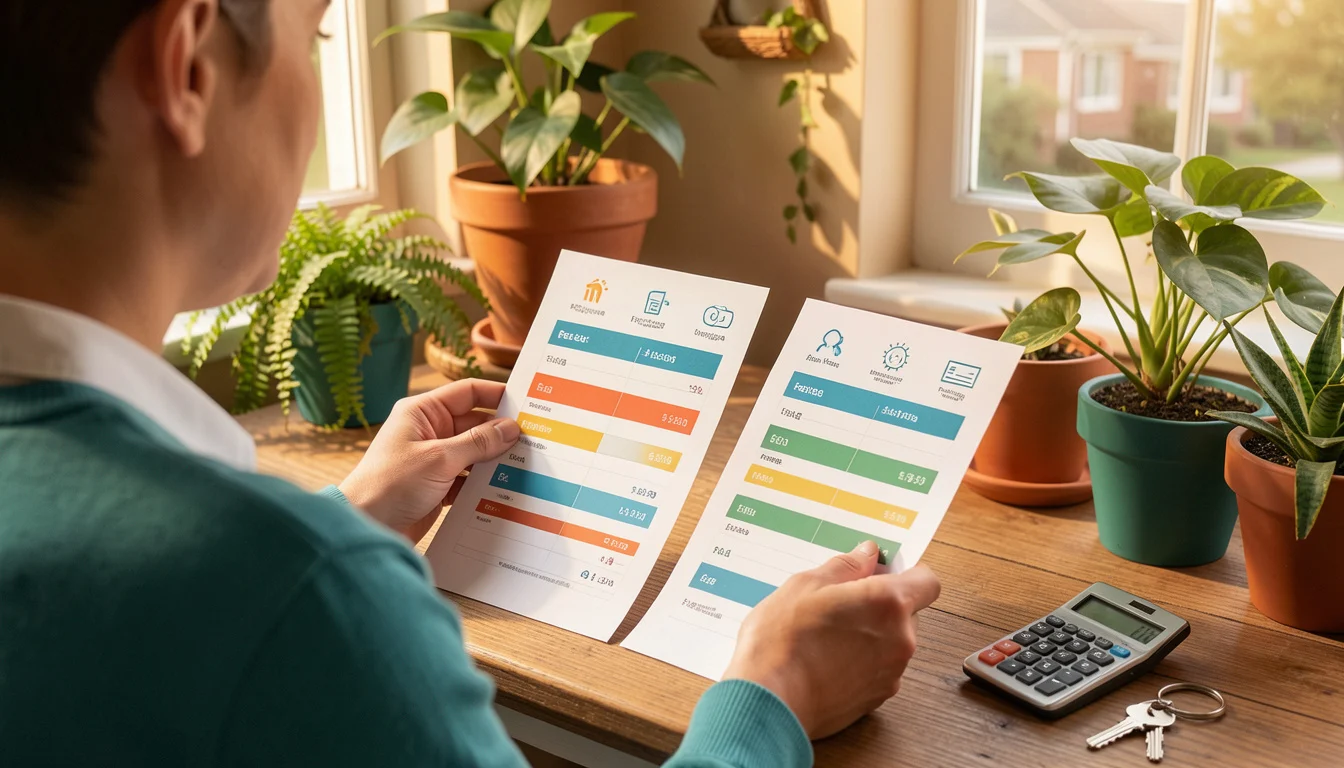
Check the Electricity Facts Label or equivalent plan document for the rate at different usage levels, recurring fees, introductory pricing, minimum-use charges, and any early termination fee. A low advertised rate may apply only at a particular monthly usage level. Look at how the plan prices your actual consumption, not just a sample rate in an advertisement.
Hypothetical example: Suppose a household uses 1,000 kWh in a month. Plan A charges 12 cents per kWh plus a $10 monthly fee: 1,000 × $0.12 = $120, then $120 + $10 = $130 before taxes and other charges. Plan B charges 13 cents per kWh with no monthly fee: 1,000 × $0.13 = $130. At that usage, the two totals are equal before additional charges; a different usage level could change which costs less.
Whether a renewable electricity plan costs more depends on the offer. Some green plans carry a premium, while others may be priced competitively with conventional options. The comparison is limited by changing market rates and differing fee structures, so use current plan documents rather than broad price claims.
Match a Renewable Energy Plan for Home to Your Usage and Switching Needs
Plan features matter most when they match how and when your household uses electricity. A fixed rate can make the energy charge more predictable during the contract term, while a variable rate may change under the plan’s terms. Neither structure guarantees a lower bill; total use and any separate charges still matter.
If you’re weighing a switch to green energy, check whether you can leave without an early termination fee and whether the new provider handles the enrollment. Switching cost depends on the plan and circumstances: a provider may charge no enrollment fee, but an existing contract can impose an exit charge. Confirm both before you authorize a change.
Use This Checklist to Compare Providers
- Confirm the service address and the plan’s availability.
- Compare the rate at your typical monthly usage, including recurring charges.
- Check fixed or variable pricing, contract length, and renewal terms.
- Find any minimum-use charge, deposit, late fee, or early termination fee.
- Ask what renewable percentage is matched and how RECs are handled.
- Save the plan disclosure and the provider’s written explanation of its green claim.
Households trying to lower consumption as well as change supply can pair a suitable plan with basic home energy-saving steps. Renters can also consider energy habits that require no major upgrades.
How to Switch Providers and Compare Electricity Plans in Texas
Before switching, check whether your current contract has an exit fee and note its end date. Compare the new plan’s full disclosure with your recent bills, then confirm the start date and whether any service interruption is expected. Keep your confirmation and final bill in case the closing charges need review.
In Texas, retail electricity choice is available in many areas, but not every location has the same options; some utilities and communities are outside the competitive retail market. Use the Public Utility Commission of Texas marketplace to compare offers where choice applies, and read the Electricity Facts Label for each candidate. Rates and availability change, so a plan that appears cheapest today may not remain the best option at renewal.
📱 See this content as a Web Story
Frequently Asked Questions
Is Green Energy Worth It?
It can be worth it for households that value documented renewable matching and find a plan whose price and terms fit their budget. Its value depends on the quality of the claim and the cost relative to available alternatives.
How Much Does It Cost to Switch to Green Energy?
There is no universal switching fee. The new provider may not charge an enrollment fee, but an early termination fee from your current contract or other plan-specific charges may apply. Check both agreements before switching.
How Can a Household Verify a Provider’s Renewable Electricity Claims?
Request plan-specific documentation describing renewable sources, the portion of usage matched, and the purchase and retirement of RECs if the offer uses them. Check any stated certification or tracking program, and compare the claim with the plan disclosure rather than relying on advertising language alone.
Can a Green Electricity Plan Lower My Bill?
It may cost less, the same, or more than another plan; the result depends on location, usage, rates, and fees. A green label alone does not predict the bill.
Do Renewable Electricity Certificates Mean My Home Receives Power from a Specific Wind or Solar Farm?
No. RECs document renewable attributes associated with electricity generated and delivered to the grid. Grid electricity is shared across the network, so a certificate does not trace particular electrons to a home.
Before enrolling, confirm current rates, plan documents, and market rules with the provider and the relevant state utility regulator, including the Public Utility Commission of Texas for eligible Texas offers.