
Where to Recycle Old Paint and Household Chemicals
Where to recycle old paint near you: steps to find local hazardous waste programs, PaintCare sites, and retailer policies based on paint type, condition, and…
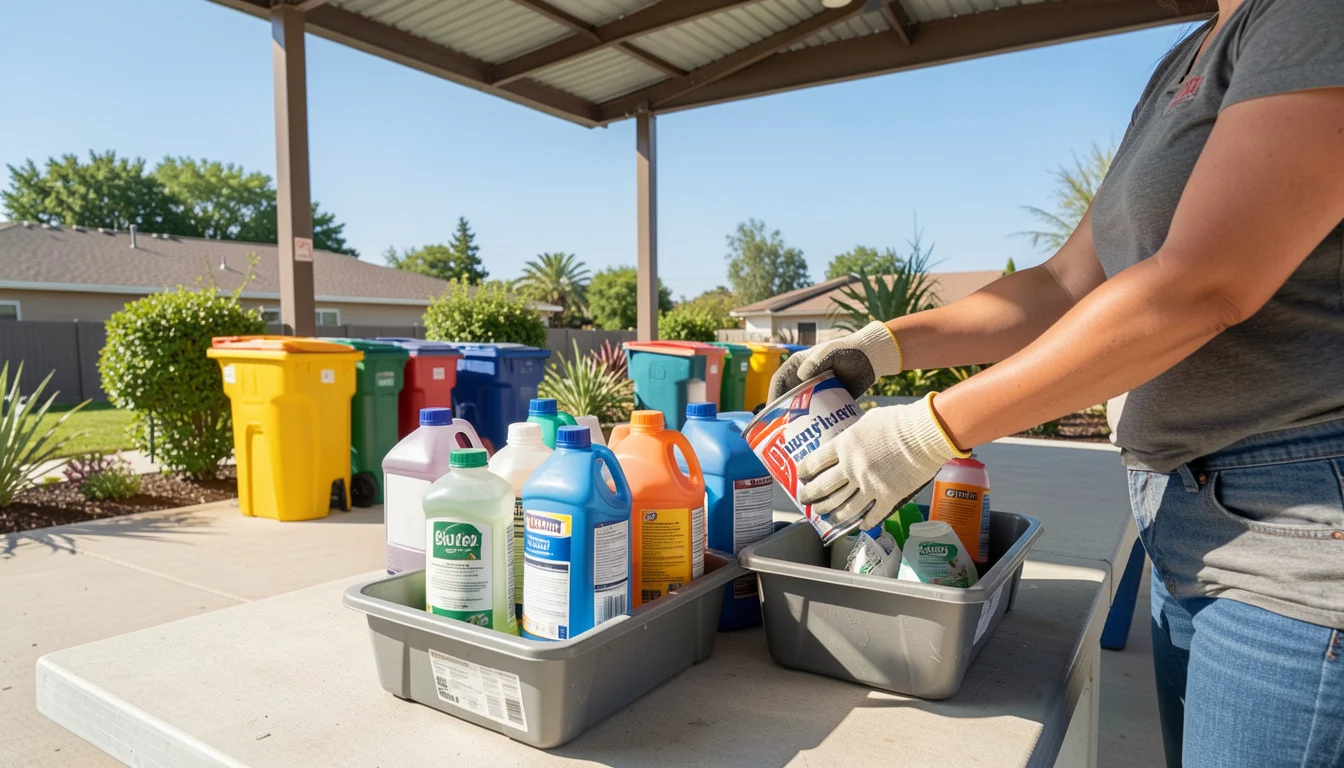 Sealed household products sorted for drop-off
Recycling old paint means routing leftover coating to a program that can reuse it, process it, or manage it as waste, rather than assuming it belongs in regular trash. The right option depends on the paint’s type, its condition, and local rules. Start with your city or county’s household hazardous waste program, then check PaintCare and nearby retailer policies.
That order can save a wasted trip: a site may accept latex paint but refuse oil-based paint, aerosols, or other household chemicals. Confirm what it takes, whether there is a fee, and how much it will accept before loading containers into your car.
Key takeaways
- Search your local waste authority’s website for household hazardous waste events and permanent drop-off facilities.
- PaintCare operates only in participating states and accepts specified paint products, not every household chemical.
- Retailer policies, accepted quantities, and fees vary by location; call the specific store before visiting.
- Keep paint in its original, sealed container when possible, and follow the receiving site’s transport instructions.
Where to Recycle Old Paint Near You
To find a suitable place to recycle old paint near you, check your local household hazardous waste (HHW) program first, then search PaintCare’s drop-off locator if your state participates. A nearby retailer may offer a separate service, but its policy is store-specific. Verify the product, container size, quantity limit, fee, and hours before you go.
- Search your city or county website for “household hazardous waste paint disposal” and look for permanent sites or scheduled collection events.
- Check PaintCare’s locator for a participating drop-off site in your state.
- Call the exact facility or store with the paint type and container details in hand.
- Follow the site’s instructions for appointment requirements, fees, and transport.
The U.S. Environmental Protection Agency’s Household Hazardous Waste guidance directs residents to local waste management authorities because HHW collection options and requirements vary. That local variation matters: a city event may accept certain household chemicals while a paint program nearby accepts only eligible architectural coatings.
For a quick decision, use this rule: if the label says oil-based, alkyd, or solvent-based, treat the paint as potentially hazardous and ask the local program where it belongs. If it is latex or water-based, still confirm the local disposal route rather than assuming liquid paint can go in household trash. Reducing waste at home also pairs naturally with other ways to reduce your household footprint.
How to Find PaintCare Drop-Off Sites
PaintCare drop-off sites are collection locations in states with PaintCare programs that accept eligible leftover paint under program rules. Search the organization’s locator by ZIP code, then confirm the site’s current requirements directly. Availability, accepted products, quantity limits, and operating details depend on the participating state and location.
PaintCare is a paint stewardship program, not a nationwide service for every household chemical. Its drop-off site locator identifies participating locations; its accepted-products list explains which paint and related products fall within the program. Use both before driving, since a map listing alone does not establish that a specific container is eligible.
What Should You Confirm Before Visiting?
Call the site and describe the product as printed on its label, including whether it is latex, oil-based, a primer, a stain, or a specialty coating. Ask about container condition, minimum or maximum quantities, opening hours, appointment rules, and any fees. A partly used can that has separated or formed a skin may still require a different route than an empty, dry container.
Searches such as “PaintCare org NY” or “paint care locations near me” can lead to useful results, but they are not a substitute for checking eligibility. If the locator shows no nearby site, check your state or local waste authority for an HHW program; PaintCare does not operate everywhere. Program coverage can change, so use the current locator rather than relying on an old directory entry.

What Different Drop-Off Locations May Accept
Acceptance depends on the program: PaintCare focuses on eligible paint products, HHW facilities handle a broader range of household hazardous waste, and retailers set their own services. The table is a screening guide, not a promise that a particular site will accept an item. Confirm every product with the receiving location.
Material
PaintCare site
Local HHW program
Retailer
Latex or water-based architectural paint
May accept if listed by the state program
May accept; check local rules
Policies vary by store
Oil-based or alkyd paint
Check the state’s accepted-products list
Often the appropriate program to ask, but confirm
Do not assume acceptance
Stain, varnish, primer, or specialty coating
Only if specifically eligible
May accept depending on the product
Policies vary
Spray paint and other aerosols
Do not assume acceptance
Ask whether the local program takes aerosols
Do not assume acceptance
Solvents, pesticides, cleaners, or fuel
Not general PaintCare items
Check the local HHW list
Only if the retailer confirms a specific service
PaintCare does not accept every paint type or household chemical. Its eligible products are defined by the program, while HHW sites may have separate rules for solvents, pesticides, cleaners, and other chemicals. If a can contains mixed or unidentified material, report that to the site rather than guessing from its color or container.
For households sorting several materials, keep paint separate from unrelated chemicals until each destination is confirmed. The EPA recommends checking with local waste authorities because community collection programs differ. The same careful sorting approach helps when setting up a household composting system: accepted materials are determined by the specific program, not by a general label.
Read also: Community Food Forests Are Trending: Could Yours Join In?
How to Prepare Paint and Household Chemicals for Drop-Off
Prepare paint for drop-off by keeping it in a secure, clearly identified container and following the receiving site’s packaging and transport instructions. Do not combine products or transfer them into unmarked containers. A facility may refuse a leaking, unlabeled, or ineligible container, so call ahead if the label is missing or the can is damaged.
- Keep the original lid on tightly and store the container upright.
- Leave the product in its original packaging when possible; make sure the label is readable.
- Separate paint from aerosols, solvents, pesticides, and other chemicals.
- Place containers in a stable box or tray during transport, away from passengers and items that could be contaminated.
- Do not open, mix, puncture, or pour out a product unless the facility specifically instructs you to do so.
- Follow any appointment, quantity, vehicle, or check-in rules given by the site.
A common mistake is arriving with a can that looks empty but still contains liquid or residue, assuming it will be treated like an empty metal container. The site may classify it by what remains inside, not by how much paint is left. Describe the can honestly when you call, especially if the contents are hardened, separated, or unknown.
Do not pour paint or chemicals into a storm drain, sink, or toilet. Also avoid putting liquid paint in household trash or drying it out unless your local authority says that method is allowed for that product. For broader household efficiency measures, see these home habits that reduce waste and resource use.

What to Do If No Nearby Drop-Off Accepts Your Paint
If no nearby site accepts your paint, contact your city or county solid waste department and ask for the approved route for that exact product. Ask whether it has a permanent HHW facility, a collection event, or a referral to a regional program. Do not leave paint at a closed site or place it beside a collection container without authorization.
Have the product name, paint type, amount, container size, and condition ready when you call. If the paint is old and the label is unreadable, say so; staff may need to distinguish it from solvent-based material or refer you to a site that can handle unknown products. State environmental agencies may also maintain disposal guidance or link to local programs.
For usable paint, ask whether a community reuse program, nonprofit, or local building-material exchange accepts donations. These organizations set their own condition and labeling standards, so confirm before dropping anything off. Paint that is contaminated, hardened, or otherwise rejected should go through a route approved by the waste authority.
Local rules are the limit of any general advice: the same product can have different permitted disposal routes across jurisdictions. A search result that says “free paint disposal near me” may describe a past event or a different product category. Verify the date and terms with the organizer before making the trip.
Do Sherwin-Williams, Lowe’s, and Other Retailers Accept Old Paint?
Sherwin-Williams, Lowe’s, and other retailers do not have one universal paint-disposal policy that applies to every store. Acceptance, fees, and services can vary by location and product, so call the specific branch before bringing paint. A store that sells paint is not automatically a collection site.
For searches like “Sherwin-Williams paint disposal,” “Sherwin Williams paint disposal near me,” or “Sherwin-Williams paint drop-off locations,” verify the store’s current policy directly. Ask whether it accepts the exact paint type, whether the container must be sealed, whether there is a quantity limit, and whether a fee applies. Do the same for “Lowe’s paint disposal”; do not rely on a general retailer name in a search result.
Do Retailer Drop-Off Sites Charge a Fee?
There is no single fee that applies to all PaintCare or retailer drop-off locations. A program’s funding and local site arrangements differ, and an individual retailer may not provide a disposal service at all. Ask the receiving location whether drop-off is available and what it costs before setting out.
“Sherwin Williams paint recycling fee” is not a reliable nationwide price to use for planning. Confirm the current charge, if any, with the exact store or program site, and ask whether the fee depends on product or quantity. If the retailer cannot take it, request the local HHW referral rather than leaving the container at the store.
How to Handle Spray Paint and Other Household Chemicals
Spray paint is an aerosol product, so do not assume a paint-recycling drop-off will accept it alongside architectural paint. Check your local HHW program for the approved route and handling instructions. The same rule applies to cleaners, solvents, pesticides, automotive fluids, and other household chemicals: acceptance depends on the product and local program.
For “where to dispose of spray paint near me,” search your city or county’s HHW page and look for aerosols in its accepted-items list. Tell the program whether the can is full, partly used, or empty, and whether it is damaged. Do not puncture or incinerate an aerosol can, even if it seems empty.
PaintCare is not a universal household-chemical collection program. A site that accepts eligible paint may refuse spray paint and unrelated chemicals, while an HHW facility may accept some of those materials under separate rules. Keep each product in its labeled container and ask the destination before transporting anything that is leaking or compromised.
Next steps: If you have architectural paint, check PaintCare’s locator and accepted-products list, then call the site. For spray paint, oil-based paint, or other household chemicals, start with your local HHW authority. If neither route works, ask the local waste department for an approved alternative and follow its instructions for that specific product.
📱 See this content as a Web Story
Frequently Asked Questions
Can I Recycle Paint in Its Original Can If the Label is Damaged?
Call the site before taking it in. Staff may need the product identity to determine whether it belongs in the paint program or an HHW stream.
Can I Take Paint to a Collection Event Without an Appointment?
Not always. Some events require registration, limit the number of containers, or accept only certain materials. Check the event’s current instructions before loading your vehicle.
Can I Donate Leftover Paint Instead of Taking It to a Disposal Site?
Possibly, if the paint is usable and a local reuse organization accepts it. Confirm its rules for product type, condition, labeling, and container size before delivering it.
What Should I Do with a Leaking Paint Can?
Do not transport a leaking container without guidance. Contact your local HHW program or waste authority and explain the leak, product label, and container condition so it can tell you how to proceed safely.