

Cheap Storage Ideas for Small Home Renovations That Free Up Space
How to unlock storage in small homes by using overlooked spaces like walls, corners, and under stairs with smart built-ins that save floor area efficiently.
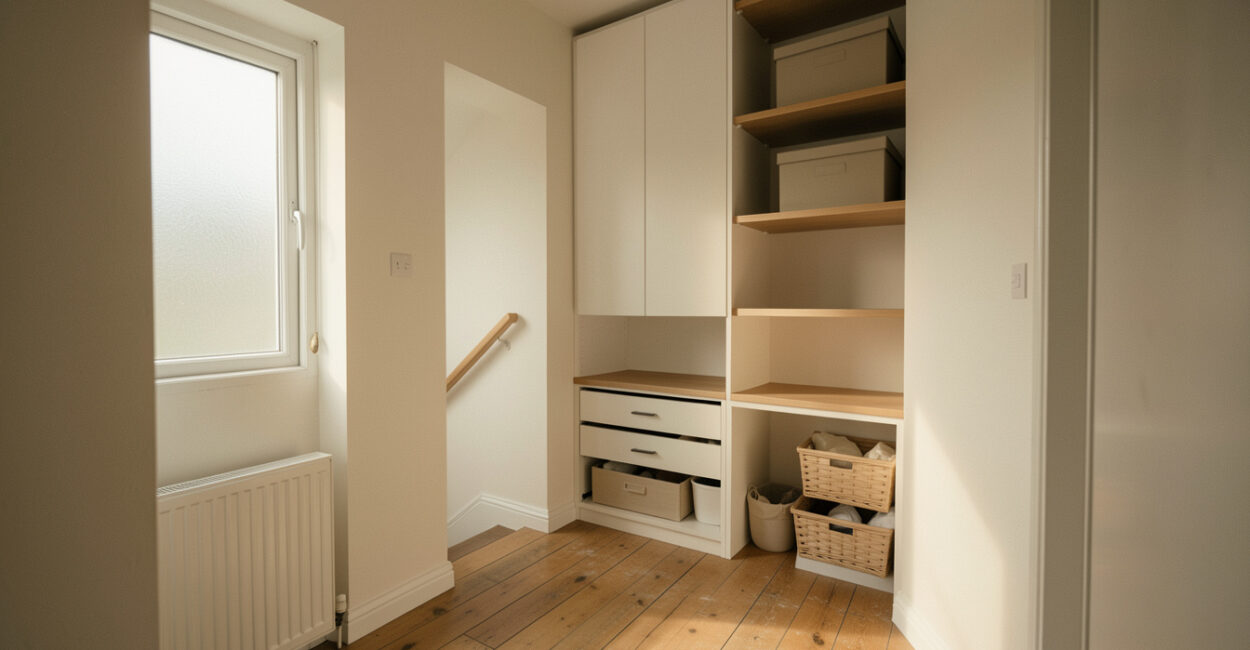
Some of the best cheap storage ideas for small homes are hiding in plain sight: corners, walls, and the empty volume above your eye level.
Cheap Storage Ideas for Small Home Renovations That Free Up Space
If your place feels full before it feels finished, the fix is usually not a bigger remodel. It’s smarter storage. Hidden corners, vertical shelving, and built-ins can add real room fast while keeping demolition and material costs under control.
Why the Cheapest Square Footage is the Space You Already Own
In small homes, storage fails for one reason: people store outward instead of upward. Floor space disappears fast, but wall space, dead corners, and the space under stairs usually sit half-empty. That’s why cheap storage ideas for small homes work best when they make one surface do two jobs.
Read also: Under-Staircase Storage Ideas for Small Family Homes
The trick is not adding more furniture. It’s turning awkward gaps into built-in function. A shallow shelf in a hallway can beat a bulky cabinet. A bench with a lift-up top can replace a side table, shoe rack, and bin all at once.
In practice, the cheapest wins come from measurements, not demolition. Before you tear anything out, measure every “lost” zone: above doors, beside the fridge, under beds, along stair strings. Those inches add up faster than most people expect.
Three Storage Moves That Look Custom Without Custom Pricing
Start with vertical shelving. Open shelves are often cheaper than closed cabinetry, easier to install, and lighter on the wall. Use them for items you reach often, not for clutter you want to hide. Put the heaviest items low. Put the visual noise high.
Next, use built-ins where the structure already creates a pocket: under stairs, inside alcoves, around a chimney bump-out, or between studs. A shallow recessed shelf is one of the most efficient cheap storage ideas for small homes because it steals almost no floor area. It feels intentional, not improvised.
Then look for hidden corners. A corner desk, corner pantry, or corner floating shelves can turn a dead angle into daily utility. This is where a small renovation pays off: one small carpentry change can remove the need for two separate storage pieces.
- Replace deep cabinets with shallower, taller units.
- Use doors, walls, and stair sides for hanging storage.
- Choose open shelving when you need speed and lower labor cost.
One caution: built-ins save space, but they can fail if you overbuild them. If the wall is uneven, the floor slopes, or moisture is an issue, cheap becomes expensive fast.

The Renovation Mistake That Makes Small Homes Feel Even Smaller
The common mistake is buying storage that blocks circulation. A closet that fits “a lot” is useless if it narrows a hallway or eats the only landing spot in a room. Storage should disappear into the layout, not dominate it.
Here’s the split that matters: before, you have separate furniture pieces fighting for floor space; after, one wall or niche works like a quiet system. That before-and-after difference is why cheap storage ideas for small homes often look better than expensive standalone pieces.
Good storage in a small home is not visible first. It is felt first.
A quick real-world example: a couple with a tiny entryway kept tripping over shoes, bags, and a vacuum. They skipped a full remodel and added one bench, two wall hooks, and a recessed shelf above the bench. The room didn’t grow. But the mess stopped spilling into the walkway, and the space started feeling calm again.
For anchoring and renovation safety basics, the FEMA home retrofit guidance is a useful place to understand structural caution, and the EPA indoor air quality resources help when you’re choosing materials for a tight interior.
Can Cheap Storage Still Look Built-in?
Yes, if you match finishes, keep lines simple, and repeat one material across a wall. The visual trick is consistency, not cost. Even a basic plywood shelf can read as intentional when it fits the room’s proportions and is painted to blend in. That’s why cheap storage ideas for small homes often feel more polished than expensive freestanding pieces.
What Should I Build First in a Tiny Renovation?
Start with the spot that causes daily friction: entry clutter, kitchen overflow, or bedroom overflow. Storage that solves a problem you touch every day gives the fastest payoff. A small bench, a vertical pantry, or under-bed drawers can change how the whole home functions without touching every room.
Are Built-ins Always Worth the Money?
Not always. Built-ins are worth it when they use wasted space, match the room’s dimensions, and reduce the need for separate furniture. They are not worth it if they require major demolition, custom millwork everywhere, or repairs to a wall that already has problems. Cheap only stays cheap when the structure cooperates.
How Do I Keep Storage from Making a Room Feel Crowded?
Use depth carefully. Shallow shelves, closed bins, and vertical stacking usually feel lighter than deep, boxy units. Leave one open visual line in each room so the eye can travel. If every wall is occupied, the room will feel smaller no matter how much it stores.
What’s the Smartest Low-cost Upgrade for Renters?
Focus on removable systems: freestanding vertical shelving, over-door organizers, tension-rod solutions, and modular bins. Renters usually can’t alter framing, so the win is flexibility. You still get the benefit of cheap storage ideas for small homes, just without the commitment of carpentry or patching walls later.
Small homes rarely need more room as much as they need fewer wasted inches. Once you start treating corners, walls, and built-ins like usable real estate, the whole place changes shape.
The best storage upgrade is the one that gives space back without stealing it first.